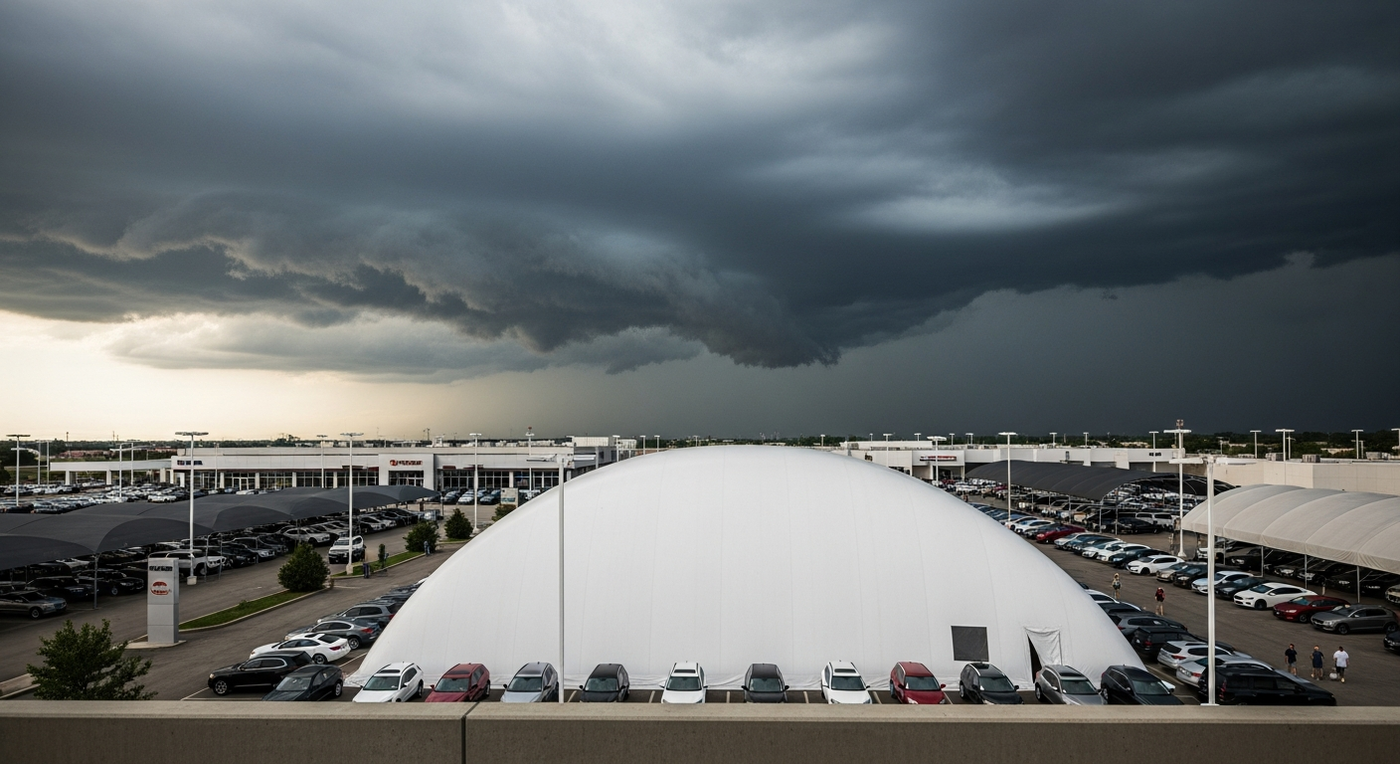
Comparison

The Carport That Crumpled: Why Most "Protective" Structures Fail When Hail Hits

Standard metal carports are engineered for snow and wind loads but not impact resistance—meaning the roof designed to protect your vehicle can become the thing that destroys it.

The Carport That Crumpled: Why Most "Protective" Structures Fail When Hail Hits
Hail Protector Editorial / GeminiComparison

The Dent That Shouldn't Exist

A homeowner in Moore, Oklahoma installed a metal carport in March 2024 specifically to protect two vehicles from hail after watching neighbors deal with insurance claims. When 1.75-inch hail arrived that May, the carport's corrugated metal roof dimpled like a golf ball across its entire surface. Several panels tore loose at the fasteners. One panel, caught by wind, slid across the hood of the truck it was supposed to protect, causing more damage than the hail itself would have inflicted.

The carport met the manufacturer's advertised specifications for wind resistance and snow load. It was installed correctly. It failed anyway, because those specifications said nothing about impact resistance.

What "Wind-Rated" Actually Means

Most carport manufacturers advertise wind ratings (typically 90-110 mph) and snow load capacity (usually 20-35 pounds per square foot). These numbers describe structural integrity under distributed loads—forces spread across the entire frame. Hail creates point loads: concentrated energy striking a small area repeatedly.

Standard 29-gauge corrugated steel or aluminum panels typically bend under impacts above approximately 1.5 inches in diameter. The metal doesn't necessarily tear immediately, but once dented, the structural geometry changes. Corrugations lose their strength. A roof that could support several hundred pounds of snow when new might fail under significantly less weight after hail damage compromises the panel shape.

Here's what buyers miss: the frame might be overbuilt and genuinely strong, but if the roofing skin fails, the structure becomes a liability rather than protection.

The Dent That Shouldn't Exist

The Impact Rating Almost Nobody Asks For

Impact-resistant carport panels exist. They're tested using the same UL 2218 standard that certifies impact-resistant roofing shingles for homes. Class 4—the highest rating—means the material withstands two strikes from a two-inch steel ball dropped from 20 feet without cracking or tearing.

These panels typically cost two to three times more than standard corrugated metal, according to industry suppliers. A 20x20-foot carport using standard 29-gauge steel panels might run approximately $2,000-$3,000 installed. The same structure with Class 4 impact-rated panels often costs roughly $5,000-$7,000.

Most carport installers don't stock impact-rated materials. They'll order them if asked, but the request has to be specific. Saying "I want hail protection" usually gets you thicker gauge metal—26-gauge instead of 29-gauge—which helps marginally but doesn't fundamentally solve the impact problem. You need to ask explicitly for UL 2218 Class 4 rated panels.

29

gauge

Standard panel thickness

1.5

inches

Hail size causing dents

2-3×

Impact-rated panel cost premium

70

mph

Large hail impact velocity

Polycarbonate: The Material Hail Can't Dent

The highest-performing carport roofing for hail isn't metal at all. Multiwall polycarbonate panels—the same material used in commercial greenhouses and stadium skylights—absorb impact energy by flexing rather than denting.

Quality polycarbonate panels rated for structural use (typically 16mm twin-wall or 25mm multiwall) can withstand impacts that would damage or shred corrugated metal. According to NOAA's National Severe Storms Laboratory, hail larger than two inches falls at terminal velocities exceeding 70 mph. Polycarbonate panels flex under these impacts, distribute the energy across a larger area, then return to shape.

The tradeoff: polycarbonate typically costs approximately $8-$15 per square foot for panels alone, compared to roughly $2-$4 for standard metal. It also requires different framing—polycarbonate expands and contracts more than metal with temperature changes, so the mounting system needs to accommodate movement. A polycarbonate carport typically costs approximately 60-80% more than an equivalent metal structure.

But polycarbonate offers something metal can't: you can see through it. Translucent panels let natural light through while blocking UV radiation. Some people consider this an aesthetic benefit. Others hate it because it means the carport doesn't provide shade the way an opaque metal roof does.

Laminated Panels: The Windshield Approach

Some manufacturers offer laminated metal panels—essentially a metal skin bonded to a polymer core, similar in concept to automotive safety glass. When struck, the metal surface may dent, but the laminated construction prevents tearing and keeps the panel attached to the frame.

These panels perform somewhere between standard metal and polycarbonate. They'll show cosmetic damage from large hail but typically maintain structural integrity. Laminated panels typically cost approximately 40-60% more than standard metal—less than polycarbonate but still a significant premium.

The real advantage shows up in wind-driven hail events. Standard metal panels can tear at fasteners when wind lifts them while hail strikes simultaneously. Laminated panels resist this tearing because the polymer layer holds the metal together even if the surface punctures.

Option Tradeoffs

Pros

  • Standard MetalLowest upfront cost, widely available, blocks sunlight completely
  • Impact-Rated MetalUL 2218 Class 4 certified, resists 2-inch steel ball drops, opaque coverage
  • PolycarbonateFlexes without permanent damage, allows natural light, best hail performance
  • Laminated PanelsPrevents tearing at fasteners, moderate price increase, holds together when punctured

Tradeoffs

  • Standard MetalDents at 1.5+ inch hail, panels can tear loose, may damage vehicles when failing
  • Impact-Rated MetalCosts $5K-$7K for typical carport, limited installer availability
  • Polycarbonate60-80% cost premium, requires special mounting, provides less shade
  • Laminated PanelsStill shows cosmetic denting, 40-60% price increase over standard

Standard metal offers minimal hail protection. Impact-rated metal or polycarbonate justify their cost in hail zones; laminated panels split the difference.

The Frame Matters More Than You Think

Panel selection dominates carport hail discussions, but frame design determines whether the structure survives sustained bombardment. A carport with excellent impact-rated panels mounted to an undersized frame will still fail if the frame twists or collapses.

Hail-resistant carport frames typically use 2.5-inch or 3-inch steel tubing with 12-gauge walls or thicker. Cheaper carports use 2-inch tubing with 14-gauge walls. The difference seems minor—we're talking about fractions of an inch in tube diameter and thickness. But structural strength increases exponentially with tube size. A 3-inch 12-gauge tube can handle approximately double the load of a 2-inch 14-gauge tube.

Leg spacing matters too. Standard carports typically place support legs every 10-12 feet. Hail-resistant designs often reduce this to approximately 8-10 feet, adding more vertical supports. More legs means higher material cost and more concrete footings, but it also means each span of roofing has less unsupported area to flex under impact.

Verified Sources

  1. Underwriters Laboratories

    Underwriters Laboratories

    UL 2218 impact resistance testing standards

  2. nssl.noaa.gov

    nssl.noaa.gov

    Referenced in article via nssl.noaa.gov.

Back to Protection Guides