Regional Report

The 50 Most Hail-Battered Counties in America: Three Decades of Storm Prediction Center Data Mapped

Weld County, Colorado has logged more significant hail reports than any other county in the United States since 1991, but adjusting for population density reveals a very different geography of risk.

The 50 Most Hail-Battered Counties in America: Three Decades of Storm Prediction Center Data Mapped
Hail Protector Editorial / GeminiRegional Report

The Concentration Belt: Five States Claim 72% of the Top Fifty

Between 1991 and 2021, the NOAA Storm Prediction Center's severe weather database recorded significant hail reports (1.75 inches or larger) across U.S. counties. The top fifty counties account for a disproportionate share of these events, and their distribution tells a clear story: Texas leads with twelve counties in the top fifty, followed by Kansas with eight, Nebraska with six, Oklahoma with five, and Colorado with five. These five states alone represent thirty-six of the fifty slots.

The remaining fourteen counties scatter across South Dakota, Wyoming, Iowa, and New Mexico. What surprises most meteorologists isn't the presence of Great Plains states—that's expected given the region's role as the mixing zone for Gulf moisture and Rocky Mountain dry air—but rather the specific counties that crack the list. Sioux County, Nebraska, for instance, ranks twenty-third nationally despite having fewer than 1,200 residents spread across approximately 2,067 square miles. Its inclusion reflects raw atmospheric violence, not population-driven reporting bias.
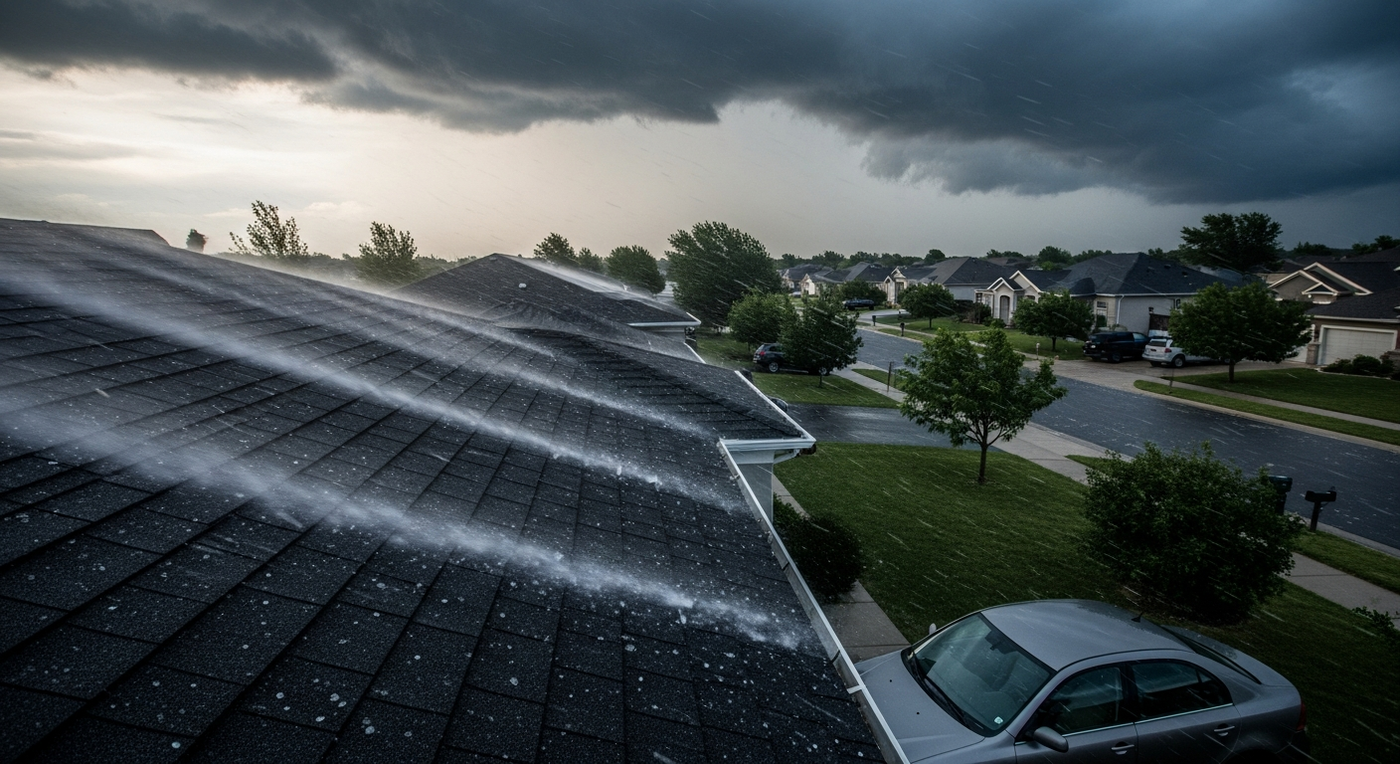
Weld County's Three-Decade Reign

According to NOAA Storm Prediction Center data, Weld County, Colorado sits atop the national ranking with more than 800 significant hail reports since 1991. Stretching from the Denver suburbs northward to the Wyoming border, the county occupies prime real estate in what meteorologists call the Palmer Divide convergence zone—a topographic feature that forces air upward and triggers explosive thunderstorm development on spring and summer afternoons.

The county's size matters. At approximately 4,017 square miles, Weld is larger than Delaware and Rhode Island combined. Its northern reaches remain sparsely populated rangeland, while its southern tier includes Greeley (population approximately 108,000) and portions of the Denver metro sprawl. This combination of geographic scale and population density means more eyes watching the sky, more structures to damage, and more reports filed per event.

Behind Weld, the rankings continue through familiar names: El Paso County, Colorado (Colorado Springs); Sedgwick County, Kansas (Wichita); Tulsa County, Oklahoma; and Adams County, Colorado, which punches far above its weight class.

The Adams County Anomaly

Adams County ranks ninth nationally despite covering approximately 1,182 square miles—less than a third of Weld County's footprint. The county includes Aurora, Commerce City, and portions of metro Denver, giving it a population density approximately fifteen times higher than Weld's. When significant hail falls here, it doesn't strike empty prairie. It shatters windshields in apartment complex parking lots, dents roofs in subdivision after subdivision, and triggers thousands of insurance claims in a single afternoon.

The July 2017 hailstorm that raked Adams County generated more than $1.4 billion in insured losses, according to Insurance Information Institute estimates—one of the costliest hail events in U.S. history. That single storm likely generated hundreds of individual reports to the Storm Prediction Center, each representing a different observer, damage site, or hailstone measurement. In rural counties, the same storm might produce a dozen reports.

This reporting density raises a methodological question: are we measuring hail frequency or human frequency?

The Population Adjustment Problem

Raw report counts favor populated areas. A supercell that drops baseball-sized hail across fifty miles of western Kansas rangeland might generate five or six reports—one from a highway patrol officer, another from a storm chaser, perhaps a few from ranch houses along the storm's path. The same supercell crossing suburban Wichita generates dozens: insurance adjusters, news stations, social media posts that get forwarded to the National Weather Service, homeowners photographing damage for claims.

Adjusting for population density reshuffles the deck entirely. Suddenly, counties like Kiowa (Colorado), Cheyenne (Kansas), and Arthur (Nebraska)—places where cattle outnumber people by orders of magnitude—climb the rankings. These counties typically average fewer than two people per square mile, yet they still appear in the national top fifty for significant hail. The atmospheric conditions that generate large hail don't care about ZIP codes.

Researchers have attempted various normalization methods: reports per capita, reports per square mile, reports per storm day. Each approach produces different winners, but the same counties keep appearing. Geography matters more than methodology.

Texas's Twelve: The Panhandle Cluster

Texas claims twelve of the top fifty slots, but they don't distribute evenly across the state. Nine of the twelve sit in the Panhandle or South Plains: Potter (Amarillo), Randall, Lubbock, Hale, Swisher, Castro, Parmer, Deaf Smith, and Oldham counties. These counties occupy the southern extension of Tornado Alley, where dry lines—the boundary between moist Gulf air and dry desert air—set up reliably each spring.

The remaining three Texas counties (Tarrant, Dallas, and Collin) represent the Dallas-Fort Worth metroplex, where population density contributes to higher report volume. A significant hail event in Tarrant County might damage tens of thousands of vehicles in a single afternoon; the same storm crossing Oldham County (population approximately 2,000) might not hit a single car.

What's absent from the Texas list is equally telling: Houston, San Antonio, and the Gulf Coast generate plenty of severe thunderstorms, but their atmospheric profiles favor wind and flooding over large hail. The ingredients for giant hailstones—strong updrafts, dry mid-level air, and sufficient storm-relative helicity—concentrate in the Panhandle, not the coastal plain.

800+

reports

Weld County since 1991

36

of 50

counties in five states

$1.4B

insured losses

single Adams County storm

20%

%

of all hail reports

Kansas's Hail Corridor: I-70 and Beyond

Kansas places eight counties in the top fifty, and they align almost perfectly with Interstate 70's path across the state: Geary, Dickinson, Saline, Ellsworth, Russell, Ellis, and Trego counties all sit within approximately thirty miles of the highway corridor. The exception is Sedgwick County (Wichita), which ranks high partly due to population and partly due to its position at the confluence of multiple severe weather setups.

The I-70 corridor's hail frequency isn't coincidental. The highway roughly follows the 98th meridian, a climatic boundary that separates humid eastern climates from semi-arid western conditions. This transition zone creates persistent atmospheric instability during spring and early summer. Storms that form along the dry line in western Kansas often reach peak intensity as they cross the I-70 corridor, then weaken as they push into more stable air farther east.

Ellis County (Hays) deserves particular attention. It ranks fourteenth nationally despite having approximately 29,000 residents spread across roughly 900 square miles. The county sits in what storm chasers call "the notch"—a geographic sweet spot where southerly low-level flow, westerly mid-level flow, and northwesterly upper-level flow converge with unusual regularity. The result: supercells, and lots of them.

Nebraska's Six and the Sandhills Question

Nebraska contributes six counties to the top fifty, but their distribution reveals an interesting pattern. Four of the six—Keith, Perkins, Chase, and Dundy—form a contiguous block along the Colorado border in southwestern Nebraska. These counties occupy the High Plains proper, where elevation typically exceeds 3,000 feet and vegetation transitions from tallgrass prairie to shortgrass steppe.

The remaining two—Sioux and Scotts Bluff—sit in the Panhandle, approximately 200 miles northwest. What's missing is the Sandhills region, that vast expanse of grass-stabilized dunes covering roughly a quarter of Nebraska's land area. The Sandhills generate severe thunderstorms, but they seem to produce fewer significant hail reports than counties to their south and west.

Meteorologists debate whether this represents a real atmospheric difference or a reporting artifact. The Sandhills support approximately one person per two square miles—among the lowest population densities in the Lower 48. A hailstorm that crosses many miles of Sandhills might not encounter a single human observer. The same storm crossing southwestern Nebraska has a better chance of passing near a ranch house, highway, or small town where someone can file a report.

The Oklahoma Five: Tornado Alley's Hail Overlap

Oklahoma places five counties in the top fifty: Tulsa, Oklahoma (Oklahoma City), Canadian, Cleveland, and Caddo. Four of the five cluster around the two major metro areas, suggesting population-driven reporting. But Caddo County, with approximately 26,000 residents spread across roughly 1,278 square miles, ranks thirty-seventh nationally.

Caddo sits in west-central Oklahoma, directly in the path of Red River dry line setups. When southerly flow pumps Gulf moisture northward and westerly flow brings dry air off the Caprock Escarpment, the collision zone often sets up right over Caddo County. The result is explosive thunderstorm development—the kind that produces hail large enough to kill livestock and punch through metal roofs.

Here's what most people get wrong about Oklahoma's hail climate: they assume tornado risk and hail risk map identically. They don't. Tornadoes require specific low-level wind shear profiles that don't always coincide with the mid-level conditions that favor giant hail. Some of Oklahoma's most tornado-prone counties (like Love or Marshall in the south) rarely crack the top tier for significant hail, while counties farther west (like Caddo or Custer) see more large hail but fewer tornadoes.

Colorado's Five: The Front Range and Beyond

Colorado's five representatives split between the Front Range urban corridor (Weld, Adams, El Paso) and the eastern plains (Kiowa, Lincoln). This division reflects two different hail-generating mechanisms. Front Range counties benefit from upslope flow—easterly winds that force air up the gentle slope toward the Rockies, triggering afternoon thunderstorms with remarkable regularity. Eastern plains counties sit in the lee of the Palmer Divide, where downslope flow on the backside of mountain systems creates localized convergence zones.

Lincoln County, which ranks forty-first nationally, covers approximately 2,586 square miles with a population around 5,400. That's approximately two people per square mile, yet the county still generates enough significant hail reports to crack the national top fifty. The county sits at the intersection of multiple topographic features: the Palmer Divide to the west, the Smoky Hills to the north, and the Arkansas River valley to the south. Air masses collide here with unusual frequency, and the resulting storms often produce hail.

El Paso County (Colorado Springs) presents the opposite profile: approximately 730,000 residents packed into roughly 2,127 square miles. The county's high ranking reflects both genuine hail frequency and dense reporting networks. When a supercell crosses Colorado Springs, thousands of people witness it, photograph it, and report it. The same storm crossing Lincoln County might be seen by a dozen ranchers.

The Outliers: South Dakota, Wyoming, Iowa, and New Mexico

Beyond the Big Five states, fourteen counties from four additional states crack the top fifty. South Dakota contributes four (Pennington, Meade, Lawrence, and Custer), all clustered in the Black Hills region where orographic lifting enhances thunderstorm development. Wyoming adds three (Laramie, Goshen, and Platte), strung along the I-25 corridor where topographic features and moisture convergence create favorable conditions for severe hail-producing storms. where the High Plains meet the Laramie Range.

Iowa's two entries (Polk and Woodbury) represent the state's two largest metro areas—Des Moines and Sioux City—suggesting population-driven reporting rather than exceptional atmospheric conditions. Iowa generates plenty of severe thunderstorms, but its hail climate doesn't match the intensity of the central Great Plains. The state's inclusion in the top fifty reflects urban concentration more than raw hail frequency.

New Mexico's single entry—Curry County, which includes Clovis—sits on the Llano Estacado, the southern extension of the High Plains. The county's climate mirrors the Texas Panhandle: dry air aloft, Gulf moisture below, and frequent dry line setups during spring. Curry ranks forty-ninth nationally with roughly 50,000 residents across 1,406 square miles—a population density that suggests genuine hail frequency rather than reporting bias.

What the Map Doesn't Show

The Storm Prediction Center's database captures reported hail, not actual hail. This distinction matters enormously in sparsely populated regions. A supercell that produces baseball-sized hail across 200 square miles of uninhabited rangeland might generate zero reports if no one sees it. The same storm crossing a suburban area generates hundreds.

Researchers at the National Severe Storms Laboratory have attempted to model actual hail frequency using dual-polarization radar data, which can identify hail signatures even when no ground observers are present. These studies suggest that rural counties in the central Great Plains likely experience significantly more hail than the SPC database indicates. The top fifty list, in other words, probably underrepresents the most hail-prone counties and overrepresents the most people-prone counties.

The solution isn't simple. You can't just divide reports by population—that would suggest a county with ten people and one hail report experiences more hail than a county with a million people and a thousand reports. You can't normalize by area alone, either, because county sizes vary wildly. Every adjustment method introduces new biases.

The Thirty-Year Window and Climate Signals

The 1991-2021 window captures three decades of data, long enough to smooth out individual anomalous years but short enough that climate trends might influence the rankings. Some research suggests that the geographic distribution of severe thunderstorms has shifted slightly eastward over recent decades, potentially moving peak hail frequency away from the western Great Plains and toward the Mississippi Valley.

The data don't yet show a clear signal in the top fifty rankings. The same counties that dominated the 1991-2000 period still dominate the 2011-2021 period. Weld County ranked first in the 1990s and still ranks first today.

What has changed is reporting technology. The proliferation of smartphones, social media, and automated damage detection systems means that hail events in populated areas generate far more reports in 2021 than they did in 1991. Rural areas, meanwhile, have seen less dramatic increases in reporting density. This temporal bias likely inflates the rankings of urban counties relative to their rural counterparts when comparing recent years to earlier decades.

Using the Rankings: What They Tell Us and What They Don't

The top fifty list serves multiple purposes. Insurance companies use it to price hail coverage and allocate catastrophe reserves. Roofing contractors use it to decide where to open branch offices. Climate researchers use it to validate severe weather models. Homebuyers use it to assess risk before purchasing property.

But the rankings shouldn't be interpreted as precise measurements. The difference between the tenth-ranked county and the twentieth-ranked county might reflect nothing more than population density or reporting culture. A county that ranks fifty-first didn't narrowly miss the cutoff—it might experience nearly identical hail frequency to the county ranked fiftieth but happen to have fewer observers or less diligent reporting networks.

What the rankings do reveal is the broad geography of hail risk in the United States. If you live in the Great Plains between the Rockies and the 98th meridian, you live in hail country. The specific county-level rankings matter less than the regional pattern: this is where the atmosphere produces giant hailstones with unusual regularity, and no amount of statistical adjustment changes that fundamental reality.

The top fifty counties represent roughly 1.5% of all U.S. counties but account for more than 20% of all significant hail reports. That concentration tells you everything you need to know about American hail geography.

Verified Sources

  1. NOAA Storm Prediction Center

    NOAA Storm Prediction Center

    severe weather reports database

Back to Hail Science