Decision Brief

The 300-Square-Foot Problem: Why RVs Are Sitting Ducks in Hail Country

Motorhomes and travel trailers combine maximum surface area with minimum protection, making them uniquely vulnerable to hail damage that can cost more than most people's annual vehicle payment.

The 300-Square-Foot Problem: Why RVs Are Sitting Ducks in Hail Country
Hail Protector Editorial / GeminiDecision Brief

The Roof You Can't Garage

A typical Class A motorhome presents roughly 300 to 400 square feet of roof surface to the sky—about the same footprint as a studio apartment. Unlike that apartment, though, most RV roofs are constructed from materials designed for weight reduction rather than impact resistance: thin aluminum sheeting, fiberglass panels, or rubber membrane over plywood substrate. According to

What Hail Actually Does to Different RV Constructions

Aluminum-sided RVs—common in Airstream and similar models—show damage differently than fiberglass units. Aluminum dents but rarely cracks, creating cosmetic damage that doesn't necessarily compromise structural integrity but destroys resale value. Hail-damaged aluminum RVs can lose an estimated 20-30% of their market value even after repair, since dent removal on curved aluminum panels rarely restores factory finish.

Fiberglass roofs and caps crack rather than dent. A single golf-ball-sized hailstone can create a spider-web fracture in a fiberglass roof panel, and these cracks propagate over time as the RV flexes during travel. What starts as a cosmetic issue becomes a leak pathway within weeks. Rubber membrane roofs—TPO, EPDM, or similar materials—can puncture outright under large hail, though they handle smaller stones better than rigid materials.

The most expensive damage occurs to roof-mounted equipment. Air conditioning units, vent covers, solar panels, and satellite domes all sit exposed on the roof plane. AC units are particularly vulnerable; the plastic shrouds that cover condenser coils typically cost $400-800 to replace, and hail can crack them beyond repair while leaving the actual cooling unit functional but exposed to the elements.

The Math That Changes Your Travel Plans

Roof replacement costs vary wildly by RV type and construction. A rubber membrane roof replacement on a 30-foot travel trailer runs roughly $3,000-6,000 in parts and labor. Fiberglass roof panel replacement on a Class A motorhome can reach approximately $8,000-15,000, depending on whether the damage extends to substrate layers. Full roof reconstruction after severe hail—including structural members, insulation, and finish materials—can exceed an estimated $20,000 on larger motorhomes.

Here's the uncomfortable comparison: many RV loans carry monthly payments of roughly $400-800. A single severe hail event can generate repair costs equivalent to approximately 10-24 months of payments. And unlike auto insurance, RV comprehensive coverage often carries higher deductibles—typically around $1,000-2,500—because the vehicles themselves are higher value and the repair costs are proportionally larger.

Insurance companies know this math. According to

Purpose-Built Protection Systems (And Why Most People Don't Use Them)

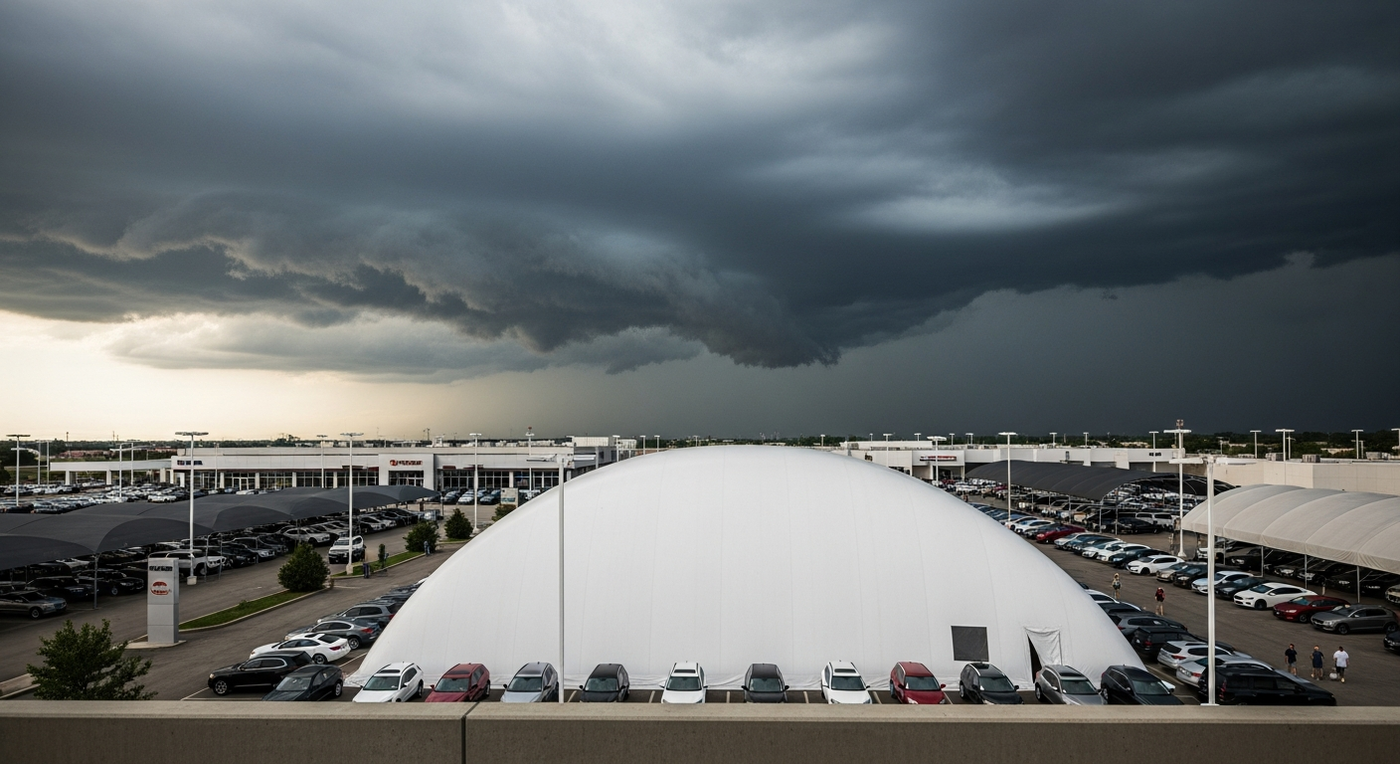
Several manufacturers produce hail protection systems specifically engineered for RVs. These aren't the car covers you see advertised online—they're inflatable or frame-supported structures that create an air gap or padded barrier above the RV roof. The most common design uses an inflatable bladder system that deploys over the RV, maintaining several inches of cushioning space between the cover material and the roof surface.

The catch: these systems cost approximately $1,500-4,000 depending on RV size, require roughly 15-30 minutes to deploy, and demand storage space inside the RV when not in use. They work—test data shows they can protect against hail up to two inches in diameter—but the deployment time makes them useless if you're caught by a fast-moving storm. You need advance warning, which means monitoring weather actively during travel.

A more practical approach involves strategic parking. Some RV parks in hail-prone regions now offer covered parking or storage facilities specifically for severe weather season. These facilities charge premium rates—typically around $50-150 per day depending on location and amenities—but provide guaranteed protection. The economics make sense if you're planning to stay in one location for an extended period during peak hail season.

300-400

sq ft

Exposed roof surface

40+

mph

Hailstone impact speed

20-30%

%

Value loss after damage

$20,000+

+

Severe reconstruction costs

The Campground Selection Strategy

Here's what experienced full-timers know: not all campgrounds offer equal hail protection, but some geographic and structural features reduce risk significantly. Campgrounds with mature tree canopy provide natural hail mitigation—trees break up hailstone formation and reduce impact velocity. The tradeoff is increased risk of falling branches during the same storms that produce hail.

Campgrounds located in natural depressions or valleys experience less severe hail than elevated locations, since hail formation requires specific atmospheric conditions that favor higher terrain. This isn't foolproof—severe thunderstorms produce hail anywhere—but statistical probability shifts in your favor at lower elevations.

Some private campgrounds in states like Colorado and Wyoming now advertise hail shelters as an amenity: covered parking structures with sufficient height clearance for Class A motorhomes. These facilities charge premium site fees but guarantee protection during severe weather events. The business model works because RV owners increasingly understand the replacement cost math.

What the Weather Radio Actually Tells You

NOAA Weather Radio broadcasts include specific hail size estimates in severe thunderstorm warnings, and these estimates matter for RV protection decisions. The National Weather Service uses comparison objects: "quarter-sized hail" (1 inch), "golf ball-sized hail" (1.75 inches), "tennis ball-sized hail" (2.5 inches). Each category represents a different threat level to RV structures.

Quarter-sized hail typically damages roof-mounted equipment and may dent aluminum siding but rarely causes structural damage to properly maintained roofs. Golf ball-sized hail will crack fiberglass, puncture rubber membranes, and destroy AC unit shrouds. Tennis ball-sized hail—relatively rare but not unheard of in Great Plains supercells—can penetrate RV roofs entirely, causing catastrophic damage to interior spaces.

The warning lead time matters enormously. Severe thunderstorm warnings typically provide approximately 30-60 minutes of advance notice, which is enough time to deploy a hail protection system if you have one, or to move the RV under available cover if you're in a campground with shelters. Tornado warnings often come with less lead time and different protective priorities.

The Insurance Conversation You Should Have Before Leaving Home

Most RV owners carry comprehensive coverage, but the policy details matter more than the coverage category. Some insurers offer "agreed value" policies that pay the pre-loss market value of the RV regardless of repair costs, while others use "actual cash value" calculations that depreciate the vehicle annually. After a major hail event, this distinction determines whether you can afford to repair the RV or whether you're forced to accept a total loss settlement.

Hail-specific deductibles are increasingly common in RV policies written for residents of high-risk states. These separate deductibles—sometimes 5-10% of the insured value—apply only to hail claims and can reach several thousand dollars on expensive motorhomes. The policy language matters: some deductibles apply per occurrence, others per policy year.

Full-timer policies, designed for people who live in their RVs year-round, sometimes include provisions for temporary housing if the RV becomes uninhabitable due to hail damage. Standard RV policies typically don't cover living expenses, treating the vehicle as recreational equipment rather than primary residence.

The Seasonal Movement Pattern

Long-term RV travelers often adopt a migration pattern that follows favorable weather: north in summer, south in winter. But hail season complicates this pattern. Peak hail activity in the Great Plains occurs from April through June, exactly when many RVers are traveling north from winter locations in Arizona, Texas, and Florida.

The optimal route strategy involves either moving early (before April) or late (after July), or choosing routes that avoid the highest-risk corridors. Interstate 70 through Kansas, Interstate 40 through Oklahoma, and Interstate 25 through Colorado all traverse prime hail territory during peak season. Alternative routes through the Pacific Northwest or upper Midwest encounter less frequent severe hail, though no region is entirely risk-free.

Some full-timers simply park for May and June. They choose a location outside the primary hail belt—coastal areas, northern forests, or desert regions with different storm patterns—and wait out the highest-risk period. The strategy trades mobility for protection, but the economics favor caution when you're protecting a six-figure asset.

Decision Tradeoffs

Pros

  • Inflatable protection systemsTested effective against 2-inch hail; reusable for multiple seasons
  • Covered campground parkingGuaranteed shelter; no deployment effort required
  • Tree canopy sitesNatural impact reduction; typically no extra cost

Tradeoffs

  • Inflatable protection systemsRequires 15-30 min setup; useless without advance warning; $1,500-4,000 investment
  • Covered campground parkingPremium daily rates ($50-150); limited availability in peak season
  • Tree canopy sitesBranch fall risk during same storms; inconsistent protection coverage

Covered parking offers best protection-to-effort ratio for stationary stays; inflatable systems work for travelers who actively monitor forecasts.

What Most People Get Wrong About RV Hail Damage

There's a persistent belief that RV insurance claims don't affect premiums the way auto claims do. This is incorrect. Multiple comprehensive claims—including hail damage—can result in policy non-renewal or premium increases of an estimated 20-40% at renewal time. Some insurers track claim frequency across all policy types, meaning your RV hail claim history can affect your homeowner's insurance rates if you use the same carrier.

Another misconception: that minor hail damage is purely cosmetic and can be ignored. On aluminum-sided RVs, this is sometimes true. On fiberglass or rubber-roofed units, it's dangerous. Small cracks admit water, and water damage in RV construction spreads rapidly through wood framing and insulation. A roughly $2,000 roof repair ignored for six months can become a $15,000 reconstruction project once water infiltration causes rot in the roof substrate and wall structures.

The most expensive mistake: assuming that any body shop can repair RV hail damage. RV construction differs fundamentally from automotive construction—different materials, different structural principles, different repair techniques. Shops that specialize in paintless dent removal for cars often can't work on RV aluminum siding because the panels are thinner and backed by insulation rather than steel framework. Proper RV hail repair requires specialized facilities, and these facilities are concentrated in specific geographic areas, sometimes requiring you to travel hundreds of miles for competent repair work.

Verified Sources

  1. NOAA National Severe Storms Laboratory

    NOAA National Severe Storms Laboratory

    Hail formation physics and impact velocity data

  2. NOAA Storm Prediction Center

    NOAA Storm Prediction Center

    Official convective outlook archive and risk categories.

  3. NOAA Storm Prediction Center

    NOAA Storm Prediction Center

    Storm report archive with severe hail event records.

Back to Protection Guides