Decision Brief

The 300-Square-Foot Problem: Why Your RV Needs a Hail Plan Before You Hit the Road

Motorhomes and travel trailers combine maximum hail exposure with minimum structural protection, creating repair bills that can exceed $15,000 from a single storm.

The 300-Square-Foot Problem: Why Your RV Needs a Hail Plan Before You Hit the Road
Hail Protector Editorial / GeminiDecision Brief

The Aluminum Roof Paradox

A Class A motorhome roof typically spans roughly 320 square feet of aluminum sheeting between approximately 0.024 and 0.040 inches thick—about the thickness of two credit cards stacked together. That's less metal than covers the hood of a sedan, stretched across an area larger than most studio apartments. When golf ball-sized hail falls at terminal velocity (typically around 100 mph), this becomes a very expensive physics problem.

Travel trailer roofs use similarly thin construction, with many manufacturers opting for fiberglass or TPO membrane over minimal substrate to save weight. According to Recreation Vehicle Industry Association data, RV roofs typically weigh just 1.5-2.5 pounds per square foot—light enough to tow, fragile enough to dimple under hail smaller than a quarter.

The damage pattern differs from automotive hail damage. Car hoods and roofs have compound curves and structural ribbing that distribute impact forces. RV roofs are essentially flat planes with minimal reinforcement between seams. A hailstone that would leave a minor dent in a car door can puncture straight through an RV roof membrane, creating leak points that won't reveal themselves until the next rainstorm—possibly hundreds of miles down the road.

What a Roof Replacement Actually Costs

Complete RV roof replacement typically runs between approximately $5,000 and $20,000, with the wide range reflecting construction type and square footage. A 25-foot travel trailer with EPDM rubber roofing might come in around $6,000-8,000 for materials and labor, according to industry estimates. A 40-foot diesel pusher with a one-piece fiberglass roof can push past an estimated $18,000 once you factor in the specialized equipment needed to remove and install a single molded piece weighing several hundred pounds.

Here's what most people get wrong: they assume RV insurance works like auto insurance, where you file a claim and get the repair covered minus your deductible. Many RV policies carry percentage-based deductibles—often 1-2% of the vehicle's insured value. On a $150,000 motorhome, that's approximately a $1,500-3,000 deductible before coverage kicks in. Some policies exclude hail damage entirely on units over ten years old, or limit roof coverage to actual cash value rather than replacement cost.

Repair costs multiply when hail penetrates the roof membrane. Water intrusion leads to delamination—the separation of the thin outer fiberglass skin from the interior substrate. Once delamination starts, it spreads like rot through wood. What began as three puncture holes from hail can necessitate replacing entire roof sections plus interior ceiling panels, insulation, and any water-damaged cabinetry or electronics. Total bills can approach an estimated $30,000 for severe cases.

The Coverage Gap Nobody Mentions

Standard portable car hail covers typically max out around 18 feet long and 7 feet wide—adequate for a pickup truck, useless for a 35-foot fifth wheel. The physics don't scale: a cover large enough to drape over a Class C motorhome would require anchoring systems capable of resisting wind loads across an estimated 400+ square feet of fabric. In practice, this means most RV owners have zero portable protection options.

Purpose-built RV hail protection systems exist, but they're infrastructure rather than accessories. Permanent carport structures with impact-resistant roofing typically run $8,000-15,000 installed for a single RV bay. Retractable fabric systems designed for RV storage facilities typically cost roughly $12,000-20,000 per unit. These make sense for full-timers with a home base, but they're irrelevant when you're parked at a campground in Kansas during tornado season.

The real protection strategy involves route planning and real-time weather monitoring. The Storm Prediction Center issues convective outlooks up to eight days in advance, highlighting regions with elevated severe weather risk. During peak hail season (April through July across the Great Plains and Midwest), checking these outlooks before booking campsites can mean the difference between parking under open sky in a high-risk zone versus choosing a campground 200 miles away with covered parking or natural tree canopy.

The Aluminum Roof Paradox

Campground Selection as Hail Defense

Not all RV sites offer equal exposure. Campgrounds with mature tree cover provide meaningful hail protection—a dense oak or maple canopy breaks up hailstone trajectories and reduces impact energy. Research from the National Severe Storms Laboratory suggests that hail damage under tree cover can be approximately 60-70% less severe than damage in open areas, though this comes with the tradeoff of potential tree limb damage during high winds.

Some private campgrounds and RV resorts now advertise covered parking as a premium amenity, particularly in hail-prone states like Texas, Oklahoma, and Colorado. These facilities typically charge around $5-15 extra per night for covered sites, which pencils out to approximately $150-450 for a month-long stay—cheap insurance compared to a $10,000 roof repair.

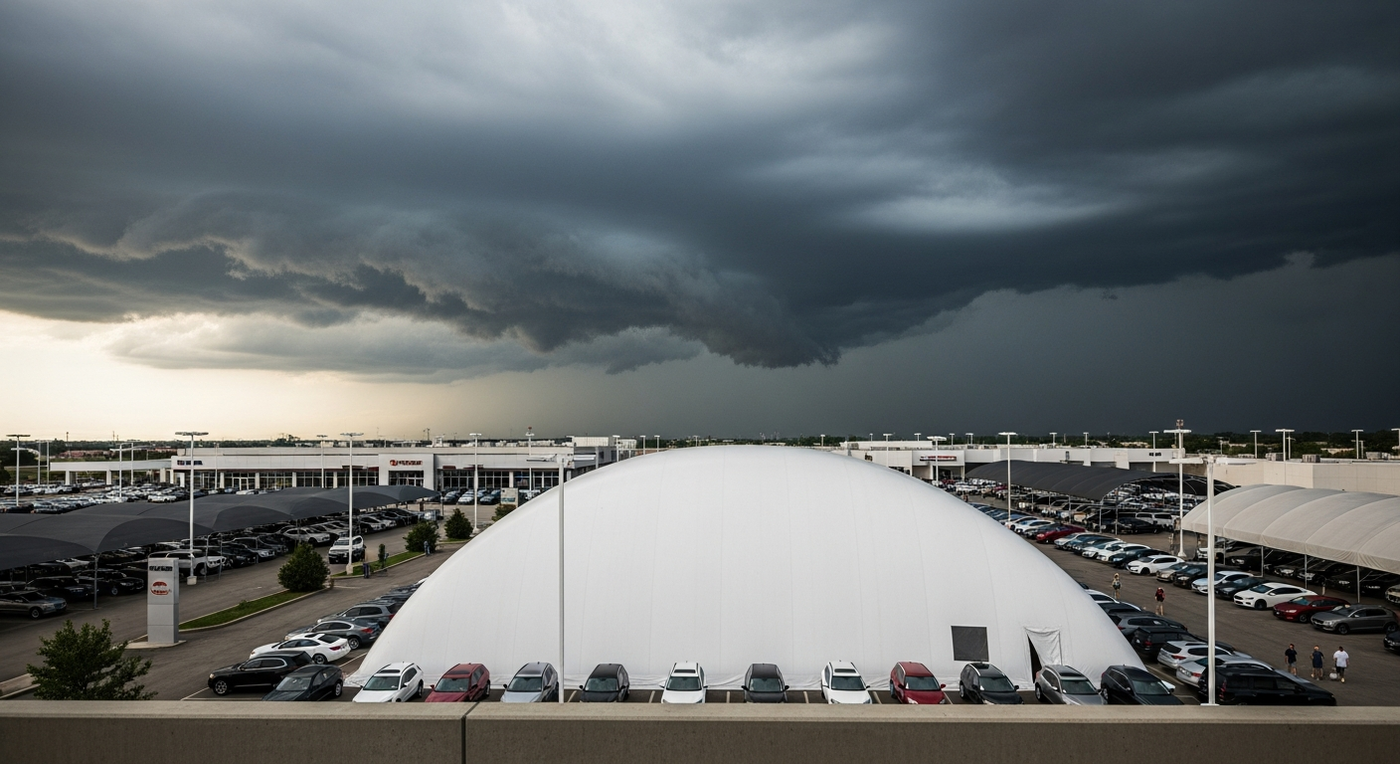
Some urban RV parks near commercial areas offer access to nearby parking structures during severe weather warnings. This requires monitoring local weather radar and being willing to unhook and relocate on short notice, but it's viable for smaller Class B and Class C motorhomes that can navigate parking garage clearances (typically 7-8 feet).

320

sq ft

Class A roof area

0.024-0.040

inches

Aluminum roof thickness

$5,000-$20,000

Full roof replacement range

1-2

%

Typical deductible percentage

The 30-Minute Decision Window

Severe thunderstorm warnings typically provide roughly 30-45 minutes of advance notice before hail arrives. For RV owners, this creates a narrow decision window: do you have time to relocate, and where would you go?

The answer depends entirely on preparation. Successful hail avoidance requires pre-scouting covered locations within approximately a 10-15 minute drive of your campsite: commercial parking garages, gas station canopies large enough to accommodate your rig, or even highway underpasses as a last resort (though parking under bridges creates its own safety issues and is illegal in many jurisdictions).

Some full-time RVers maintain a digital map of covered parking options along their regular routes—truck stops with canopy fueling stations, fairground buildings with overhangs, agricultural equipment dealers with large pole barns. This sounds paranoid until you're watching a supercell develop 40 miles upwind with your $80,000 fifth wheel parked in an open field.

Mobile weather radar apps provide the precision needed for these decisions. Modern apps show hail probability and projected hail size for individual storm cells, typically updated every 2-5 minutes. When radar indicates a storm cell with 1.5-inch hail probability approaching from the southwest at 35 mph, you can calculate almost exactly when it will arrive and whether you have time to move.

Insurance Fine Print Worth Reading

RV insurance policies vary wildly in their hail coverage. Some insurers offer "full-timer" policies that mirror homeowners insurance, including comprehensive coverage for hail damage without depreciation. Others treat RVs as recreational vehicles with actual cash value coverage that may depreciate the roof at approximately 10-15% per year.

The difference matters enormously. A five-year-old RV roof with an estimated $12,000 replacement cost might receive just $6,000-7,000 under an actual cash value policy after depreciation—leaving you to cover the gap out of pocket or accept a substandard repair.

Specialized RV insurers sometimes offer hail coverage endorsements that waive deductibles for covered storage or reduce deductibles if you can prove you took preventive measures (relocating based on weather warnings, for instance). These endorsements often add around $100-200 annually to premiums but can save thousands in a single event.

What Actually Works

After talking to RV owners who've survived hail events, three strategies emerge consistently.

Seasonal routing. Plan major travel through the Great Plains and Midwest for September through March when hail frequency drops dramatically. If you must cross tornado alley during spring, budget extra days so you can hole up in covered storage when severe weather threatens rather than pushing through on schedule.

Covered storage relationships. Establish contacts with RV storage facilities along your regular routes. Many facilities will rent covered space by the day (often $25-50) during severe weather events, even if you're not a monthly customer. Having these numbers saved before you need them eliminates the panic of searching during a weather emergency.

Radar literacy. Learn to read velocity and reflectivity data, not just the pretty colored maps. Understanding mesocyclone signatures and hail cores lets you distinguish between a severe thunderstorm warning that will produce wind and rain versus one that will drop baseball-sized hail. Not every warning requires evacuation—but knowing which ones do requires more than watching local news.

The least effective strategy? Hail covers designed for RVs that claim to work. Most are simply oversized car covers with inadequate anchoring. In the wind conditions that accompany hail-producing storms, these covers either blow off entirely or flap violently enough to cause more damage than the hail itself.

Decision Tradeoffs

Pros

  • Tree canopy parkingReduces hail impact by 60-70% through trajectory disruption
  • Covered campground sitesPremium amenity at $5-15/night provides structural protection
  • Seasonal route planningAvoiding Great Plains April-July eliminates peak risk period
  • Storage facility contactsDaily rentals ($25-50) available during weather emergencies

Tradeoffs

  • Portable RV coversInadequate anchoring causes wind damage; ineffective above 18 feet
  • Permanent carport structures$8,000-15,000 investment only protects home base location
  • Highway underpass parkingIllegal in most areas and creates additional safety hazards
  • Dropping comprehensive coverageLeaves older RVs vulnerable to total loss from single event

Effective hail protection requires advance planning and weather monitoring rather than physical barriers. Covered parking and strategic routing provide the best cost-to-protection ratio for mobile RVs.

The Math That Matters

A single severe hail event can total an older RV outright. Insurance companies often declare a total loss when repair costs exceed approximately 70-80% of the vehicle's actual cash value. For a ten-year-old Class A motorhome worth an estimated $60,000, that threshold sits around $42,000-48,000. Extensive roof damage plus delamination repair can potentially cross that line.

This creates a perverse incentive: comprehensive coverage on older RVs sometimes costs more than the vehicle is worth after a total loss payout. Many owners drop comprehensive coverage on units over 15 years old, accepting that a major hail event means the end of that RV's useful life.

For newer RVs still under loan, this isn't an option—lenders require comprehensive coverage. This makes hail avoidance a financial necessity rather than merely good practice. Missing a loan payment costs you late fees and credit score points. A hail-totaled RV can leave you making payments on a vehicle you can't use while simultaneously needing to buy or rent a replacement.

The per-day cost of covered parking (typically $25-50) versus the expected value of hail damage in high-risk areas makes the decision mathematically clear. Even if you only face an estimated 5% chance of significant hail on any given day in a high-risk zone, the expected value of damage (0.05 × $15,000 = $750) far exceeds the cost of covered parking.

Verified Sources

  1. NOAA Storm Prediction Center

    NOAA Storm Prediction Center

    Official convective outlook archive and risk categories.

Back to Protection Guides