Decision Brief

The $50,000 Deductible: Why Fleet Hail Protection Math Changes at Scale

A single hail event can trigger deductibles across every vehicle in your lot simultaneously—turning standard $500-1,000 comprehensive coverage into a five-figure out-of-pocket expense before insurance pays a dollar.

The $50,000 Deductible: Why Fleet Hail Protection Math Changes at Scale
Hail Protector Editorial / GeminiDecision Brief

The Compounding Deductible Problem Nobody Explains

Most fleet managers understand hail damage as a per-vehicle risk. A dented hood typically costs roughly $2,500-4,500 to repair. Comprehensive insurance covers it after the deductible. The math seems straightforward until you park 40 vehicles in an unprotected lot during a severe thunderstorm.

Here's what changes: deductibles don't pool. If you carry $1,000 comprehensive deductibles and hail damages 40 vehicles in your lot, you're paying $40,000 out of pocket before your insurance carrier contributes anything. The total claim might reach $120,000-180,000 in repairs, but your immediate cash outlay—the money that hits your operating budget this quarter—is the sum of every individual deductible.

This is fundamentally different from the risk calculation for personal vehicle owners. A homeowner with two cars faces a maximum $2,000 deductible exposure in a hail event. A fleet operator with 50 vehicles faces $50,000 if they've structured policies vehicle-by-vehicle, which most do for flexibility in adding and removing units.
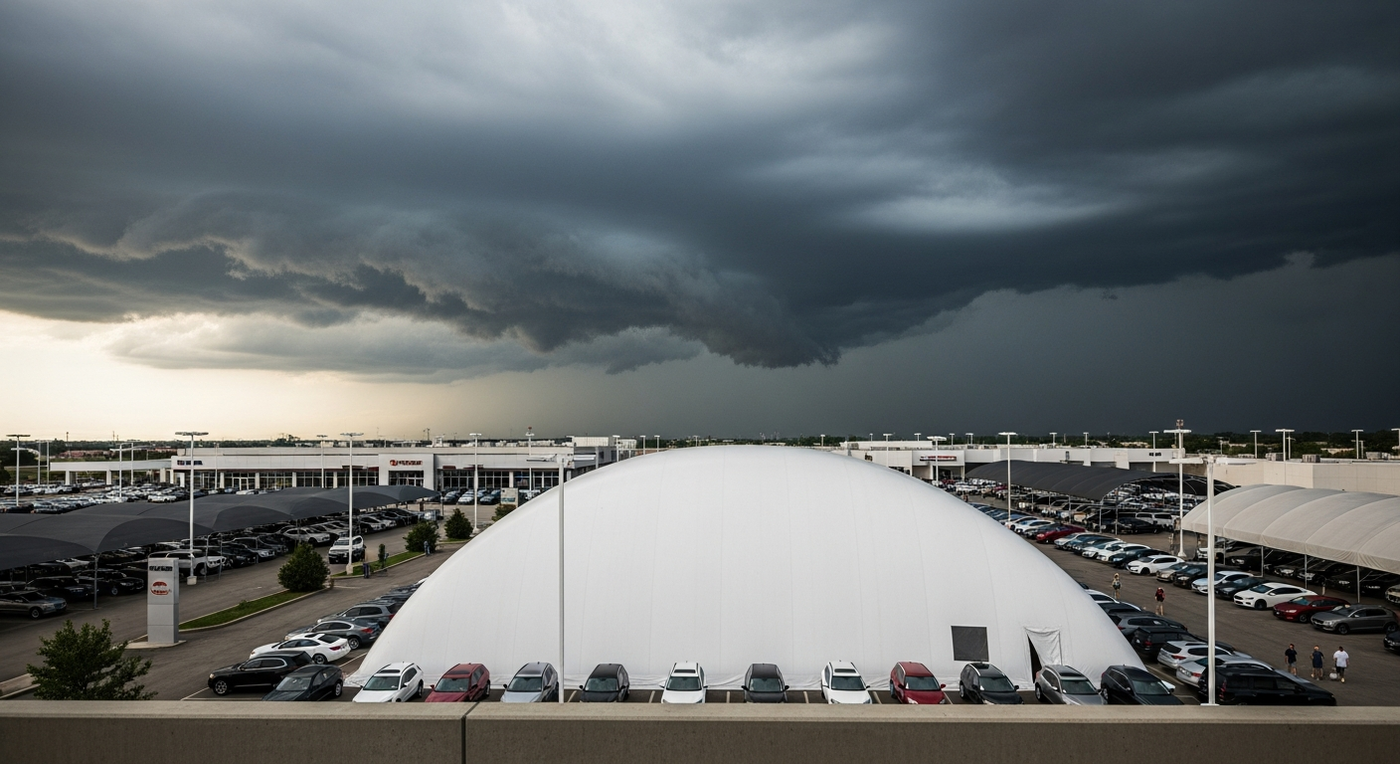
What Fleet Hail Damage Actually Costs

Comprehensive claims for hail damage typically average several thousand dollars per vehicle, varying significantly based on vehicle type and damage severity. A light hail event that only dents hoods and roofs might generate approximately $1,800-3,200 per vehicle. Severe hail with golf-ball-sized stones can total vehicles or require an estimated $8,000-12,000 in panel replacement and paintwork.

The expected annual cost for an unprotected fleet depends almost entirely on geography. A 50-vehicle fleet based in Denver faces materially different exposure than the same fleet in Portland, Oregon. Storm Prediction Center climatology data shows the hail belt—stretching from Texas through Oklahoma, Kansas, Nebraska, and into Colorado and Wyoming—experiences the highest frequency of damaging hail days annually.

A fleet of 50 vehicles parked outdoors in a high-frequency hail zone (Denver, Oklahoma City, Wichita) might expect significant hail damage every 3-5 years on average, with minor events more frequently. That translates to an expected annual cost of approximately $15,000-75,000 when you amortize major damage events across multiple years. Fleets in moderate-risk areas see proportionally lower figures, but the risk never zeros out entirely—hail occurs in all 50 states.

The timing problem compounds this. Hail season peaks April through June across most of the central United States. A fleet manager who budgeted $8,000 for vehicle maintenance in Q2 suddenly faces a $45,000 unplanned deductible expense, plus the operational disruption of having a third of the fleet in body shops for approximately 2-3 weeks.

The Protection Cost Structure

Portable hail covers for fleet vehicles typically cost approximately $200-400 per unit for commercial-grade products designed for repeated deployment. A 50-vehicle fleet investment runs approximately $10,000-20,000 depending on vehicle sizes and cover specifications.

The math gets interesting when you compare this one-time capital expense against the deductible exposure. At approximately $15,000 for 50 covers (splitting the difference), you've effectively pre-paid the deductible for 15 vehicles. The first hail event that would have damaged 15 or more vehicles pays for the entire cover investment through avoided deductibles alone—before considering avoided premium increases, downtime costs, or depreciation from hail history on vehicle titles.

Permanent carport structures change the equation. A 10-vehicle steel carport installation runs approximately $15,000-30,000 depending on specifications and site preparation. For 50 vehicles, you're looking at five structures and a total investment of approximately $75,000-150,000. This only pencils for fleets with fixed parking locations and multi-year planning horizons, but it eliminates the deployment labor entirely.

Here's what most people get wrong: they calculate ROI based only on repair cost avoidance. The real return includes avoided insurance premium increases (comprehensive claims typically bump fleet premiums approximately 10-20% for 3-5 years), eliminated vehicle downtime (a service van in the body shop for two weeks isn't generating revenue), and preserved resale value (hail history reduces trade-in values by approximately 10-25% even after professional repair).

When the Math Doesn't Work

Fleet hail protection has a break-even threshold, and not every operation crosses.

Fleets with fewer than 10 vehicles rarely justify dedicated hail infrastructure. The deductible exposure stays below $10,000 even in worst-case scenarios, and portable covers for 8 vehicles cost approximately $1,600-3,200—a reasonable expense, but one that might take a decade to pay back in a low-frequency hail area.

Geographic location matters more than fleet size in some cases. A 75-vehicle fleet in Seattle faces minimal hail risk. Annual expected damage costs might run under approximately $2,000. Investing approximately $25,000 in hail covers would take 12+ years to break even on deductible avoidance alone. The same 75-vehicle fleet in Amarillo, Texas faces expected annual costs potentially exceeding $50,000, making the same approximately $25,000 investment pay back in under a year.

Vehicle type creates another variable. A fleet of compact sedans sustains less damage per vehicle than a fleet of box trucks with large flat roof surfaces. Cargo vans with minimal glass and simple body panels repair cheaper than passenger vans with extensive windows and complex curves. A mixed fleet needs weighted calculations—protecting the high-value units might make sense while leaving the work trucks exposed.

$40,000

Deductible exposure: 40 vehicles

3-5

years

Major hail event frequency

10-25

%

Resale value loss post-repair

$15,000

Portable covers: 50 vehicles

The Insurance Relationship

Most fleet insurance policies don't discount premiums for hail protection measures. Unlike commercial property insurance, which often reduces rates for storm shutters or impact-resistant roofing, auto comprehensive coverage prices primarily on loss history and geography, not prevention infrastructure.

This creates a perverse incentive structure. You invest in protection, avoid claims, and your premium decreases slightly due to clean loss history—but you would have received the same decrease by simply getting lucky and avoiding hail without any protection. The ROI comes entirely from avoided out-of-pocket costs, not insurance savings.

Some fleet managers negotiate higher deductibles to reduce premiums, then use the savings to fund hail protection. Moving from $500 to $2,000 comprehensive deductibles might save approximately $150-300 per vehicle annually on a 50-vehicle fleet—that's approximately $7,500-15,000 in annual premium reduction. Over two years, that funds the entire portable cover investment, and you've actually reduced your exposure because protected vehicles don't trigger deductibles at all.

The coverage gap matters here. Comprehensive insurance covers hail damage, but it doesn't cover lost revenue from vehicles out of service, rush fees for expedited repairs, or rental vehicles to maintain operations during body shop time. A delivery company with 30 vans might face approximately $3,000-5,000 in rental costs during a two-week repair period, none of it insured.

Deployment Realities

Portable hail covers only work if someone deploys them before the storm arrives.

A 50-vehicle fleet needs approximately 2-3 hours for a trained crew to cover every vehicle, assuming covers are stored accessibly and weather conditions permit outdoor work. Severe thunderstorms in the Great Plains often develop rapidly—the window between "possible hail" on radar and stones falling can compress to approximately 30-45 minutes.

This operational reality pushes some fleet managers toward partial protection strategies. Cover the 15 highest-value vehicles (the new delivery vans, the executive sedans, the specialized service trucks) and accept exposure on older, fully-depreciated units. This reduces both the capital investment and the deployment timeline while protecting the assets that hurt most to damage.

Weather monitoring becomes part of the infrastructure cost. Effective fleet hail protection requires someone watching forecasts during hail season and making deployment decisions. Some operations assign this to existing facilities staff; others subscribe to commercial weather alerting services that provide location-specific warnings. The labor and attention cost money, even if it's hard to line-item in a budget.

One fleet manager I spoke with in Oklahoma City runs a 60-vehicle operation and protects only the 20 newest units. His calculation: those 20 vehicles represent 65% of the fleet's total value, and covering them takes under an hour with two people. The remaining 40 vehicles are 4+ years old with existing cosmetic damage. Hail won't total them, and he's willing to self-insure the deductibles on older assets while protecting the capital-intensive new purchases.

The Resale Value Factor

Hail damage follows vehicles through their entire lifecycle, even after professional repair.

Title history reports now commonly include insurance claim records. A fleet vehicle with a $4,500 hail damage claim in its history sells at auction for approximately 10-15% less than an identical vehicle with clean history. For a $30,000 van, that's approximately $3,000-4,500 in lost resale value—often exceeding the repair deductible itself.

This creates a hidden cost that doesn't appear in annual budgets but accumulates across fleet lifecycle. A company that cycles through 10 vehicles per year, each with approximately $3,500 in reduced resale value from hail history, loses approximately $35,000 annually in trade-in value. That's real money that could have funded new vehicle purchases or returned to operations.

The math gets worse for specialized vehicles. A standard cargo van with hail history loses approximately 10-15% of value; a vehicle with custom upfitting (refrigeration units, ladder racks, specialized storage systems) can lose approximately 20-25% because buyers assume the hail might have damaged equipment beyond the visible body panels, even when it didn't.

Decision Tradeoffs

Pros

  • Eliminates deductible cascadeSingle event won't trigger dozens of simultaneous out-of-pocket payments
  • Preserves resale valuesClean title history maintains 10-25% higher auction prices
  • Prevents operational disruptionVehicles stay in service instead of spending weeks in body shops
  • Avoids premium increasesNo claims means rates stay stable for 3-5 year periods

Tradeoffs

  • Upfront capital requirementCovers demand $10K-20K investment before seeing any return
  • Deployment labor needed2-3 hours required to protect 50 vehicles before each storm
  • No insurance discountsCarriers don't reduce premiums for prevention infrastructure
  • Geography-dependent ROILow-risk regions may wait decade-plus for payback

Protection makes financial sense for 30+ vehicle fleets in hail-prone regions with multi-year replacement cycles. Smaller fleets or low-risk locations rarely justify the investment.

What Actually Drives the Decision

Fleet hail protection ROI ultimately reduces to three numbers: your deductible structure, your location's hail frequency, and your vehicle replacement cycle.

A fleet with $500 deductibles in a low-hail area with 2-year vehicle turnover probably shouldn't invest in protection infrastructure. The expected damage cost stays low, and vehicles exit the fleet before hail history accumulates.

A fleet with $1,000 deductibles in Denver or Oklahoma City with 6-year vehicle lifecycles should run the numbers seriously. The combination of high exposure, long enough timelines to almost certainly experience hail, and resale value concerns typically pushes the ROI positive.

The calculation isn't elegant. You're estimating the probability of rare events, projecting insurance market responses, and valuing operational disruption that's hard to quantify. But the core question is simple: does spending approximately $10,000-20,000 now save you more than that in avoided costs over the next 3-5 years?

For many fleets in hail-prone regions, the answer is yes—not because the math is overwhelming, but because the downside scenario (40 damaged vehicles, $40,000 in deductibles, three weeks of operational chaos) is sufficiently painful that eliminating it has value beyond the spreadsheet.

Verified Sources

  1. Storm Prediction Center

    Storm Prediction Center

    hail frequency climatology and geographic risk distribution

  2. NOAA Storm Prediction Center

    NOAA Storm Prediction Center

    Storm report archive with severe hail event records.

Back to Protection Guides