How-To How-To Guide

The First Hour: Fleet Hail Response Protocol That Determines Your Insurance Outcome

What you photograph and document in the hour immediately after hail stops falling matters more than anything you'll do in the following weeks—here's the systematic approach that keeps claims moving and vehicles rolling.

The First Hour: Fleet Hail Response Protocol That Determines Your Insurance Outcome
Hail Protector Editorial / GeminiHow-To Guide

Stop All Vehicle Movement Before Documentation Begins

The instinct to move damaged vehicles under cover is understandable and completely wrong. The moment hail stops, every car on your lot becomes evidence in what may be a substantial insurance claim. Moving vehicles before systematic documentation creates gaps in your photographic record that adjusters will notice and question.

Issue an immediate lot freeze. No test drives, no deliveries, no repositioning "just to get them out of the weather." According to Insurance Information Institute guidance on commercial claims, the burden of proof for pre-loss condition falls entirely on the policyholder. Every car that moves before you photograph it is a car whose damage timeline you can no longer definitively establish.

The exception: vehicles actively creating a safety hazard. A car with a shattered windshield blocking your service bay entrance can be moved, but photograph it in place first, then photograph it again in its new location with a timestamp showing the interval.
The 15-Minute Overhead Survey

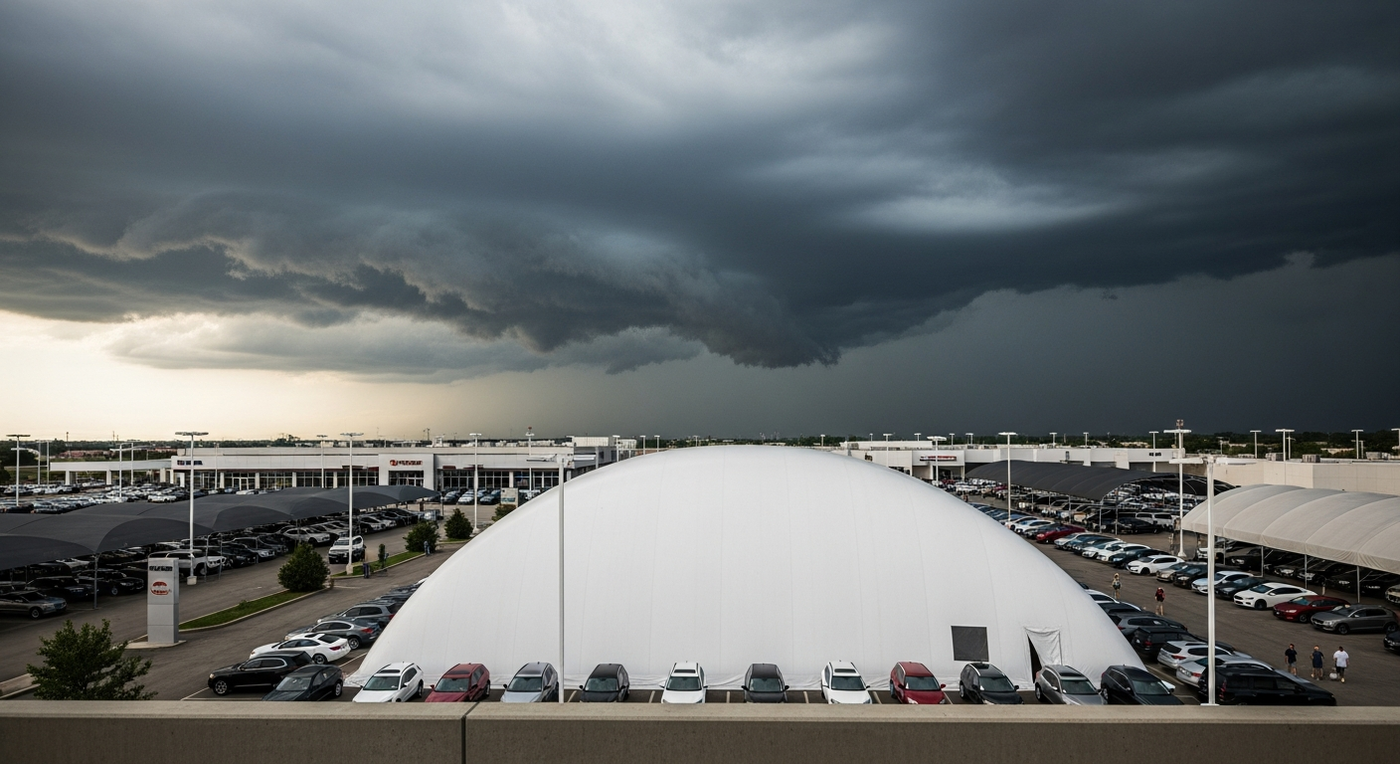
Before you touch a single vehicle, walk your entire lot with a camera or phone set to include GPS coordinates in the image metadata. You're creating a damage map, not an art project. Shoot straight down each row from both ends. Capture the overall scene—hailstones still on the ground, dented hoods visible in sequence, the full scope of impact.

This overhead survey accomplishes two things insurance companies care about: it establishes that damage occurred simultaneously across multiple vehicles (ruling out pre-existing damage claims), and it shows the spatial distribution of impact. A lot with 40 damaged vehicles clustered in the northwest corner and 15 untouched vehicles under a canopy tells a clear story. A lot with claimed damage on every vehicle but no environmental context raises questions.

Most fleet managers skip this step and go straight to individual vehicle documentation. That's backwards. The wide shots prove the event; the close-ups prove the extent.

The Vehicle-by-Vehicle Documentation Template

Now you document every single vehicle, and you do it the same way every time. Inconsistent documentation is what turns a straightforward claim into a six-month negotiation.

Your template should capture.

Vehicle identification: VIN, stock number, year/make/model, odometer reading. Photograph the VIN plate and odometer display—don't just write numbers down.

Panel-by-panel damage notes: Hood, roof, trunk, each door, each fender, mirrors, windshield, rear glass. Use a simple severity scale: none, light (dime-sized or smaller), moderate (quarter-sized), severe (larger than quarter or multiple impacts per panel). The adjuster will make the final determination, but your initial assessment creates the baseline.

Photographic sequence: Front quarter, driver side full length, rear quarter, passenger side full length, straight-on hood, straight-on roof, straight-on trunk. Then close-ups of the worst damage on each affected panel. Twelve photos minimum per vehicle. For a typical fleet, this means hundreds of photos. Budget your time accordingly.

Timestamp everything: Most phones embed this automatically, but verify your settings before you start. An insurance company processing a fleet claim will check whether your documentation timeline makes physical sense. If you claim to have photographed 70 vehicles in 45 minutes with panel-by-panel notes, they'll know you're cutting corners.

Here's what most people get wrong: they photograph damage but not undamaged areas. Shoot the clean panels too. A photo showing an undamaged passenger door next to a destroyed driver door proves the impact pattern was directional, which matches hail behavior.

24

hours

Claim filing to follow within

24

hours

Contact you within

Triage Categories That Resume Operations

While you're documenting, you're also sorting. Every vehicle goes into one of three categories, and this classification determines your operational recovery timeline.

Category A—Drivable, cosmetic damage only: Light to moderate hail on panels, all glass intact, no mechanical impact. These vehicles can be delivered to customers with full disclosure or kept in service fleet rotation while awaiting PDR scheduling. You're not hiding damage; you're maintaining operations with informed consent.

Category B—Drivable, needs body work: Severe panel damage, cracked glass, or damage affecting functionality (mirrors, sensors, lights). These vehicles stay grounded until repairs are completed, but they don't need towing. They'll drive themselves to the body shop when capacity opens up.

Category C—Non-drivable: Shattered windshields creating visibility hazards, damaged suspension from impact with debris, electrical systems affected by water intrusion through broken glass. These need immediate towing and represent your true operational loss.

Most fleet lots discover their Category A vehicles outnumber Categories B and C combined. That means you can typically resume a majority of normal operations within hours, not weeks. But only if you've done the triage during documentation instead of treating every damaged vehicle as equally unavailable.

The Damage Assessment Form That Adjusters Actually Want

Insurance companies process numerous hail claims every spring. The ones that move quickly share a common trait: documentation that matches the adjuster's own assessment template.

Your damage form should include fields.

- Date/time of storm event (not documentation time—actual hail impact time) - Weather service confirmation (NOAA storm report number if available) - Vehicle location on lot (row/space number or GPS coordinates) - Pre-event condition notes (any existing damage that predates the hail) - Estimated repair category (PDR candidate vs. conventional body work) - Preliminary loss estimate (even a rough range helps).

The pre-event condition field is critical. If a vehicle had a dented fender from a previous parking lot incident, note it and photograph it separately. Adjusters assume you're trying to slip old damage into new claims. Proactively identifying pre-existing issues builds credibility for everything else you submit.

National Weather Service storm reports provide third-party verification of hail size and timing. Reference the specific report in your documentation. "Per NWS report #25-0523-001, hail ranging from 1.5 to 2 inches fell between 3:15 and 3:40 PM" carries more weight than "big hail around 3:00.".

Communication Protocol: Who Needs to Know What, When

Your insurance agent should receive preliminary notification within the first hour: "Hail event confirmed, damage assessment in progress, formal claim filing to follow within 24 hours." That's it. Don't estimate totals, don't speculate about repair timelines, don't ask procedural questions while you're still documenting. Give them the heads-up, then finish your work.

Your fleet customers need different information depending on vehicle status. Category A vehicles: "Your vehicle experienced hail damage during today's storm. All mechanical systems are unaffected. Cosmetic repairs will be scheduled. You may proceed with pickup/delivery as planned with full disclosure of condition." Category B and C: "Your vehicle requires repair assessment before release.

Employees need to understand the lot freeze and why it matters. "We're preserving evidence for insurance purposes" gets better compliance than "don't touch anything." People support what they understand.

The First-Hour Checklist

Stop all vehicle movement. Wide-angle lot documentation showing overall impact. Individual vehicle photo sequences with VIN, panel notes, and damage close-ups. Triage sorting into operational categories.

That's the protocol. Everything else—repair scheduling, claim filing, customer communication details—flows from this foundation. But the foundation only exists if you build it in the first hour, before rain washes away hailstones, before wind scatters debris, before the physical evidence of what happened becomes a matter of interpretation instead of documentation.

The storms don't wait for you to have a plan. The insurance companies don't care that you were overwhelmed. The only thing that matters is what you can prove happened, and you can only prove what you documented before the scene changed.

Verified Sources

  1. Insurance Information Institute

    Insurance Information Institute

    commercial claims documentation requirements

  2. National Weather Service

    National Weather Service

    storm report verification system

Back to Protection Guides