Comparison

The Fleet Manager's Hail Math: When $800 Covers Beat $8,000 Claims

A single severe hailstorm can turn a profitable quarter into a budget crisis, but the ROI calculation for protective covers depends less on the cover price than on three numbers most fleet managers don't track.

The Fleet Manager's Hail Math: When $800 Covers Beat $8,000 Claims
Hail Protector Editorial / GeminiComparison

The Real Cost Isn't the Dent

A hail-damaged delivery van doesn't just need bodywork. It sits idle while your route gets reassigned, your customer calls go to voicemail, and your insurance adjuster schedules their third site visit of the week. According to Insurance Information Institute data, commercial vehicle hail claims typically average several thousand dollars in direct repair costs—but that's the visible expense.

The invisible cost is the roughly 12-18 days that vehicle typically spends off the road. If that van generates $400 in daily revenue, you've lost $4,800 to $7,200 in downtime before the body shop even orders parts. For a 20-vehicle fleet, a single severe hailstorm can mean approximately $160,000 in combined repairs and lost productivity.

The Three-Number ROI Formula

Fleet hail protection ROI collapses to three variables: cover cost per vehicle, regional hail frequency, and your cost per vehicle-day out of service.

Start with geography. NOAA's National Centers for Environmental Information tracks severe hail reports by region. The Texas-Oklahoma-Kansas corridor sees 10-15 significant hail days annually in peak zones. Colorado's Front Range typically experiences 8-12 days. Even lower-frequency areas like the Mid-Atlantic might see 3-5 severe hail events per season.

A commercial-grade hail cover for a full-size van typically runs approximately $600-$900. Multiply that by your fleet size, then divide by your regional hail frequency times your average claim cost. A 15-vehicle fleet in Tulsa spending approximately $12,000 on covers faces roughly 12 severe hail days per season. If each uncovered vehicle has a 30% chance of damage on a severe hail day, you're looking at roughly 54 exposure events (15 vehicles × 12 days × 0.30). At an average $6,000 per claim, the expected annual loss without protection runs around $18,000-$24,000. The covers pay for themselves in one season with a single prevented claim cluster.

The Insurance Conversation Nobody's Having

Here's what most fleet managers miss: insurance carriers track your loss history, and hail claims spike your commercial auto premiums for three to five years. A fleet with $50,000 in hail claims this year might see premium increases of around 15-25% at renewal, according to industry estimates—that's an extra $3,000-$6,000 annually on a $25,000 base premium.

But the inverse is also true. Demonstrating proactive hail protection protocols during renewal negotiations gives underwriters a concrete risk mitigation measure. Some carriers offer modest premium reductions for fleets with documented protective equipment and deployment procedures. Even a 5% reduction on that $25,000 premium—approximately $1,250 annually—creates a permanent offset against cover costs.

The challenge is documentation. Insurance underwriters want proof of consistent deployment, not just ownership. Fleet managers who implement GPS-triggered hail alerts and photograph covered vehicles during events build the loss-control narrative that influences premium calculations.

The Downtime Multiplier Most Spreadsheets Ignore

Vehicle downtime costs vary wildly by industry, but they're always higher than managers estimate. A delivery van might generate $300-$500 in daily revenue, but that's not your true cost when it's sidelined. You're paying for rental replacements, rerouting logistics, delayed deliveries, and customer service recovery.

Calculate your actual cost per vehicle-day out of service: lost revenue plus replacement vehicle cost plus operational disruption. For many commercial fleets, this number typically lands between $400 and $800 daily. Multiply by the typical 12-18 day repair cycle for hail damage, and a single vehicle's downtime costs $4,800 to $14,400—before the repair bill arrives.

This multiplier transforms the ROI calculation. A $700 cover that prevents one hail damage event saves not just an estimated $5,000 repair cost but approximately $8,000 in downtime costs. The payback period isn't measured in seasons but in single weather events.

When Covers Don't Make Sense

Not every fleet should buy hail covers. If your vehicles operate exclusively in coastal regions with minimal hail risk, the ROI math collapses. If your fleet consists of older vehicles with high mileage and low residual value, cosmetic hail damage might not justify protection costs—though downtime costs remain.

The calculation also assumes deployment compliance. Covers that stay in the warehouse during hailstorms have zero ROI. Fleet managers need deployment protocols: Who monitors weather? Who's responsible for covering vehicles? What's the alert threshold? Without operational discipline, protective equipment becomes expensive garage decoration.

Option Tradeoffs

Pros

  • Prevents repair expensesTypical damage bills run $5,000-$8,000 per vehicle
  • Eliminates downtime lossesKeeps vehicles earning revenue instead of sitting idle for weeks
  • Stabilizes insurance ratesClean loss history prevents multi-year premium spikes
  • Fast payback periodSingle prevented event often covers entire investment

Tradeoffs

  • Upfront capital requiredFull fleet protection demands $600-$900 per vehicle
  • Deployment discipline neededUnused equipment delivers zero protection value
  • Geography-dependent valueLow-risk regions see minimal return on investment
  • Older fleet complicationsCosmetic damage matters less on high-mileage vehicles

Protection makes financial sense for fleets in moderate-to-high hail zones where downtime costs exceed $400 daily and deployment protocols ensure consistent use.

The Budget Justification Template

When presenting hail protection ROI to budget committees, lead with the three-year cost comparison.

Scenario A (No Protection): Expected annual hail losses based on regional frequency × average claim cost × fleet size, plus premium increases over three years.

Scenario B (Full Protection): One-time cover investment plus deployment labor costs, minus prevented claims and potential premium reductions.

The difference is your net savings. For most fleets in moderate-to-high hail frequency zones, Scenario B typically shows positive ROI within 18-24 months.

Include a sensitivity analysis showing ROI across different hail frequencies. Even if your region experiences only half the expected severe hail days, does the investment still pencil? For most commercial fleets, the answer is yes—because the downtime cost alone justifies the protection.

Fleet manager hail
Fleet manager hail

Fleet manager hail

Not every fleet should buy hail covers. If your vehicles operate exclusively in coastal regions with minimal hail risk, the ROI math collapses. If your fleet consists of older vehicles with high mileage and low residual value, cosmetic hail damage might not justify protection costs—though downtime costs remain.
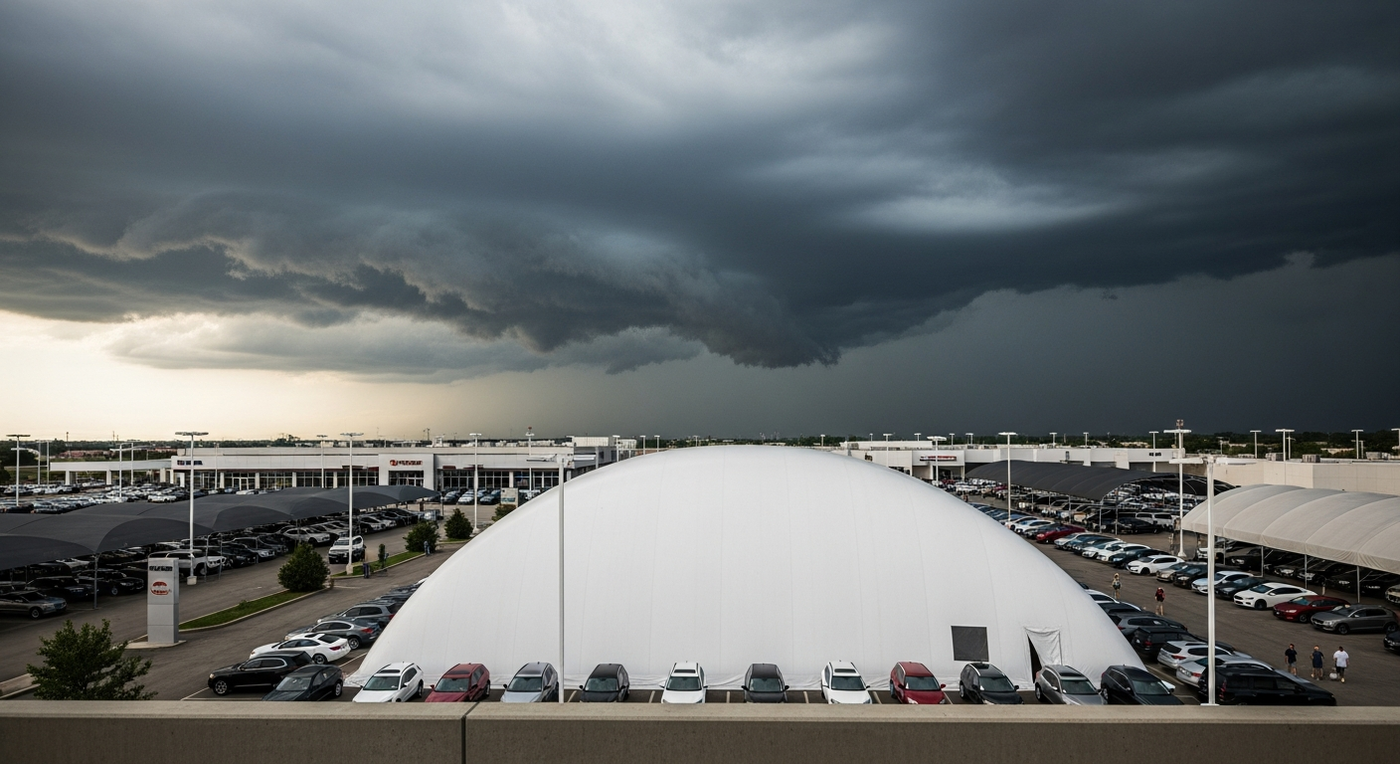
For a 20-vehicle fleet, a single severe hailstorm can mean $160,000 in combined repairs and lost productivity.
Review deployment options

Verified Sources

  1. Insurance Information Institute

    Insurance Information Institute

    Insurance context for auto losses and claims impact.

  2. NOAA Storm Prediction Center

    NOAA Storm Prediction Center

    Storm report archive with severe hail event records.

  3. National Weather Service

    National Weather Service

    Public guidance on severe thunderstorm and hail safety.

  4. NOAA Storm Prediction Center

    NOAA Storm Prediction Center

    Official convective outlook archive and risk categories.

  5. iii.org

    iii.org

    Referenced in article via iii.org.

  6. ncei.noaa.gov

    ncei.noaa.gov

    Referenced in article via ncei.noaa.gov.

Back to Protection Guides