Decision Brief

The Three-Car Hail Problem: A Triage System That Actually Works Under Pressure

When severe weather approaches and you have more vehicles than garage bays, the families who protect their assets best aren't making decisions in real-time—they're executing a plan they've already rehearsed.

The Three-Car Hail Problem: A Triage System That Actually Works Under Pressure
Hail Protector Editorial / GeminiDecision Brief

The 8-Minute Window

A hail core typically travels at roughly 30-40 mph once it reaches the ground. From the moment the National Weather Service issues a severe thunderstorm warning until stones start falling, you typically have approximately 8-15 minutes.

The households that consistently minimize damage treat this like a fire drill. One person has garage duty, another handles the portable covers, and everyone knows which vehicle gets priority. The plan exists on paper—or better yet, laminated and magneted to the refrigeaker—before the sky turns green.

Value-Based Garage Assignment Isn't Obvious

Most families default to parking their newest vehicle in the garage. But the newest isn't always the most expensive to repair. A 2024 pickup truck with a steel hood might cost roughly $2,800 to fix after golf-ball hail, while a 2022 sedan with an aluminum hood and panoramic sunroof could run approximately $6,500 for the same storm.

Calculate your garage priority by repair vulnerability, not purchase price. Vehicles with large glass surfaces, aluminum body panels, or complex sensor arrays (adaptive cruise control housings, lane-keep cameras) should claim covered space first. A $45,000 SUV with a traditional metal roof beats a $50,000 Tesla with a glass roof for garage priority—the Tesla's repair bill will typically exceed the SUV's by several thousand dollars.

The second garage bay goes to whichever remaining vehicle has the highest combined value and repair complexity. That $15,000 commuter car with a basic steel body? It's your cover candidate, not your garage occupant.

8-15

min

Warning to impact window

30-40

mph

Hail core ground speed

$6,500

Aluminum panel repair cost

10-20%

%

Premium increase after claim

Portable Covers: The $400 Insurance Policy

A quality hail cover for a mid-size vehicle typically costs roughly $200-300. For a family protecting two uncovered vehicles, that's approximately a $400-600 one-time investment defending potentially $40,000-60,000 in asset value.

Not all covers perform equally. The multi-layer padded designs with approximately 6-8mm of foam protection will typically stop stones up to about two inches in diameter—the size that causes the majority of insurance claims. Single-layer covers or basic car covers marketed as "hail resistant" typically fail above one-inch stones, which means they're nearly useless in the severe events that actually matter.

Deployment time is the hidden variable. A cover that takes 12 minutes to install and secure is a cover that won't get used when warnings arrive. Practice the installation on a calm Saturday. If you can't get both covers on two vehicles in under six minutes, you need a different system or a different product. Some families keep covers pre-attached with bungee cords during hail season, removing only the top layer for daily driving—it looks ridiculous, but it works.

The Overflow Location You've Already Scouted

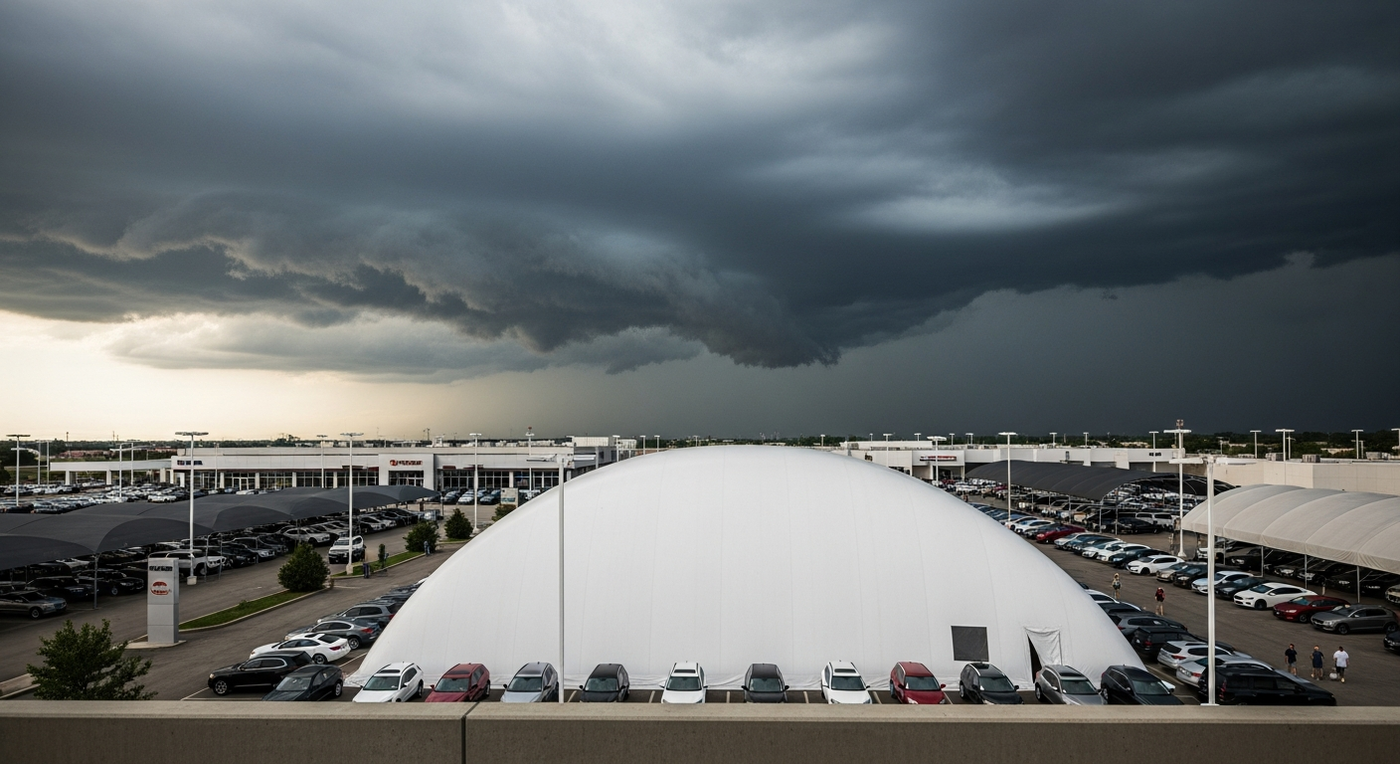
For families with four or more vehicles, or during events when you're caught away from home, you need a pre-identified parking structure within five minutes of your house. This isn't theoretical planning—this is knowing exactly where you're driving when the warning hits.

Covered mall parking, airport economy garages, and hospital parking structures are the standard options. But here's what most people miss: accessibility during severe weather. Some parking structures close their gates when lightning is within a certain range. Some mall garages lock after hours. The optimal overflow location is accessible 24/7, doesn't require payment-booth interaction that eats precious minutes, and has enough vertical clearance that you're not parking on the top exposed level.

Drive the route once. Time it. Verify the entrance stays open. Save the address in your phone as "HAIL SHELTER" so anyone in the family can navigate there without thinking.

For families with four or more vehicles, or during events when you're caught away from home, you need a pre-identified p
The Overflow Location You've Already Scouted

The Assigned Roles That Eliminate Chaos

Decision fatigue is real when hail is ten minutes out and you're trying to coordinate three people and three vehicles. Families who execute cleanly have assigned roles that never change.

Role One: Garage Manager. This person moves the two garage-priority vehicles into covered space, period. They don't help with covers, they don't make phone calls, they complete one task.

Role Two: Cover Deployment. This person deploys portable covers on the designated vehicles. If there's only one person available for this role and two vehicles to cover, the lower-value vehicle gets sacrificed—no heroic attempts to cover everything.

Role Three: Overflow Driver. If you have a fourth vehicle or if someone is away from home with a high-value car, this person drives to the pre-scouted parking structure. They leave immediately, before the other roles even start.

Run this drill once per season. Set a timer. You'll discover that your cover storage location is inconvenient, or that your teenager doesn't actually know how to open the garage door manually when the power's out, or that you can't find the car keys for the vehicle that needs to move. Better to learn this during practice than during a warned supercell.

When the Math Says Do Nothing

Here's the uncomfortable truth: sometimes the economically rational choice is to leave a vehicle exposed. If you own a 2008 sedan worth approximately $4,500 and a hail cover costs $250, and you live in an area that sees damaging hail once every 8-10 years on average, the cover doesn't pencil out. Your expected loss is lower than the protection cost.

This calculates differently for high-value vehicles in hail-prone regions. According to Insurance Information Institute data, comprehensive claims for hail damage typically increase premiums by roughly 10-20% at renewal, and that increase persists for three to five years depending on your carrier. According to Insurance Information Institute data, a $7,000 hail claim on a $40,000 vehicle might cost you an additional $800-1,200 in premiums over the following years. Suddenly that $300 cover is protecting you from $8,000+ in total financial impact.

Run the numbers for your specific situation. Your insurance agent can tell you exactly how a comprehensive claim would affect your rates. That information converts this from an emotional decision to a mathematical one.

The Pre-Season Inventory

Every April, before severe weather season accelerates, conduct a 15-minute household inventory.

- Confirm all garage door openers work and batteries are fresh - Verify you can locate keys for every vehicle within 30 seconds - Check that hail covers are accessible, not buried under winter storage - Update your phone contacts with the National Weather Service warning system for your county - Confirm everyone in the household knows their assigned role.

The families who protect their vehicles most effectively aren't smarter or faster. They've simply removed the decision-making from the emergency. When the warning arrives, they're executing a plan that already exists, not inventing one under pressure.

That's the difference between eight minutes of chaos and eight minutes of choreographed efficiency. One approach leaves you standing in the driveway wondering which car to prioritize while hail starts falling. The other leaves you inside watching the storm, confident that everything you could protect is already protected.

Decision Tradeoffs

Pros

  • Multi-layer padded coversStops 2-inch stones with 6-8mm foam protection
  • One-time investment$400-600 protects $40K-60K in vehicle value
  • Pre-attached storage methodReduces deployment to under 3 minutes per vehicle

Tradeoffs

  • Single-layer coversFail above 1-inch stones, ineffective for severe events
  • Slow deployment designs12+ minute installation means unused during actual warnings
  • Low-value vehicle coverageDoesn't justify cost in regions with infrequent hail

Quality padded covers with fast deployment systems provide cost-effective protection for vehicles worth $15,000+ in hail-prone areas, but skip coverage for older low-value cars where expected loss is minimal.

Verified Sources

  1. NOAA Storm Prediction Center

    NOAA Storm Prediction Center

    Official convective outlook archive and risk categories.

Back to Protection Guides