Decision Brief

The Three-Car Hail Problem: A Triage System That Actually Works When the Sky Turns Green

Most families with three vehicles and one garage spend the first five minutes of a hail warning arguing about which car to move — this pre-assigned system eliminates that debate entirely.

The Three-Car Hail Problem: A Triage System That Actually Works When the Sky Turns Green
Hail Protector Editorial / GeminiDecision Brief

Why the Standard Advice Fails Multi-Vehicle Households

The conventional wisdom — "park your most expensive car in the garage" — works fine when you own one vehicle. It breaks down completely when you're standing in your driveway at 6:47 PM with a severe thunderstorm warning, three cars, one garage space, and maybe a carport that fits another vehicle if you're lucky.

The paralysis isn't about not knowing what to do. It's about having too many decisions compressed into too little time. Which car is actually worth more after depreciation? Should you prioritize the newest vehicle or the one that's hardest to replace? What about the car your teenager drives — does a hail-dimpled hood matter less on a vehicle that already has parking lot dings?

By the time you've mentally worked through this calculus, the first stones are already bouncing off your driveway.

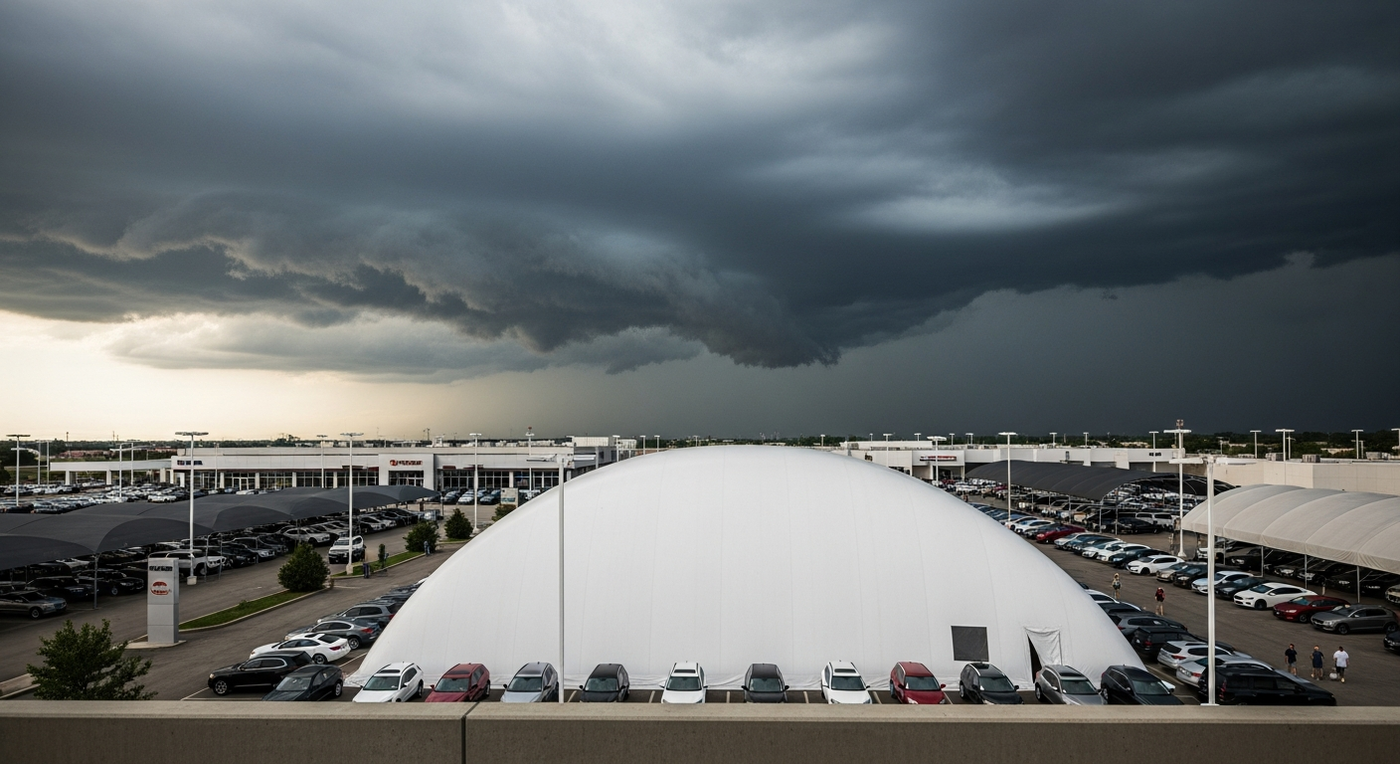
The Pre-Assigned Vehicle Hierarchy

Establish your vehicle priority order right now, in June, when no storms are visible on radar. Write it down. Stick it to your refrigerator. The ranking isn't about purchase price — it's about replacement cost minus current value, modified by practical considerations.

Position One (garage): The vehicle with the highest current market value that you'd actually repair if damaged. This usually means your newest car or the one you're still making payments on. A three-year-old SUV worth roughly $35,000 beats a paid-off ten-year-old truck worth $12,000, even if the truck cost more originally.

Position Two (covered protection): Your second-most-valuable vehicle gets a car cover. Not someday. Not when you get around to ordering one. Before storm season starts. A proper hail-resistant cover typically runs $150-400 depending on vehicle size — a single hail event can cause damage in the several-thousand-dollar range, making this math straightforward.

Position Three (tactical parking): Your third vehicle either gets a basic cover if you've invested in a second one, or it goes to your pre-scouted emergency location. More on this shortly.

The key insight: you're not protecting all vehicles equally. You're protecting the maximum dollar value with the minimum decision-making during an actual event.

Families with carports often assume they have two protected spaces.
The Carport Miscalculation

The Cover Investment Calculation

Here's what most people get wrong about car covers: they think of them as all-or-nothing protection. Either the cover stops hail completely, or it's worthless.

Real hail protection exists on a spectrum. A quality multi-layer cover won't prevent all damage from golf-ball-sized hail, but it typically reduces severity from "total loss" to "repairable dings." It transforms an estimated $8,000 insurance claim into roughly a $2,000 deductible you might choose not to file.

For a household with three vehicles valued at roughly $45,000, $28,000, and $16,000, spending approximately $400-600 on two covers protects $44,000 of your $89,000 total exposure. You're leaving your least valuable vehicle exposed, which is exactly the right call.

The math shifts if your vehicles cluster closer in value. Three cars each worth around $25,000 might justify three covers, because you don't have an obvious "sacrifice this one" option.

The Ten-Minute Drill

Assign roles before the warning arrives in a typical household.

Person A moves the garage vehicle. This takes roughly two minutes if you're not blocked in — pull the current garage car onto the driveway, drive the priority vehicle in, close the door. If you are blocked in, Person A handles the shuffle while Person B starts deploying covers.

Person B deploys the first cover. A practiced person can get a car cover on a sedan in approximately three minutes, an SUV in four.

Person C (if you have a third adult or teenager) either deploys the second cover or drives the third vehicle to your emergency location. If you're a two-adult household, Person B handles both covers while Person A finishes the garage shuffle.

Practice this once. Seriously. On a calm Saturday afternoon, time how long it actually takes your household to execute the plan. Most families discover they need seven to eight minutes, not the three they assumed. Knowing your real timeline means you know when to abandon the plan and just get everyone inside.

$8,000

Typical severe hail claim

$150-$400

Quality hail cover cost

7-8

minutes

Real household execution time

30-45°

Wind-driven hail angle

The Emergency Parking Location

Every multi-vehicle household needs a pre-scouted location within a five-minute drive where you can park a car under solid cover during extreme hail warnings. This isn't your everyday solution — it's your "the radar shows a supercell with 2.5-inch hail and we have 15 minutes" option.

Covered parking garages: Many shopping centers, hospitals, and office buildings have structures that remain accessible after hours. Drive there once before storm season to confirm access and identify which levels have the most overhead protection.

Gas station canopies: The large canopies at truck stops offer more coverage than standard gas stations. According to National Weather Service safety guidance, these structures provide reasonable protection during severe weather, though you should never remain in your vehicle under a canopy during a tornado warning.

Highway underpasses: This is controversial because underpasses are dangerous locations during tornadoes — the wind tunnel effect makes them worse than open ground. But for hail-only events (rare, since severe hail usually comes with tornado potential), an underpass provides solid overhead protection. Use this option only when you're certain the threat is hail-specific, and never block traffic or emergency access.

A friend's garage: If your neighbor two streets over has a three-car garage and only two vehicles, establish an understanding now.

The point isn't to use this location for every storm. It's to eliminate the mid-warning scramble where someone says "maybe I should drive somewhere?" and nobody knows where that somewhere is.

The Carport Miscalculation

Families with carports often assume they have two protected spaces.

A standard carport provides excellent protection from vertical rain and direct sun. It provides almost no protection from wind-driven hail. Stones don't fall straight down during severe thunderstorms — they come in at roughly 30- to 45-degree angles, propelled by winds that can exceed 60 mph in a strong storm.

If your carport has solid walls on three sides, it's worth using for your second-priority vehicle. If it's just a roof on posts, treat it as unprotected space and deploy a cover over any vehicle parked there.

When Covers Aren't Worth It

Some vehicles shouldn't get covers even if you own them.

Vehicles you're planning to sell within six months: Hail damage disclosure requirements vary by state, but cosmetic damage to a car you're already selling doesn't change your position much. Save the cover deployment time for your keepers.

High-mileage vehicles worth less than your deductible: If your 15-year-old commuter car is worth roughly $4,000 and your comprehensive deductible is $1,000, hail damage doesn't create an insurance scenario that makes sense to file. The vehicle's value is already mostly in its mechanical function, not its appearance.

Vehicles you can't cover in time: If your work truck is 20 minutes away at a job site when the warning hits, don't waste mental energy on it. Focus on the vehicles you can actually protect.

The Rental Car Loophole

Here's something most people don't consider: if you're planning a road trip during peak hail season and you'll be driving through Tornado Alley, the rental car becomes your lowest-priority vehicle by default.

You're financially responsible for damage to rental cars, but rental companies typically offer loss damage waivers for roughly $15-30 per day. That daily fee is cheaper than a car cover and transfers all hail risk to the rental company. Meanwhile, your three personal vehicles sit safely in your garage, under covers, and at your emergency location.

This only works if you're actually taking a trip. Don't rent a car just to have a fourth vehicle to worry about. But if you were renting anyway, the risk hierarchy shifts.

The Post-Storm Assessment Protocol

After the storm passes, resist the urge to immediately remove covers and inspect damage. Severe thunderstorms often come in waves — the first cell passes, you get 20 minutes of calm, then a second cell hits. Check radar to confirm the line has fully passed your area before uncovering vehicles.

When you do inspect, photograph everything before touching anything. If you have damage to multiple vehicles, you'll file multiple claims, and insurance adjusters appreciate clear documentation of which damage belongs to which vehicle.

For minor damage — a few small dings on your lowest-priority car — consider whether filing makes sense. According to Insurance Information Institute data, comprehensive claims can affect your rates at renewal, though typically less than collision or liability claims. A $1,200 repair on a vehicle worth $8,000 might not justify a claim that could raise your annual premium by an estimated $150-200 for the next three years.

Why This System Beats Real-Time Decisions

The value of a pre-assigned system isn't that it's perfect — it's that it's decided. When you're watching a storm approach, your brain is already processing a dozen inputs: where are the kids, are the windows closed, did we bring in the patio furniture, is the dog freaking out. Adding "determine optimal vehicle protection strategy" to that cognitive load guarantees you'll make worse decisions than you would sitting calmly at your kitchen table in June.

Decision fatigue is real. The quality of your choices degrades with each additional decision you make under stress. A family that has already decided "SUV in garage, sedan gets the cover, truck goes to the Walmart parking garage" executes that plan efficiently. A family that debates the options every time ends up with the worst outcome: partial execution of multiple strategies, with no vehicle getting optimal protection.

Decision Tradeoffs

Pros

  • Eliminates decision paralysisPre-assigned rankings remove real-time debate during warnings
  • Maximizes protection valueFocuses resources on highest-value assets rather than spreading thin
  • Reduces cognitive loadFrees mental capacity for other storm safety priorities
  • Enables practice runsHouseholds can time and refine execution before emergencies

Tradeoffs

  • Requires upfront investmentQuality covers and emergency location scouting take time and money
  • Leaves vehicles exposedLowest-priority car accepts damage risk by design
  • Needs household coordinationMulti-person execution fails if roles aren't clear
  • May feel emotionally wrongDeliberately sacrificing one vehicle challenges protective instincts

Pre-assignment beats real-time optimization when seconds matter and stress degrades judgment quality.

Verified Sources

  1. National Weather Service

    National Weather Service

    hail safety guidance and protective structure recommendations

  2. iii.org

    iii.org

    Referenced in article via iii.org.

Back to Protection Guides