Why Horizontal Velocity Matters More Than Stone Mass
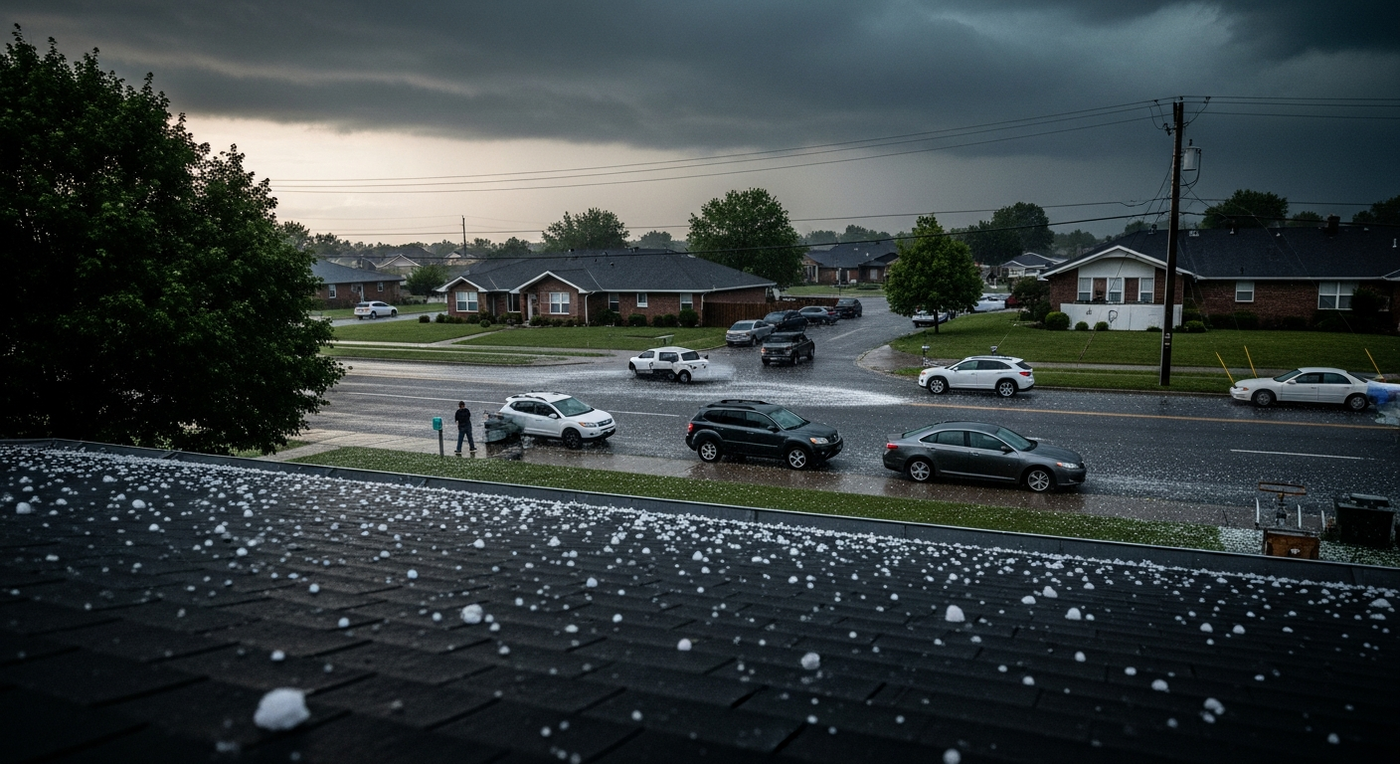
Hail damage follows impact physics, not just gravitational physics. A small hailstone falling vertically strikes a horizontal surface — a roof, a hood — at roughly the speed dictated by its terminal velocity. For stones less than 1 inch in diameter, that's typically between 9 and 25 mph, according to NOAA's National Severe Storms Laboratory. Even quarter-size hail (1 inch, the threshold for severe classification) falls at modest speeds when wind is calm. Roofs are designed to shed water and withstand some perpendicular force; hoods are stamped steel with ribbing underneath. A vertical impact distributes energy across a relatively large contact patch, and the surface yields gradually — a dent forms, but the panel's structural integrity usually holds.
Add 40 mph of horizontal wind, and the same quarter-size stone now strikes the driver's door at a compound velocity. The stone isn't just falling; it's traveling sideways at storm-wind speed while simultaneously descending. The resulting impact vector is no longer perpendicular to the panel — it's oblique, sometimes nearly parallel to the ground. This geometry changes everything. The stone hits edge-first or at a glancing angle, concentrating force on a much smaller contact area. Instead of a smooth dent, you get a crease, a puncture, or a spiderweb of stress fractures in the paint and metal. Worse, the stone often strikes surfaces that were never engineered for lateral impacts: door panels, quarter panels, the nearly-vertical faces of side mirrors and A-pillars.
Wind-driven hail claims routinely run several thousand dollars higher than calm-day hail claims, even when the reported stone size is identical. The difference isn't fraud or exaggeration — it's that angled impacts require panel replacement rather than paintless dent repair, and they damage components (trim, seals, glass edges) that vertical hail leaves untouched.
Here's the part that surprises most people: the worst damage often occurs on the *leeward* side of the vehicle. You'd think the side facing into the wind would take the beating, but supercell outflows create complex turbulence. Hail wraps around the vehicle, and the sheltered side — where stones decelerate and tumble rather than impacting cleanly — experiences chaotic, multi-directional strikes. A single stone might hit the rear quarter panel, ricochet into the taillight assembly, and then scrape down the bumper. That's three separate repair line items from one piece of ice.
The phenomenon scales with storm intensity. A supercell's rotating updraft can be as large as 10 miles in diameter and up to approximately 50,000 feet tall, and the winds feeding that rotation don't shut off when hail starts falling. In fact, the strongest straight-line winds often coincide with the hail core. Derechos — linear wind events typically classified when wind damage extends more than 240 miles and includes gusts of at least 58 mph along most of its length — produce some of the most expensive hail swaths precisely because the sustained horizontal wind component never relents. Every stone falls at an angle. Every impact is oblique.