Editorial Quick Answers

Rental Car Hail Damage: Who Pays, What's Covered, and the Credit Card Trap

Most travelers assume their credit card covers rental car damage, but weather events like hail typically fall into an exclusion that sends you scrambling between your insurer, the rental company, and a benefits administrator who won't return your calls.

Rental Car Hail Damage: Who Pays, What's Covered, and the Credit Card Trap
Hail Protector Editorial / GeminiEditorial

Your Credit Card Probably Won't Cover It

Pull out any major credit card offering rental car coverage and search the benefits guide for "weather" or "act of God." You'll find hail damage explicitly excluded in a majority of policies — typically around 80% based on common policy structures. Chase Sapphire, American Express, and most Visa Signature cards classify hail as an environmental or natural event outside their coverage scope — the same category as flood, earthquake, and windstorm damage.

The exclusion exists because credit card rental coverage functions as secondary collision damage waiver, not comprehensive insurance. It's designed to cover crashes you cause, not things that fall from the sky. When travelers decline the rental counter's insurance assuming their Platinum card has them covered, they're making a bet on weather conditions they haven't checked.
Your Personal Auto Policy Extends — With Asterisks

Most personal auto policies with comprehensive coverage extend to rental vehicles, treating them as temporary substitutes for your own car. If your policy covers hail damage at home (and you haven't selected a comprehensive-only policy without liability), it typically covers hail damage in a rental.

But here's where the process gets messy: you'll file the claim through your own insurer while the rental company simultaneously bills your credit card for the damage estimate. According to Insurance Information Institute guidance, you're dealing with two parallel tracks — your deductible goes to your insurer, while the rental company holds funds until your insurance pays them directly. The settlement can take weeks, during which you're monitoring both your credit card statement and your insurance adjuster's progress.

Some personal policies cap rental car coverage at your vehicle's actual cash value or exclude certain vehicle classes. If your policy covers a 2018 sedan and you're renting a luxury SUV, you may hit coverage limits that leave you exposed.

~80%

%

Cards exclude weather damage

$35-50

/day

Loss of use fees

15-20

days

Body shop wait times

Loss of Use: The Hidden Cost Nobody Expects

The rental company doesn't just charge for repairs. They bill for every day the damaged vehicle sits unavailable for rent — typically called "loss of use" or "loss of revenue." After a hail event, body shops in affected areas back up for weeks. A car needing paintless dent repair might sit in queue for 15-20 days, generating loss of use charges around $35-50 per day depending on vehicle class.

That's typically an additional $525-1,000 on top of repair costs, and it's the charge most likely to catch renters off guard. Your personal auto policy may or may not cover loss of use depending on your state and carrier. Credit card coverage, even when it applies to collision damage, often excludes consequential losses like loss of use entirely.

Enterprise, Hertz, and other major companies calculate loss of use based on their published daily rental rate for that vehicle class, not their actual revenue loss. You can't argue that the car would have sat idle anyway — the charge applies automatically once the vehicle enters their damage workflow.

The Rental Counter Upsell Actually Makes Sense Sometimes

Rental company insurance — the coverage agents push at pickup — typically costs $15-30 per day depending on the provider and coverage tier. For a week-long rental, you're typically looking at $105-210 added to your bill. It feels like a waste when you "already have coverage" through your credit card or personal policy.

But rental company coverage eliminates the deductible, covers loss of use without argument, and resolves everything in a single transaction. No claim filed with your insurer. No impact on your personal policy rates. No credit card hold that takes three weeks to release.

If you're renting during peak hail season — April through June across the Great Plains, or summer months in Colorado and Wyoming — the math shifts. A typical $500 comprehensive deductible plus potential loss of use charges can exceed the cost of the rental company's coverage for trips under two weeks.

Rental car hail Key Questions

What Actually Happens After Hail Hits

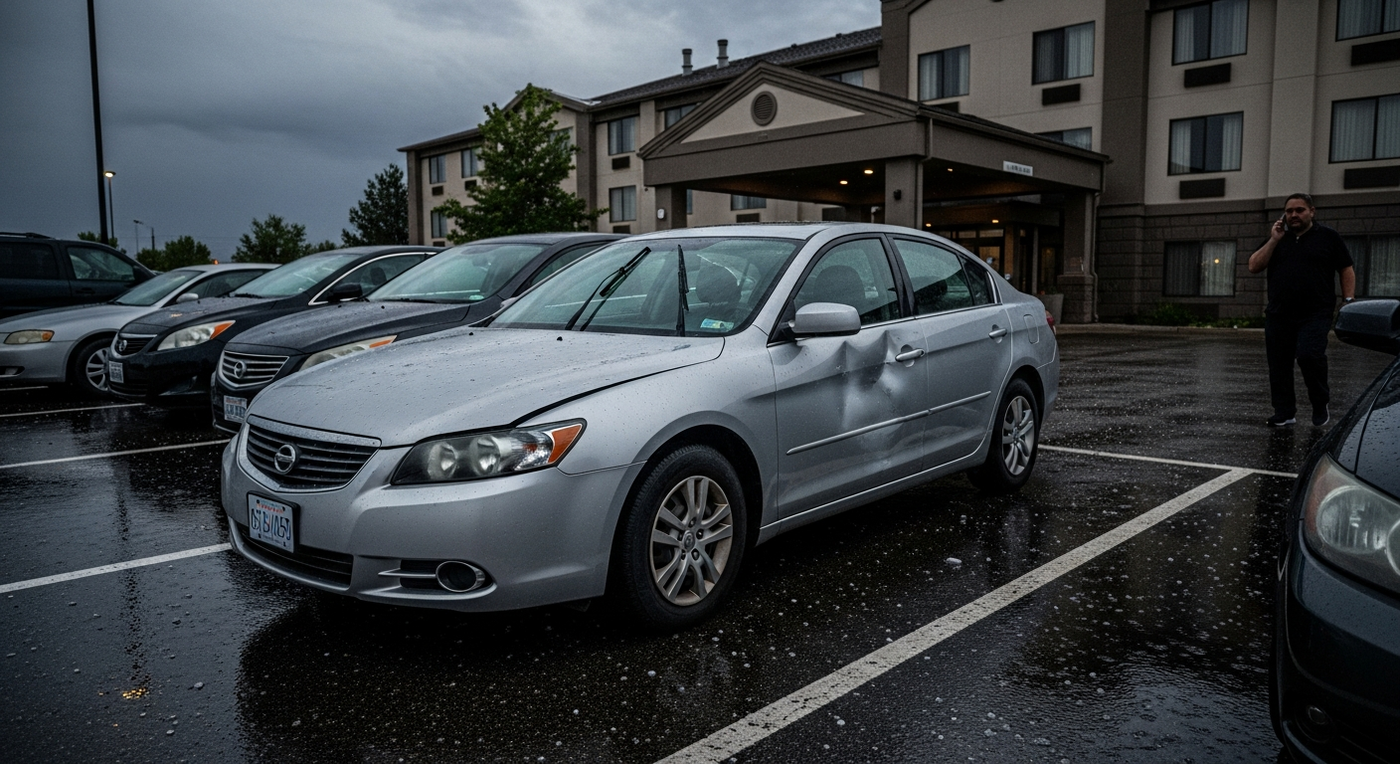
You return to the parking lot and find your rental car dimpled like a golf ball. The rental company inspects the vehicle at return, generates a damage report, and charges your card for their estimated repair cost plus loss of use. This happens immediately — you don't get to file your insurance claim first and wait for resolution.

If you're using personal auto insurance, you'll file a comprehensive claim and provide the rental company's damage estimate to your adjuster. Your insurer will typically pay the rental company directly after subtracting your deductible, which you pay out of pocket. The rental company releases the hold on your credit card once they receive payment, minus any amount your insurance doesn't cover.

If you're relying on credit card coverage that actually applies (rare for hail, but possible for collision), you'll file a claim with the card's benefits administrator — a third-party company that processes these claims. You'll need the rental agreement, damage report, repair estimate, and proof of charges. The administrator reviews everything, determines coverage, and reimburses you directly. This process typically takes 30-60 days.

If you have no coverage — because your credit card excludes weather and you don't have comprehensive on your personal policy — you pay the full amount. The rental company doesn't negotiate.

The Pre-Trip Coverage Audit

Before picking up a rental car, check three things: Does your personal auto policy include comprehensive coverage, and does it extend to rentals? Does your credit card coverage exclude weather events? What's the weather forecast for your destination during your trip?

Most people skip this audit until they're standing at the rental counter making a decision in 30 seconds while other customers wait behind them. By then, you're choosing based on gut feeling rather than actual coverage analysis.

Call your auto insurer and ask specifically: "If a rental car is damaged by hail, does my policy cover repairs and loss of use charges?" Get the answer before you travel. Pull up your credit card benefits guide and search for "hail," "weather," and "act of God." If those terms appear in the exclusions section, your card won't help.

For trips to hail-prone regions during active weather months, the rental company's coverage stops being an upsell and starts being a known cost of doing business. You're not buying insurance against an unlikely event — you're buying certainty about who handles the problem if it happens.

Verified Sources

  1. NOAA Storm Prediction Center

    NOAA Storm Prediction Center

    hail climatology and seasonal patterns

  2. Insurance Information Institute

    Insurance Information Institute

    rental car insurance coverage options and how personal auto policies extend to rentals

  3. NOAA National Centers for Environmental Information

    NOAA National Centers for Environmental Information

    severe weather tracking and regional hail data

Back to Storm Prep