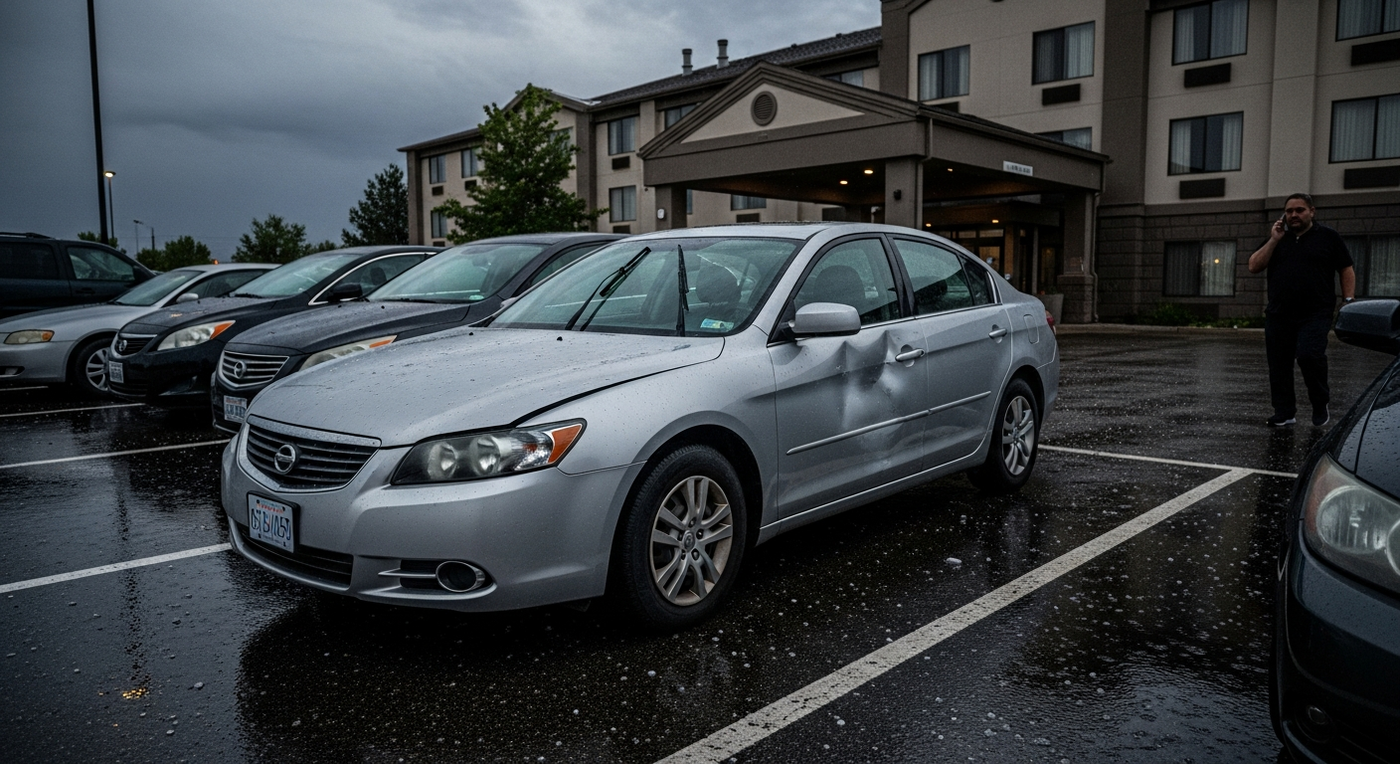
Regional Report Colorado Hail Report

The Northeast Corridor: Mapping Denver's Hail Damage Hot Zones by Neighborhood

Denver metro hail claims follow a diagonal stripe from Lakewood through downtown to Commerce City—the same path afternoon thunderstorms trace as they roll off the foothills.

The Northeast Corridor: Mapping Denver's Hail Damage Hot Zones by Neighborhood
Hail Protector Editorial / GeminiRegional Report

The I-25 Diagonal: Where Claims Concentrate

Pull up a decade of homeowners insurance claims data for the Denver metro area and a pattern emerges immediately: hail damage doesn't distribute evenly across the Front Range. Instead, claims cluster along a northeast-trending corridor that runs from west Lakewood through central Denver, then continues through Aurora and into Commerce City. This isn't random. It's the path most afternoon thunderstorms follow as they develop over the foothills, drift east-northeast with prevailing upper-level winds, and intensify over the urban heat island.

Neighborhoods along this corridor—Sloan's Lake, Highland, Five Points, Park Hill, Stapleton, and northeast Aurora—appear repeatedly in high-claim years. According to Insurance Information Institute data, Colorado consistently ranks among the top three states for hail claim frequency, and within Colorado, the Denver metro accounts for a substantial portion of all reported events.

Northern Suburbs: Sitting in the Strike Zone

Westminster, Thornton, Northgllen, and Brighton occupy what meteorologists call the "sweet spot"—the zone directly downwind of where storms typically initiate along the Palmer Divide and Rampart Range. These northern suburbs don't just see frequent hail; they see it earlier in the storm lifecycle, often between 2 and 5 PM when convection first fires.

These neighborhoods file hail claims at rates typically around 20-30% higher than the metro average during active hail seasons. The geography works against them: storms forming over the foothills gain strength as they move northeast, and the northern suburbs sit squarely in that intensification zone. By the time a storm cell reaches Thornton or Westminster, it's had approximately fifteen to twenty miles to organize, develop rotation, and build the updraft strength needed to produce golf ball-sized hail or larger.

Commerce City and northeast Aurora extend this high-frequency zone even further east. These areas catch both the initial wave of afternoon storms and the secondary pulse that sometimes develops as cells interact with the South Platte River valley's moisture gradient.

The Southern Exception: Fewer Storms, Bigger Hail

Centennial, Highlands Ranch, Castle Rock, and Parker tell a different story. These southern suburbs see hail less frequently—sometimes going two or three seasons without a major event—but when storms do reach them, they tend to arrive as mature supercells.

Here's what most people get wrong: they assume southern neighborhoods are "safer" because they see fewer hailstorms. The data doesn't support that conclusion. While claim frequency runs lower, average claim severity runs higher. A supercell that's traveled roughly forty miles from its initiation point has had time to develop the kind of persistent rotation and powerful updrafts that produce baseball-sized hail. When Highlands Ranch gets hit, it gets hit hard.

The NOAA Storm Events Database shows this pattern clearly: southern metro neighborhoods might report several fewer hail days per decade than northern suburbs, but those events disproportionately involve hail larger than two inches in diameter.

50%

%

Metro claims statewide

20-30%

%

Higher northern suburb rates

15-25%

%

Annual claim probability

Lakewood and West Metro: The Entry Point

Lakewood, Wheat Ridge, and Arvada sit at the beginning of the damage corridor. Storms crossing these neighborhoods are often still organizing, which creates an interesting dynamic: hail size tends to be smaller (typically pea to quarter-sized), but storm frequency runs high because nearly every afternoon system that develops over the foothills passes through this zone.

The result is a different claims profile. West metro homeowners file more frequent claims for moderate damage—dented gutters, cracked roof tiles, pockmarked siding—rather than the catastrophic roof replacements common in northern suburbs. Insurance adjusters know this pattern well: a Lakewood claim might involve replacing several dozen roof tiles; a Thornton claim from the same storm system often means a full roof tearoff.

Green Mountain and the western edge of Lakewood see slightly different patterns because of elevation. Neighborhoods above approximately 5,800 feet sometimes experience smaller hail or even rain as storms are still in their developmental phase.

Downtown and Central Denver: The Urban Heat Island Effect

Central Denver—Capitol Hill, Cherry Creek, Washington Park, City Park—occupies the middle of the damage corridor but with a twist. The urban heat island intensifies afternoon convection, sometimes causing storms to pulse stronger as they cross the metro core. Surface temperatures in downtown Denver can run roughly 5-10 degrees warmer than surrounding areas on summer afternoons, and that temperature differential feeds back into storm dynamics.

Neighborhoods immediately east of downtown—Park Hill, Stapleton, Montbello—consistently rank among the highest claim areas in the entire metro. They catch storms that have been supercharged by the urban heat island and are moving into the open terrain east of the city where nothing disrupts updraft development.

One surprising detail: Cherry Creek and Glendale sometimes experience more intense hail than neighborhoods just a mile north or south. Meteorologists suspect this relates to how storms interact with the Cherry Creek valley's topography, though the mechanism isn't fully understood.

The I-25 Diagonal: Where Claims Concentrate

Aurora: The Full Spectrum

Aurora stretches far enough east-west that it experiences nearly every hail pattern the metro produces. West Aurora sees frequent moderate events. Central Aurora (around Buckley Space Force Base) sits in the high-frequency corridor. East Aurora catches mature supercells as they drift onto the plains.

According to local insurance agents, Aurora generates more hail claims than any other single municipality in the metro area—not because any one neighborhood is particularly vulnerable, but because the city's geography spans the entire damage gradient. A storm that drops quarter-sized hail in west Aurora might produce golf balls in Stapleton and baseballs by the time it reaches Watkins.

The E-470 corridor marks a rough eastern boundary for the highest-frequency zone. Beyond that line, claim frequency drops noticeably, though severe events still occur.

Elevation and Microclimates

Elevation matters more than most homeowners realize. Neighborhoods above approximately 6,000 feet—parts of Castle Rock, Ken Caryl, and the western edge of Littleton—sometimes escape hail entirely during events that hammer lower elevations. Storms need specific temperature and moisture profiles to produce large hail, and those conditions don't always extend to higher elevations.

Conversely, some microclimates seem to attract hail. Insurance adjusters have noted that certain subdivisions in Thornton and Commerce City appear in claims data far more often than neighboring areas at the same elevation. The reasons aren't always clear—possibly local wind patterns, possibly coincidence over small sample sizes—but the pattern persists across multiple hail seasons.

What the Pattern Means for Homeowners

If you live along the northeast corridor from Lakewood through Commerce City, hail isn't a question of "if" but "when." Homeowners in these zones face an estimated 15-25% chance of filing a hail claim in any given year during active hail cycles. That probability compounds over time: across a typical 30-year mortgage period, the odds of experiencing at least one significant hail event are substantial.

Northern suburbs should budget for hail as a recurring expense, not an unlikely disaster. Southern suburbs face the opposite calculation—lower frequency but potentially catastrophic severity when events do occur.

The damage corridor has remained remarkably stable over decades of observation. Afternoon storm tracks don't shift much year to year because they're driven by consistent geographic and atmospheric factors: the Palmer Divide's topography, prevailing westerly winds aloft, and the Front Range's role in triggering convection. Until those fundamental factors change, the northeast corridor will continue concentrating Denver's hail claims.

Verified Sources

  1. NOAA National Centers for Environmental Information

    NOAA National Centers for Environmental Information

    Storm Events Database showing hail size and location data for the Denver metro area

  2. NOAA Storm Prediction Center

    NOAA Storm Prediction Center

    Official convective outlook archive and risk categories.

  3. NOAA Storm Prediction Center

    NOAA Storm Prediction Center

    Storm report archive with severe hail event records.

  4. Insurance Information Institute

    Insurance Information Institute

    Colorado hail claim frequency and national rankings

Back to Storm Prep