Explainer Deep Dive

A Two-Inch Steel Ball Falls Twenty Feet: Why Your Roof Has a Hail Rating and Your Car Doesn't

Building codes mandate impact testing for roofing materials using standardized steel balls, while automotive panels have no hail resistance standards at all — a divergence that reveals fundamentally different philosophies about who pays for storm damage.

A Two-Inch Steel Ball Falls Twenty Feet: Why Your Roof Has a Hail Rating and Your Car Doesn't
Hail Protector Editorial / GeminiExplainer

10-35

%

Insurance discount for Class 4

600,000-700,000

claims

Annual vehicle hail claims

2

inches

Steel ball diameter tested

$10-15

per year

Hail cost per auto premium

The Four Classes and What They Actually Mean

The UL 2218 standard divides impact resistance into four classes, each corresponding to a different steel ball size dropped from specific heights. Class 1 withstands a 1.25-inch ball dropped from 12 feet. Class 2 survives a 1.5-inch ball from 15 feet. Class 3 handles a 1.75-inch ball from 17 feet. Class 4 — the designation that matters for insurance discounts and building codes — means the material survives that two-inch ball from twenty feet, twice.

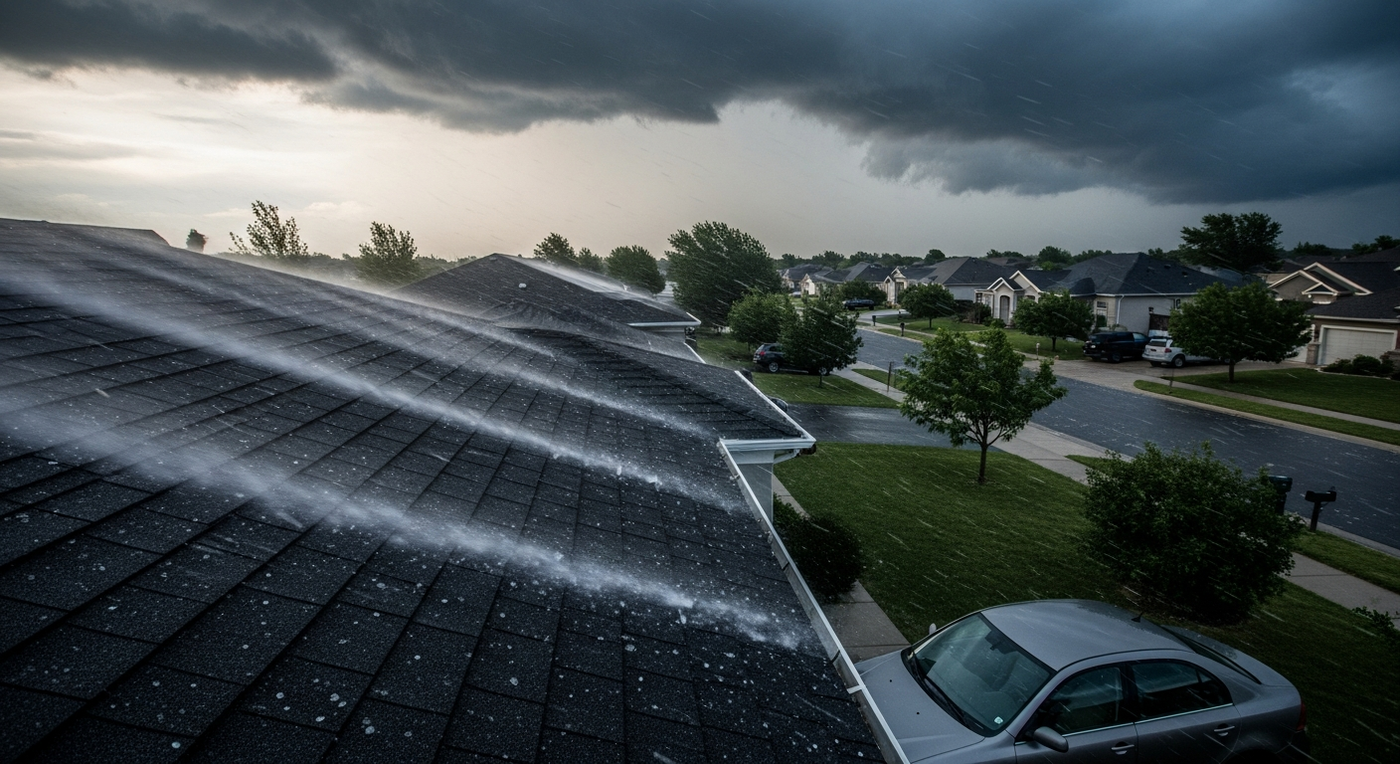
The test mimics hailstone impact, though imperfectly. Real hailstones aren't steel spheres, and they don't fall straight down at terminal velocity in controlled conditions. They tumble, spin, and arrive at angles during storms with horizontal wind components. A two-inch steel ball approximates the kinetic energy of roughly a two-inch hailstone, but hail density varies with atmospheric conditions, and shape matters more than the test accounts for. Still, the standardization allows meaningful comparisons. A Class 4 asphalt shingle demonstrably outperforms a Class 3 shingle when actual hail arrives.

Insurance companies noticed. Carriers in hail-belt states now offer premium discounts typically ranging from 10% to 35% for Class 4 roofing, with some Texas insurers reaching the upper end of that range, according to Insurance Information Institute data. The discounts aren't altruism — they're actuarial math. Class 4 roofs generate fewer claims. In Colorado, some insurers won't write new homeowner policies without Class 4 roofing in designated high-risk zones.

Building codes followed the insurance incentives. The International Residential Code doesn't mandate Class 4 roofing nationally, but states and municipalities overlay their own requirements. Parts of Texas, Oklahoma, and Colorado now require impact-resistant roofing for new construction or major roof replacements in hail-prone areas. The requirements typically apply to roofing first, sometimes extending to skylights and siding, creating a tiered system where the most exposed building components face the strictest standards.

Here's what surprises people: Class 4 doesn't mean hail-proof. It means the material survived a specific laboratory test. A three-inch hailstone carries far more energy than the two-inch steel ball in the UL 2218 test. Class 4 shingles still crack, dent, and fail under severe hail — they just fail less often than Class 1, 2, or 3 materials. The rating represents a threshold of resilience, not invulnerability.
Why Cars Live Outside the Testing Regime

Automotive sheet metal faces no equivalent standard because the industry made a different calculation decades ago: hail damage is an insurance problem, not an engineering problem.

Vehicle manufacturers design body panels for crash safety, aerodynamics, manufacturing efficiency, and aesthetics. Federal Motor Vehicle Safety Standards govern how cars perform in collisions with other vehicles, pedestrians, and fixed objects. Roof crush resistance standards exist to protect occupants during rollovers. But nothing in the regulatory framework addresses hail impact. The National Highway Traffic Safety Administration standards contain hundreds of pages on crashworthiness and zero sentences on storm resilience.

The philosophical difference runs deeper than regulation. Buildings stay put. A house in Lubbock, Texas will spend decades in Hail Alley, experiencing the same statistical storm risk year after year. The homeowner can't move the structure to a garage during severe weather. Impact-resistant roofing makes actuarial sense because the exposure is permanent and predictable.

Cars move. They're garaged, parked under cover, driven to different climates. A vehicle sold in Phoenix might spend its entire service life in a low-hail-risk environment, while an identical model sold in Oklahoma City faces annual severe storm exposure. Manufacturers build vehicles for a national market, not regional hail patterns. Designing every car to withstand hail impacts would add cost and weight to vehicles that might never see a hailstone.

More importantly, comprehensive insurance exists specifically to cover hail damage to vehicles. The insurance industry absorbed automotive hail risk decades ago, building it into premium structures rather than pushing manufacturers to engineer around it. When hail damages a car, the owner files a claim, pays a deductible, and the insurer covers repair costs. The system works — not efficiently, not cheaply, but predictably. Approximately 600,000 to 700,000 automotive hail claims occur annually in the United States, yet no sustained pressure has emerged to create impact-resistance standards for vehicles.

The absence of standards also reflects repair economics. Hail-damaged roofs often require complete replacement, a major expense that impact-resistant materials can prevent. Hail-damaged vehicles usually undergo paintless dent repair, a relatively affordable process where technicians massage dents from behind body panels without repainting. A typical hail repair bill for a vehicle runs several thousand dollars — expensive for an individual owner, manageable for an insurance pool. The cost-benefit calculation for engineering hail-resistant automotive panels doesn't close the way it does for roofing.

Some manufacturers have experimented with more hail-resistant materials. Certain pickup trucks use aluminum body panels that dent less easily than traditional steel, though the motivation was weight reduction for fuel efficiency rather than hail protection. Composite materials and advanced high-strength steels could theoretically improve hail resistance, but they'd increase manufacturing costs without providing a marketable benefit — few buyers select vehicles based on hail resilience, and no insurance discount exists for hail-resistant cars the way it does for Class 4 roofs.

The Asymmetry and What It Costs

This creates a strange asymmetry in hail country. A homeowner in Moore, Oklahoma might install a Class 4 roof, impact-resistant siding, and laminated hail-resistant skylights, fortifying the structure against storm damage while their two vehicles sit in the driveway with standard sheet metal panels, completely vulnerable. The house earns an insurance discount. The cars don't, even though they represent comparable asset values and face the same hailstorms.

The total cost of this asymmetry is substantial but diffuse. Automotive hail damage adds an estimated $10 to $15 to every comprehensive insurance premium annually in the United States, spreading the cost of hail claims across the entire insured vehicle pool. In hail-belt states, the cross-subsidy is more pronounced — drivers in low-risk areas effectively subsidize repairs for drivers in high-risk areas, since most insurers don't price comprehensive coverage with the same geographic granularity they use for collision or liability.

Homeowner insurance, by contrast, has become intensely granular about hail risk. Premiums in hail-prone ZIP codes can run double or triple the rates in nearby low-risk areas, and the Class 4 roofing discount provides a mechanism for individual homeowners to reduce their premiums through risk mitigation. No such mechanism exists for vehicles. You can't install a Class 4 hood and earn a discount, because no Class 4 hood exists.

Some fleet operators have quietly developed their own hail strategies. Rental car companies track severe weather and relocate vehicles away from predicted hail paths when economically feasible. Dealerships in hail-belt states sometimes invest in protective hail netting systems for outdoor inventory. But these are operational responses, not engineering solutions. The vehicles themselves remain as vulnerable as ever.

The question isn't whether automotive hail standards will emerge — the industry has had decades to develop them and hasn't — but whether the current system's costs will eventually exceed its benefits. As severe hail events potentially increase in frequency or intensity with changing climate patterns, and as vehicle values continue rising, the substantial annual automotive hail claims might eventually justify the engineering investment that roofing underwent twenty years ago.

For now, the steel ball drops in roofing laboratories, the shingles crack or hold, and the ratings get printed on packaging. Meanwhile, cars sit outside, unrated and untested, waiting for the next storm.

Verified Sources

  1. Underwriters Laboratories

    Underwriters Laboratories

    UL 2218 impact resistance testing standards

  2. Insurance Information Institute

    Insurance Information Institute

    hail damage statistics and insurance discount ranges

  3. codes.iccsafe.org

    codes.iccsafe.org

    Referenced in article via codes.iccsafe.org.

  4. nhtsa.gov

    nhtsa.gov

    Referenced in article via nhtsa.gov.

Back to Hail Science