Explainer Deep Dive

Hail Isn't Frozen Rain — It's a Recycling Accident Inside Thunderstorms

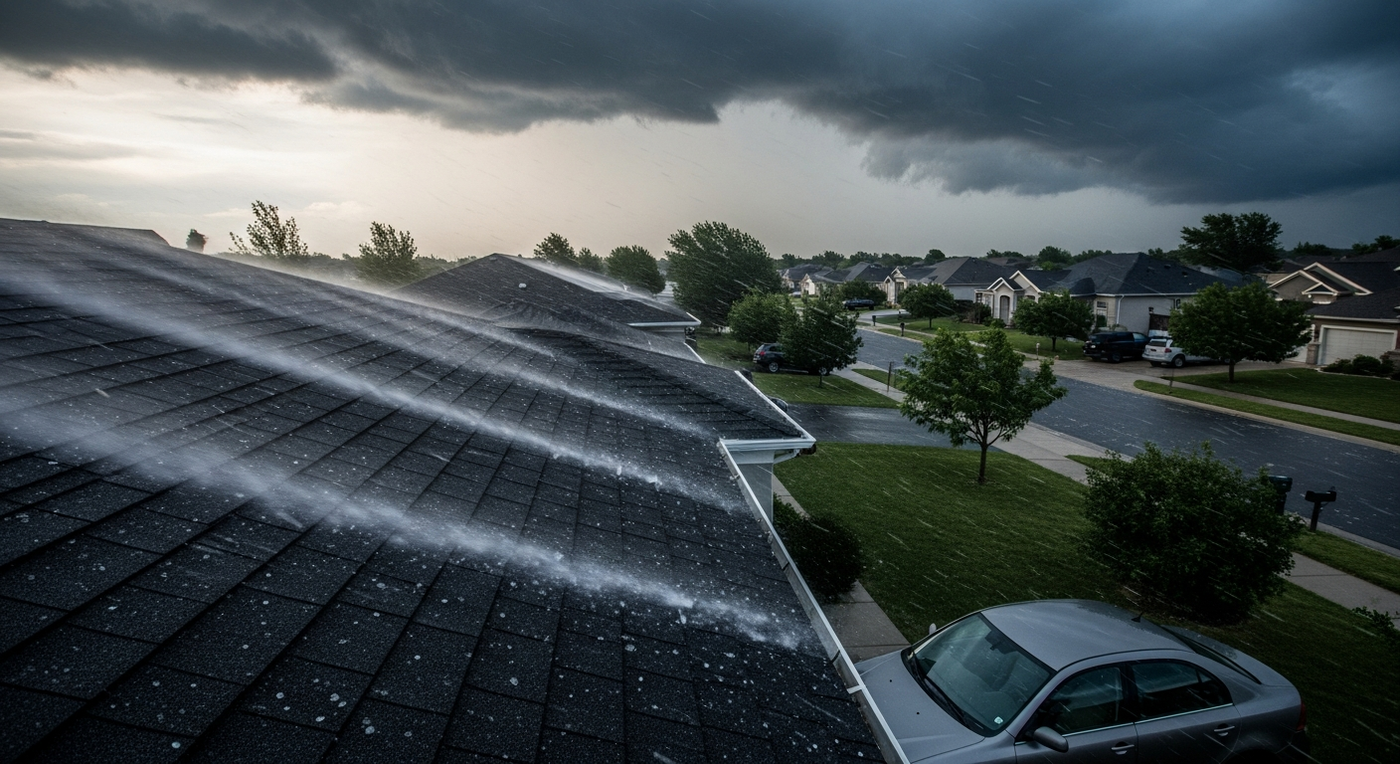
Ice stones form when updrafts repeatedly throw raindrops back into freezing air, building layers like an onion until gravity wins.

Hail Isn't Frozen Rain — It's a Recycling Accident Inside Thunderstorms
Hail Protector Editorial / GeminiExplainer

The Violent Birth of a Hailstone

On May 22, 2011, a hailstone the size of a volleyball fell on Vivian, South Dakota. It measured eight inches in diameter and weighed nearly two pounds. This wasn't frozen rain that happened to get large — it was a piece of ice that spent an estimated ten minutes cycling through a thunderstorm's interior, riding updrafts that exceeded 100 mph, accumulating frozen layers with each trip through the cloud.

Most people assume hail forms the way icicles do: water freezes, gets heavy, falls down. The actual process is far stranger. Hailstones are built by violence, not cold. They require specific atmospheric machinery that has nothing to do with winter and everything to do with the chaotic energy inside severe thunderstorms.

If you've ever filed an auto insurance claim for hail damage, you were paying for the consequences of atmospheric physics that turned water droplets into projectiles. Understanding how that happens explains why your car is most vulnerable in April and May, not January — and why some storms produce pea-sized nuisances while others drop ice capable of totaling vehicles.

Why Updrafts Matter More Than Temperature

Hail requires three ingredients: supercooled water droplets (liquid water that exists below 32°F without freezing), strong updrafts, and time. The updraft is the engine. Without it, you just get rain or sleet.

Inside a mature thunderstorm, warm air rushes upward at speeds that would knock you off your feet. According to NOAA's National Severe Storms Laboratory, updrafts in supercell thunderstorms — the rotating storms that produce the largest hail — can exceed 100 mph. These updrafts carry raindrops upward into subfreezing air, where they freeze into tiny ice pellets called embryos.

Here's where the recycling begins. The embryo falls back down through the cloud, colliding with supercooled water droplets that freeze onto its surface, adding a layer of ice. But before it falls out of the cloud entirely, the updraft catches it and throws it back up into the freezing zone. Another layer forms. The hailstone falls again, gets caught again, accumulates another layer. This cycle repeats until the stone becomes too heavy for even a 100-mph updraft to support, at which point gravity wins and the hailstone falls to the ground.

If you cut a large hailstone in half, you'd see concentric rings of ice — clear layers alternating with opaque ones — like tree rings documenting each trip through the storm. The number of layers tells you how many times the stone was recycled. The Vivian, South Dakota stone had dozens.

8

inches

Vivian, SD record stone

100+

mph

Supercell updraft velocity

$1

billion

Annual US hail losses

1

inch

Auto damage threshold size

Spring Storms Build Bigger Stones Than Winter Ever Could

This is why hail season peaks in spring and early summer, not winter.

The strongest updrafts form when there's a sharp contrast between warm, moist air near the surface and cold, dry air aloft. Spring provides this contrast. In May across the Great Plains, you might have temperatures around 80°F at the surface with subfreezing air just a few thousand feet up. That temperature gradient creates instability — the atmosphere wants to mix, and it does so violently, generating the powerful updrafts that build hailstones.

Winter lacks this energy. Cold air sits on top of cold air. The atmosphere is stable. Thunderstorms are rare. You might get sleet (frozen raindrops that form when rain falls through a shallow layer of freezing air), but you won't get the sustained updrafts necessary to recycle ice embryos into destructive stones.

According to Storm Prediction Center climatology data, the central United States sees its highest frequency of large hail reports from April through June. Colorado's "hail alley" along the Front Range experiences peak activity in May. Texas sees maximums in April and May. These patterns track atmospheric instability, not calendar winter.

Why Some Hailstones Grow Enormous

The size of a hailstone depends on two factors: how long it stays inside the updraft and how much supercooled water it encounters during each cycle.

Stronger updrafts support larger stones. An updraft of approximately 60 mph might suspend a golf ball–sized stone. A 100-mph updraft can support a baseball. The longest-lived supercells — storms that maintain organized rotation for hours — produce the largest hail because their updrafts remain strong and stable, giving embryos more time to accumulate mass.

The availability of supercooled water matters too. Storms forming in very moist environments have more raw material to work with. Each pass through the cloud adds more ice. Dry storms produce smaller hail, if they produce any at all.

Here's the counterintuitive part: hail can fall when surface temperatures exceed 90°F. I've seen hail reports from Phoenix in July, from Dallas in August. The surface temperature is irrelevant. What matters is the temperature five miles up, where the hailstone is forming. As long as the upper atmosphere is cold enough and the updraft is strong enough, hail can fall through hot air and reach the ground before melting completely. Smaller stones melt in transit, which is why intense storms sometimes produce hail at the storm's core but only rain a mile away — the small stones melted before landing.

What This Means for Your Car

Auto insurers pay attention to hail formation because it determines damage patterns. Hail doesn't fall randomly — it falls from specific storm types in specific seasons in specific regions.

Supercell thunderstorms produce the most damaging hail. These are rotating storms with persistent updrafts, often the same storms that produce tornadoes. They move slowly, sometimes parking over an area for 20 to 30 minutes, dropping continuous hail. A single supercell passing over a parking lot can generate thousands of insurance claims.

Hail swaths — the ground path where hail accumulates — are typically narrow, often just a few miles wide, but they can extend for dozens of miles. This is why hail damage is so localized. Your neighbor three blocks away might see nothing while your car looks like it was hit with ball-peen hammers. The storm's internal structure determined where the largest stones fell, and you happened to be underneath that column.

The size threshold that typically matters for auto damage is roughly one inch in diameter — about quarter-sized. Anything smaller typically bounces off without leaving dents. Stones between one and two inches (quarter to golf ball) typically dent hoods, roofs, and trunk lids. Above two inches, you're typically looking at broken glass, cracked windshields, and potential total losses on older vehicles. According to Insurance Information Institute data, hail causes more than $1 billion in property damage annually in the United States, with auto claims representing the majority of losses.

The Forecasting Problem

Meteorologists can predict when conditions favor hail formation — instability, moisture, strong upper-level winds — but predicting exactly where individual hailstones will fall remains difficult.

Radar can detect hail inside storms by measuring the size and density of precipitation particles. The "hail spike" — a radar signature showing extremely high reflectivity — indicates large hail aloft. But radar tells you what's happening now, not what will happen in ten minutes when the storm moves. By the time you see the warning, the hail may already be falling.

This is why hail causes so much auto damage despite advance warnings. You can know a severe thunderstorm is approaching. You can know it's capable of producing large hail. But you often can't know whether your specific parking lot will be in the damage path until the hail is already hitting your windshield. The difference between no damage and several thousand dollars in repairs can be two blocks.

A Recycling System That Builds Projectiles

The key insight is that hail isn't a temperature phenomenon — it's a momentum phenomenon. Hailstones form because updrafts are strong enough to defeat gravity, repeatedly, giving ice time to accumulate mass. The process is less like freezing and more like construction, with each updraft cycle adding another layer to the structure.

This is why the most destructive hail falls from the most organized storms during the most unstable atmospheric conditions, which occur in spring and early summer when temperature contrasts are sharpest. Winter is too stable. Late summer loses the temperature gradient. Spring is the sweet spot where atmospheric violence peaks.

Your car is vulnerable not because of cold weather, but because of the specific physics that turn water droplets into ice projectiles inside thunderstorms. Understanding that process won't prevent damage, but it explains why hail season exists, why it's geographically concentrated, and why a storm that produces gentle rain two miles away can total a parking lot full of vehicles where the updraft happened to be strongest.

The next time you see a severe thunderstorm warning mentioning "hail up to two inches in diameter," you're reading a forecast about updraft strength and atmospheric instability, not a weather report about frozen rain. Those stones were built by a recycling system inside the cloud, thrown upward dozens of times, accumulating ice with each trip, until they became too heavy to lift. Then they fell — and whether they hit your car or your neighbor's was determined by winds, storm motion, and physics you can't control.

Verified Sources

  1. NOAA Storm Prediction Center

    NOAA Storm Prediction Center

    Storm report archive with severe hail event records.

  2. nssl.noaa.gov

    nssl.noaa.gov

    Referenced in article via nssl.noaa.gov.

  3. spc.noaa.gov

    spc.noaa.gov

    Referenced in article via spc.noaa.gov.

  4. iii.org

    iii.org

    Referenced in article via iii.org.

Back to Hail Science