The Wichita Problem
Wichita's location makes it a case study in how urban development and meteorology intersect badly. The city sits in what meteorologists call the warm sector—the region of warm, moist air ahead of a cold front where discrete supercells most commonly form. These aren't squall lines or messy complexes. They're isolated rotating thunderstorms with textbook structure: a well-defined updraft, a clear rear-flank downdraft, and a hail core that can remain stationary relative to the storm's movement for extended periods.
The city's position roughly 140 miles north of the Oklahoma border puts it in the sweet spot where dryline storms that form in the Texas or Oklahoma Panhandle have had just enough time to mature but haven't yet encountered the slightly more stable air masses farther north. Spring storms tracking northeast often pass directly over the Wichita metro area during their peak intensity window—typically between 5 PM and 9 PM, when the afternoon heating has maximized but the nocturnal stabilization hasn't yet begun.
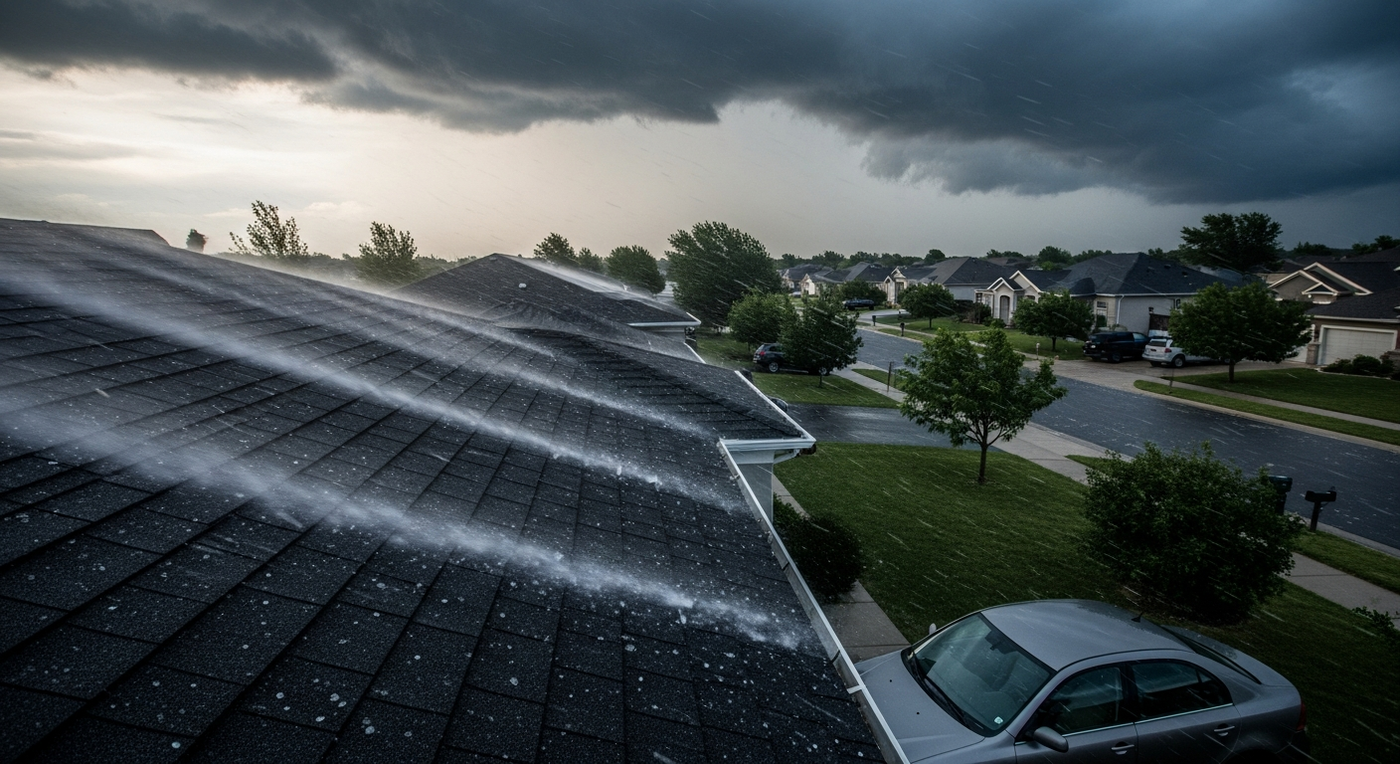
What makes this particularly expensive is that Wichita has roughly 390,000 people and a substantial automotive manufacturing presence, which means both a high density of insured vehicles and a concentration of inventory sitting on dealer lots. A single hail event in May 2019 caused an estimated several hundred million dollars in insured losses across the metro area, according to NOAA National Centers for Environmental Information, with some dealerships reporting damage to hundreds of vehicles within minutes. The flat terrain meant the storm maintained its intensity all the way through the urban core—there was no weakening as it approached, no terrain feature to disrupt the updraft, just a fully mature supercell tracking directly over the most densely populated area in Kansas.
The agricultural community experiences the same storms but processes the damage differently. A wheat farmer in Reno County watching the same supercell approach faces a different calculation. Crop-hail insurance operates on different principles than auto or homeowner policies, with premiums that typically run several percent of the crop's expected value and coverage that typically pays out based on percentage of crop destroyed. According to USDA Risk Management Agency data, hail claims in Kansas wheat country follow a predictable pattern: most damage occurs in a roughly six-week window from late May through early July, when the wheat is heading out but hasn't yet been harvested. A storm that would total a car might reduce a wheat yield by approximately 30-40%, which sounds less catastrophic until you're the farmer who just lost a third of the year's income in fifteen minutes.
Here's what most people get wrong about agricultural hail damage: it's not the size of the hailstones that matters most, it's the duration of the hail fall and the growth stage of the crop. Wheat can survive brief exposure to inch-diameter hail if the storm moves through quickly. But a slow-moving supercell dropping marginally severe hail (three-quarters of an inch to one inch) for 20 or 30 minutes will shred the crop just as effectively. The flat terrain contributes to this problem because storms don't accelerate or decelerate as they cross terrain features—they maintain whatever forward speed they established when they formed, which in Kansas is often frustratingly slow, typically around 15-25 mph.