Explainer Deep Dive

The Hail Belt: Why the Great Plains Get Hammered by Ice More Than Anywhere Else on Earth

A unique collision of geography, moisture, and altitude creates the world's most concentrated hail zone across America's midsection.

The Hail Belt: Why the Great Plains Get Hammered by Ice More Than Anywhere Else on Earth
Hail Protector Editorial / GeminiExplainer

The Three-Ingredient Recipe

Hail requires three specific conditions arriving simultaneously at the same location: abundant low-level moisture, extreme atmospheric instability, and strong wind shear that keeps storms rotating long enough to cycle ice particles through multiple freeze-thaw loops. The Great Plains is the only place on Earth where all three ingredients converge with clockwork regularity every spring and summer.

Start with moisture. The Gulf of Mexico sits roughly 1,000 miles south of Kansas, close enough that southerly winds can pump tropical humidity northward in a matter of hours. This moisture doesn't just arrive — it floods the lower atmosphere. Dewpoints in the 60s and 70s Fahrenheit become common across Oklahoma and Kansas during late spring, creating the kind of atmospheric fuel that powers explosive thunderstorm development. Without an intervening mountain range to wring out this moisture, Gulf air flows unimpeded across flat terrain all the way to the Canadian border.

Now add mountains, but only on one side. The Rocky Mountain chain sits immediately west of the Plains, rising abruptly from elevations around 3,000 feet to peaks above 14,000 feet. Air descending the eastern slopes of the Rockies arrives dry and warm, creating what meteorologists call a dryline — a sharp boundary between humid air from the Gulf and arid air from the mountain rain shadow. This boundary doesn't sit still. It oscillates east and west across the Plains like a slow pendulum, and where it intersects with Gulf moisture, the atmospheric instability becomes extreme. Temperature differences across the dryline can exceed 20 degrees Fahrenheit within a few miles.

The third ingredient comes from above. The jet stream — a river of high-altitude wind circling the Northern Hemisphere — dips southward over the Rockies during spring before arcing northeast across the Plains. This pattern creates powerful wind shear, where winds at ground level blow from the south while winds at 30,000 feet scream from the west. Thunderstorms that develop in this environment don't just grow tall — they begin rotating. These supercell thunderstorms can sustain themselves for hours, cycling hailstones through multiple trips up and down within the storm before finally releasing them.

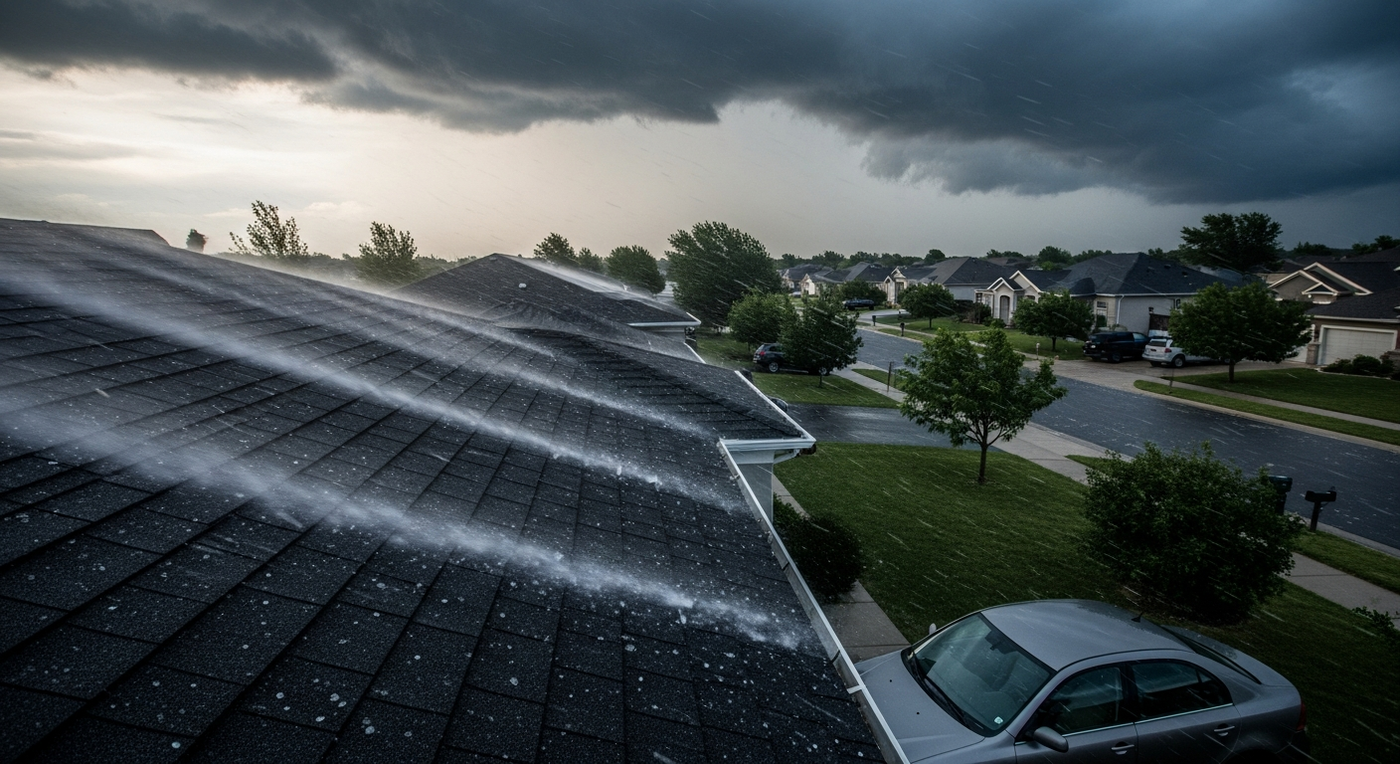
Here's what most people get wrong: they assume hail forms when rain freezes on the way down. It doesn't. Hailstones begin as small ice particles in the upper reaches of a thunderstorm, then fall into the updraft — the column of rising air that feeds the storm. The updraft blasts them back upward, where they collect another layer of ice. Fall, rise, freeze, repeat. The stronger the updraft, the larger the hailstone can grow before the updraft can no longer support its weight. Supercells over the Great Plains can generate updrafts exceeding 100 miles per hour. That's enough to suspend a baseball-sized chunk of ice long enough for it to add multiple concentric layers, like an atmospheric jawbreaker.
8

inches

Vivian, SD record hailstone

7-9

days/year

Annual hail events, NE Colorado

100+

mph

Supercell updraft velocities

1,400

reports

Single month, spring 2011

Why Nowhere Else Comes Close

Other continents have mountains. Other continents have moisture sources. But no other continent arranges them in this specific configuration.

South America's Andes run north-south along the western edge of the continent, similar to the Rockies. Argentina's pampas region sits east of the mountains and does experience significant hail, particularly in the provinces of Córdoba and Mendoza. But South America lacks a comparable moisture source positioned to the southeast. The Atlantic Ocean sits too far east, and the moisture it provides arrives less reliably. The jet stream over South America follows different patterns, rarely creating the same persistent wind shear that characterizes Great Plains springs.

Australia's hail events concentrate along the eastern coast and the ranges inland from Sydney and Brisbane. The region sees damaging hailstorms — a 1999 Sydney hailstorm caused an estimated $1.5 billion in insurance claims. But Australian hail remains episodic rather than systematic. The continent lacks a north-south mountain barrier on the scale of the Rockies, and its interior desert provides dry air without the same organized dryline dynamics. Moisture from the Coral Sea and Tasman Sea fuels storms, but the wind shear patterns don't create the same supercell frequency.

Europe's geography works against hail production entirely. The Alps run east-west rather than north-south, and the Mediterranean provides moisture from the south rather than southeast. The jet stream over Europe typically flows west to east without the same southward dip and northeastward arc that characterizes the North American pattern. Severe hailstorms occur — Italy's Po Valley and parts of southern France see damaging events — but the annual frequency remains a fraction of what the Great Plains experiences.

Asia's Tibetan Plateau sits too far inland and too far north to interact with tropical moisture the way the Rockies interact with the Gulf. China experiences severe thunderstorms and hail, particularly in the eastern provinces, but the events scatter across a vast geography rather than concentrating in a defined belt.

The Great Plains hail belt exists because the Gulf of Mexico sits at approximately 25-30 degrees north latitude, the Rockies rise abruptly at roughly 105 degrees west longitude, and the jet stream's spring position creates a zone where these elements intersect. Move any one element — shift the mountains hundreds of miles east, move the Gulf hundreds of miles west, change the jet stream's typical path — and the hail belt would likely disappear.

The Belt Shifts and Expands

The hail belt isn't a fixed boundary drawn on a map.

Year to year, the zone of maximum hail activity shifts east or west depending on where the jet stream sets up camp for the season. During springs when the jet stream remains farther west, the dryline stays pinned near the Rockies, and hail activity concentrates in eastern Colorado and western Kansas. When the jet shifts east, the dryline pushes into central Kansas and Oklahoma, and the hail maximum moves with it. Individual storms can drop hail anywhere from New Mexico to Minnesota, but the statistical bullseye wanders within a broader zone.

Over longer timescales, research from the Storm Prediction Center suggests the hail belt may be expanding eastward. Analysis of hail reports from 1955 through 2014 shows increasing hail frequency in portions of Kansas, Missouri, and Arkansas, while some traditional hotspots in the western Plains show stable or slightly declining reports. The pattern isn't uniform — hail remains notoriously difficult to verify since reports depend on population density and observer availability — but the eastward signal appears in multiple datasets.

Climate variables influence this shift. Sea surface temperatures in the Gulf of Mexico affect how much moisture reaches the Plains and how far north it penetrates. Pacific Ocean temperature patterns — El Niño and La Niña cycles — alter jet stream positioning, which changes where the critical wind shear sets up. Springtime temperature trends affect when the season begins and how long it lasts. According to research published in the early 2020s examining severe thunderstorm environments, the number of days per year with conditions favorable for severe hail has increased in parts of the eastern Plains and Midwest, while decreasing slightly in portions of the western Plains.

The seasonal timing matters as much as the geography. The hail belt reaches peak activity from April through June, when the jet stream still dips far enough south to interact with Gulf moisture but has begun its seasonal retreat northward. By July, the jet typically lifts into Canada, and hail activity diminishes across the Plains even though temperatures remain hot. The moisture and instability persist, but without the jet stream's wind shear, storms become less organized. They still produce hail, but smaller stones and shorter-duration events.

Early spring — March and early April — sees hail activity concentrated in the southern Plains, particularly Texas and Oklahoma, where the jet stream and Gulf moisture first begin interacting. As spring progresses, the zone of maximum activity shifts north. By late May and June, Nebraska, South Dakota, and even southern Montana enter their peak hail season. This northward migration follows the jet stream like a wave moving up the Plains.

Living in the Crosshairs

The Great Plains hail belt isn't an abstract meteorological curiosity — it's a persistent economic and practical reality for millions of people living in the crosshairs.

Crop insurance data from the USDA Risk Management Agency shows hail damage consistently ranking among the top causes of crop loss across Kansas, Nebraska, and the Dakotas. Wheat fields can be shredded in minutes. Corn stalks get snapped. Hail doesn't just reduce yield — it can eliminate it entirely if the timing hits during critical growth stages. Farmers in the hail belt treat crop insurance not as a hedge but as a necessity, with premiums reflecting the statistical certainty that hail will strike somewhere in the region every season.

Vehicle damage follows similar patterns. Auto insurance claims for hail damage spike predictably across the Plains every spring and early summer, with repair costs often running several thousand dollars per vehicle for moderate hail and total losses common when stones exceed golf ball size. Dealership lots, airport parking areas, and anywhere vehicles sit exposed become vulnerability zones. Some residents invest in covered parking or hail blankets. Others accept the damage as a cost of living in the region.

The building industry has adapted. Roofing materials marketed specifically for hail resistance — impact-rated shingles, metal roofing, synthetic materials designed to absorb impact without cracking — sell disproportionately across the Plains states. Building codes in some hail-prone areas now reference impact resistance standards. Home insurance policies include hail damage as a standard covered peril, but premiums in the hail belt reflect the elevated risk.

Storm chasing tourism has turned the hail belt into a destination. Every spring, hundreds of tour groups and independent chasers descend on the Plains, positioning themselves along the dryline and waiting for storms to initiate. They're not chasing hail specifically — tornadoes draw the primary interest — but the same supercells that produce the most dramatic tornadoes also generate the largest hail. The infrastructure has grown around this seasonal migration: hotels in towns like Dodge City, Kansas and Amarillo, Texas see predictable spring bookings from chasers, and local businesses cater to the influx.

What makes the Great Plains hail belt remarkable isn't just the frequency or intensity of individual storms — it's the relentless consistency. Other places get hit by catastrophic hailstorms occasionally. The Great Plains get hit every single year, across the same general geography, driven by the same atmospheric mechanics. The mountains won't move. The Gulf isn't going anywhere. The jet stream will keep flowing.

The hail will keep falling.

Verified Sources

  1. NOAA National Centers for Environmental Information

    NOAA National Centers for Environmental Information

    Hail frequency climatology and regional occurrence data

  2. spc.noaa.gov

    spc.noaa.gov

    Referenced in article via spc.noaa.gov.

Back to Hail Science