Regional Report Arizona Hail Report

Why Tucson Gets Hit Harder Than Phoenix During Monsoon Season — Even Though It's Smaller

Arizona's two largest cities sit just 116 miles apart, but a 1,300-foot elevation difference creates entirely different hail environments during summer storms.

Why Tucson Gets Hit Harder Than Phoenix During Monsoon Season — Even Though It's Smaller
Hail Protector Editorial / GeminiRegional Report

The Mountain Trigger

Monsoon storms need three ingredients: moisture from the Gulf of California, afternoon heating, and something to force air upward. In Tucson, the Santa Catalinas provide that trigger within five miles of downtown. As morning sun heats the south-facing slopes, air rises along the mountainside. By 2 p.m. on a typical July day, cumulus clouds begin stacking over the peaks. By 3 p.m., those clouds have grown into towering cumulonimbus. By 3:30 p.m., hail is falling on the Foothills.

Phoenix storms follow a different script. The Superstition Mountains sit approximately 40 miles east of downtown. The Mazatzals are roughly 50 miles north. Storms that develop over these ranges must cross the Sonoran Desert to reach the metro area — and that journey weakens them. As thunderstorms move across sun-baked terrain, they ingest hot, dry air near the surface. This process, called entrainment, disrupts the storm's internal circulation. Hailstones that might have reached golf-ball size over the Superstitions often melt to pea-size by the time they reach Tempe.

According to National Weather Service climatology data for Arizona, Tucson averages 38 days per year with measurable precipitation, compared to Phoenix's 36 — nearly identical. But the character of those precipitation events differs substantially. Tucson's storms tend to be more intense and localized. Phoenix's storms tend to be weaker but more widespread.

The elevation difference amplifies this pattern. At approximately 2,400 feet, Tucson's atmosphere has a lower freezing level than Phoenix's. During monsoon season, the height at which water droplets freeze into ice — critical for hail formation — typically sits around 15,000 feet above Tucson. Over Phoenix, that same freezing level might be around 16,000 feet. A thousand feet sounds trivial, but it means hailstones have less distance to fall before reaching the ground, giving them less time to melt.

Here's what most people get wrong: they assume Phoenix's heat dome would suppress hail formation more effectively than Tucson's slightly cooler temperatures. In practice, the opposite happens. Phoenix's extreme surface heating creates strong updrafts when storms do arrive, but those storms have already been degraded during their desert crossing. Tucson's storms form in place, maintaining their structure from birth to impact.

Insurance claim data reflects this geography. While Phoenix generates higher total hail damage in dollar terms — simply because there are more cars and roofs to damage — Tucson's per-capita hail damage during monsoon months (July through September) runs surprisingly close to Phoenix's despite the population difference. Tucson residents file hail claims at an estimated 70-80% the rate of Phoenix residents during peak monsoon season, even though the metro area is approximately 25% the size.
The Outflow Problem

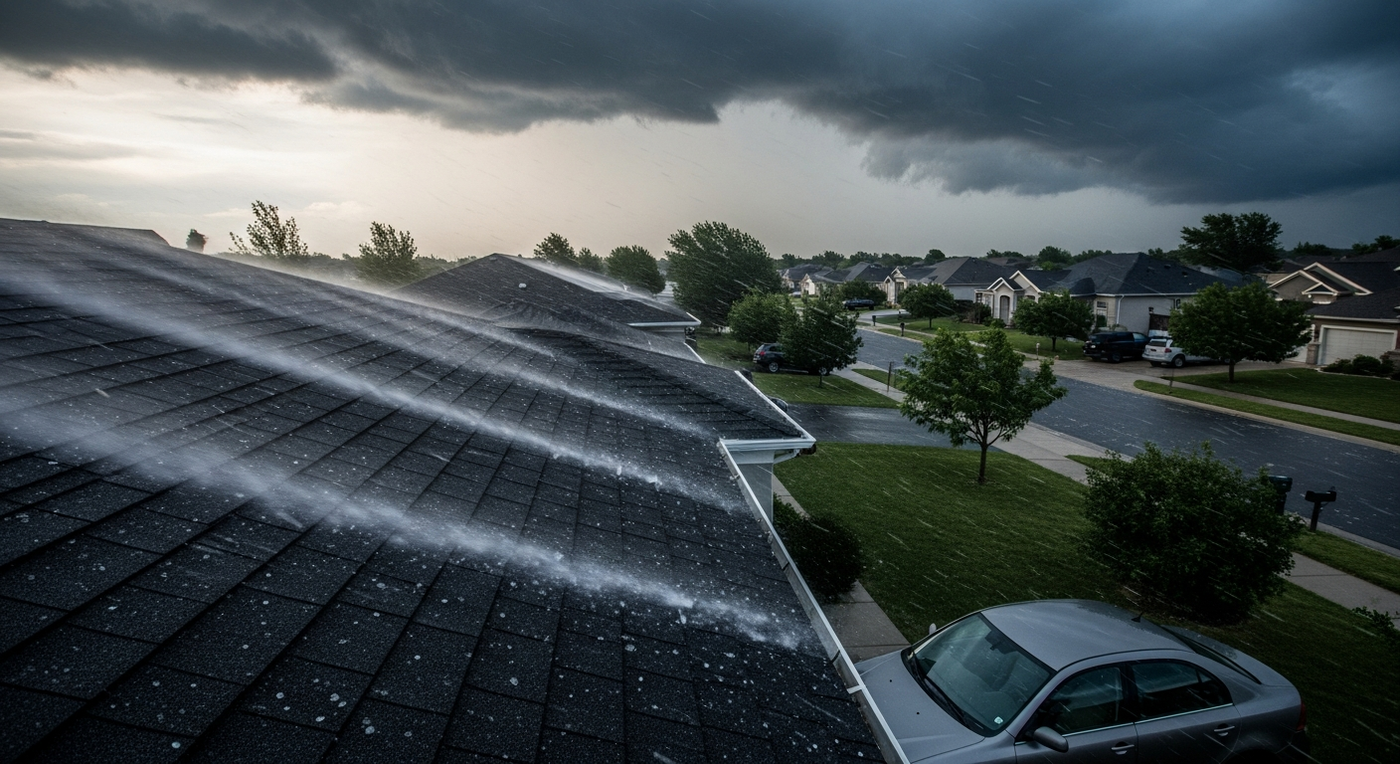
Tucson faces a secondary hail threat that Phoenix largely avoids: outflow-triggered storms. When an initial thunderstorm collapses, it sends a surge of cool air rushing outward in all directions. This outflow acts like a miniature cold front. If it collides with another developing storm, the result can be explosive.

The Santa Catalinas create a natural barrier that traps outflow against the mountains. Instead of dissipating across open desert, the cool air pools in the Tucson basin, then sloshes back toward the ranges. This sets up a feedback loop. The first storm of the afternoon might drop quarter-inch hail on the Foothills. Two hours later, a second storm — fed by the first storm's outflow — drops inch-diameter hail on midtown. By evening, a third pulse can develop, this time hitting the south side.

Phoenix's geography doesn't support this pattern as effectively. Outflow from storms over the Superstitions spreads across the East Valley, but there's no mountain wall to contain it. The energy dissipates. Secondary storms develop, but they're typically weaker than the initial event.

The Rincon Mountains east of Tucson add another wrinkle. Storms that form over the Rincons track westward toward the city, pushed by prevailing upper-level winds. These storms have already matured by the time they reach the metro area — they arrive as organized systems with established hail cores, not as developing cells that might still be growing. A storm that initiates over the Rincons at 3 p.m. can drop significant hail on the east side of Tucson by 3:45 p.m., having traveled roughly 20 miles.

Phoenix storms that originate over the Superstitions must travel approximately 40-50 miles, giving them time to weaken. By the time they reach Mesa or Chandler, they're often producing heavy rain and frequent lightning, but the hail has melted.

Terrain channeling plays a role too. The Tucson basin funnels storms along predictable corridors. The gap between the Santa Catalinas and the Rincons acts like a natural wind tunnel, concentrating storm energy. Phoenix sits in a broad, flat valley with no comparable channeling effect. Storms can approach from any direction, but they're not focused or enhanced by topography.

One consequence: Tucson residents learn to read the mountains. When clouds start building over Mount Lemmon in early afternoon, people move cars into garages. When the first rumble of thunder echoes off Pusch Ridge, pool furniture gets secured. Phoenix residents don't have the same visual cues. Storms appear on the horizon, but the horizon may be 30 miles away, and a lot can happen in the time it takes a storm to cross that distance.

The Arizona Cooperative Extension at the University of Arizona has documented this pattern in agricultural damage reports. Pecan orchards in the Tucson area experience hail damage roughly twice as often as citrus groves in the Phoenix area, despite both regions sitting within the same monsoon circulation pattern. The difference isn't moisture or instability — both cities draw from the same Gulf surge events. The difference is delivery mechanism.

What This Means for Residents

If you're shopping for a home in either city, the hail risk calculation differs. In Phoenix, properties on the far east side near Apache Junction or in north Scottsdale near the McDowell Mountains face higher hail risk than central Phoenix neighborhoods. The closer you are to the mountains where storms initiate, the more likely you'll see hail before it melts.

In Tucson, the gradient runs north to south. Foothills neighborhoods see hail multiple times per monsoon season. Central Tucson sees it less frequently but still regularly. South Tucson, farthest from the Santa Catalinas, sees the least hail — though outflow-triggered storms can still bring surprises.

Roof age matters more in Tucson than Phoenix for this reason. A 15-year-old composition shingle roof in Phoenix might have weathered a handful of hail events. The same roof in Tucson's Foothills has likely endured a dozen or more, with cumulative damage that might not be obvious until a leak develops.

Vehicle insurance follows similar logic. Comprehensive coverage costs may run several hundred dollars more annually in Tucson than in Phoenix, even after adjusting for vehicle values. Insurers price the elevation and terrain factors into their risk models.

The timing difference creates practical complications. Phoenix residents might have until 5 or 6 p.m. to prepare for an approaching storm — time to get home from work, move the car, close awnings. Tucson residents often have approximately 30 minutes or less between the first towering cumulus and the first hailstone. Storms develop fast and strike fast.

This makes weather radar essential in Tucson in a way it isn't quite as critical in Phoenix. Phoenix storms often show up on radar roughly 45 minutes before arrival, giving people time to react. Tucson storms can go from "first echo" to "severe thunderstorm warning" in approximately 20 minutes, especially during peak heating on June afternoons before the monsoon fully establishes.

June is actually Tucson's most dangerous hail month, not July or August. The atmosphere is unstable, moisture is beginning to increase, but the monsoon circulation hasn't fully organized. This creates isolated, intense storms rather than the more widespread but weaker systems common in mid-summer. A single June supercell over the Santa Catalinas can drop baseball-size hail on a narrow corridor through the Foothills, causing millions in damage to a few hundred homes while neighborhoods two miles away stay dry.

Phoenix's June hail events tend to be less severe because the storms are still forming over distant mountains and weakening en route. The city's worst hail typically comes in July and August, when moisture is abundant enough to sustain storms during their desert crossing.

Option Tradeoffs

Pros

  • Phoenix: Longer warning windowsStorms visible 45+ minutes out, giving residents time to prepare and protect property
  • Phoenix: Weaker hail intensityDesert crossing melts larger stones before arrival, reducing damage severity
  • Tucson: Predictable corridorsTerrain channeling creates consistent storm paths that locals learn to anticipate

Tradeoffs

  • Tucson: Rapid onsetStorms form overhead with minimal advance notice, often under 30 minutes
  • Tucson: Multiple daily pulsesOutflow pooling against mountains can trigger successive waves throughout afternoon
  • Phoenix: East-side vulnerabilityProperties near mountain ranges face similar risks to Tucson without the warning culture

Geography determines hail risk more than city size. Tucson's proximity to mountains creates faster, more intense events despite smaller population.

Neither city is immune, obviously

Neither city is immune, obviously. Phoenix experienced significant hail events in October 2010 and September 2022, both from unusual weather patterns that brought storms directly over the metro rather than from the typical eastern approach. Tucson can go weeks without hail during weak monsoon seasons when moisture stays south of the border. But the baseline pattern — Tucson's mountains creating more frequent, more intense, more localized hail events — holds across decades of data.

The elevation and terrain don't just create different storm patterns. They create different relationships between residents and summer weather. Phoenix treats monsoon storms as dramatic visitors that arrive with warning. Tucson treats them as volatile neighbors that can turn dangerous without notice.

Both cities are beautiful. Both cities flood. Both cities get hail.

But Tucson gets it harder, faster, and closer to home — because the mountains that make the city spectacular also make it vulnerable.

Verified Sources

  1. National Weather Service Phoenix

    National Weather Service Phoenix

    Arizona monsoon climatology and precipitation patterns

Back to Hail Science