Editorial Quick Answers

The Dent Count: How Insurance Adjusters Calculate Your Hail-Damaged Car's Value

Appraisers use standardized grid methods to estimate repair costs, but lighting conditions, panel geometry, and the total-loss threshold can swing your settlement by thousands of dollars.

The Dent Count: How Insurance Adjusters Calculate Your Hail-Damaged Car's Value
Hail Protector Editorial / GeminiEditorial

The Grid Walk and the Math Behind Each Dent

When an adjuster arrives to inspect your hail-damaged vehicle, they're typically working from a tablet loaded with estimating software—CCC ONE, Mitchell, or Audatex dominate the industry—that breaks your car into roughly 20-30 distinct panels. The process starts with what appraisers call a "grid walk": they move systematically across the vehicle, counting dents on each panel and categorizing them by size. A dent smaller than a dime might be logged as "minor," while anything quarter-sized or larger enters a different repair category with higher costs.

The software then multiplies dent counts by standardized labor rates. Paintless dent repair (PDR)—the preferred method for hail damage—typically costs around $75-$125 per dent for straightforward repairs, though prices vary significantly by region and shop rates. Panels with dense damage exceeding a certain threshold (typically around 8-12 dents per square foot) get flagged for complete replacement rather than repair, which dramatically increases the estimate.

What most drivers don't realize: the adjuster isn't just tallying numbers. They're making judgment calls about repairability, and those calls follow guidelines that favor the insurer's bottom line.

Why Curved Surfaces Hide Damage

Here's the counterintuitive part: the flatter your car's panels, the more accurate your appraisal will likely be. Modern vehicles with sculpted fenders, curved hoods, and character lines present a measurement problem. Dents on curved surfaces only reveal themselves when light hits at specific angles—typically low-angle side lighting that creates shadows inside each dimple.

Adjusters working in midday overhead sun systematically undercount damage on curved panels. The light floods directly down, filling in the shadows that would otherwise make dents visible. A hood that shows 15 dents at noon might reveal 40 under the raking light of late afternoon. This isn't intentional deception; it's simple physics. But the financial consequence is real.

Some body shops have caught onto this dynamic. They've started photographing vehicles under controlled lighting before the adjuster arrives, documenting dents that might disappear under unfavorable conditions. These shops then use the photos during supplement negotiations—the process where repair facilities request additional payment after discovering damage the initial estimate missed.

$75-$125

per dent

PDR typical cost

8-12

dents/sq ft

Panel replacement threshold

70-80%

%

ACV ratio triggers total loss

20-40

%

Estimate increase with re-inspection

The Actual Cash Value Calculation That Determines Total Loss

The repair estimate matters enormously, but it's only half the equation. The other half is your car's actual cash value (ACV)—what the insurer determines your vehicle was worth the moment before the hailstorm hit. If the repair estimate reaches approximately 70-80% of ACV (the exact threshold varies by state and insurer), the company will declare your car a total loss and cut you a check for the ACV minus your deductible, then take possession of the vehicle.

Adjusters calculate ACV using databases like CCC, NADA, or Kelley Blue Book, adjusted for your specific vehicle's mileage, condition, and local market values. A 2018 sedan with 65,000 miles might have an ACV of roughly $18,000 in one market and $16,000 in another. If the hail repair estimate comes in at around $14,000, you're looking at a total loss in the second market but a repairable claim in the first.

Here's what catches people off guard: you don't get to choose. Even if you'd prefer to keep your damaged car and pocket a smaller settlement, once the insurer declares it totaled, that decision is final in most states.

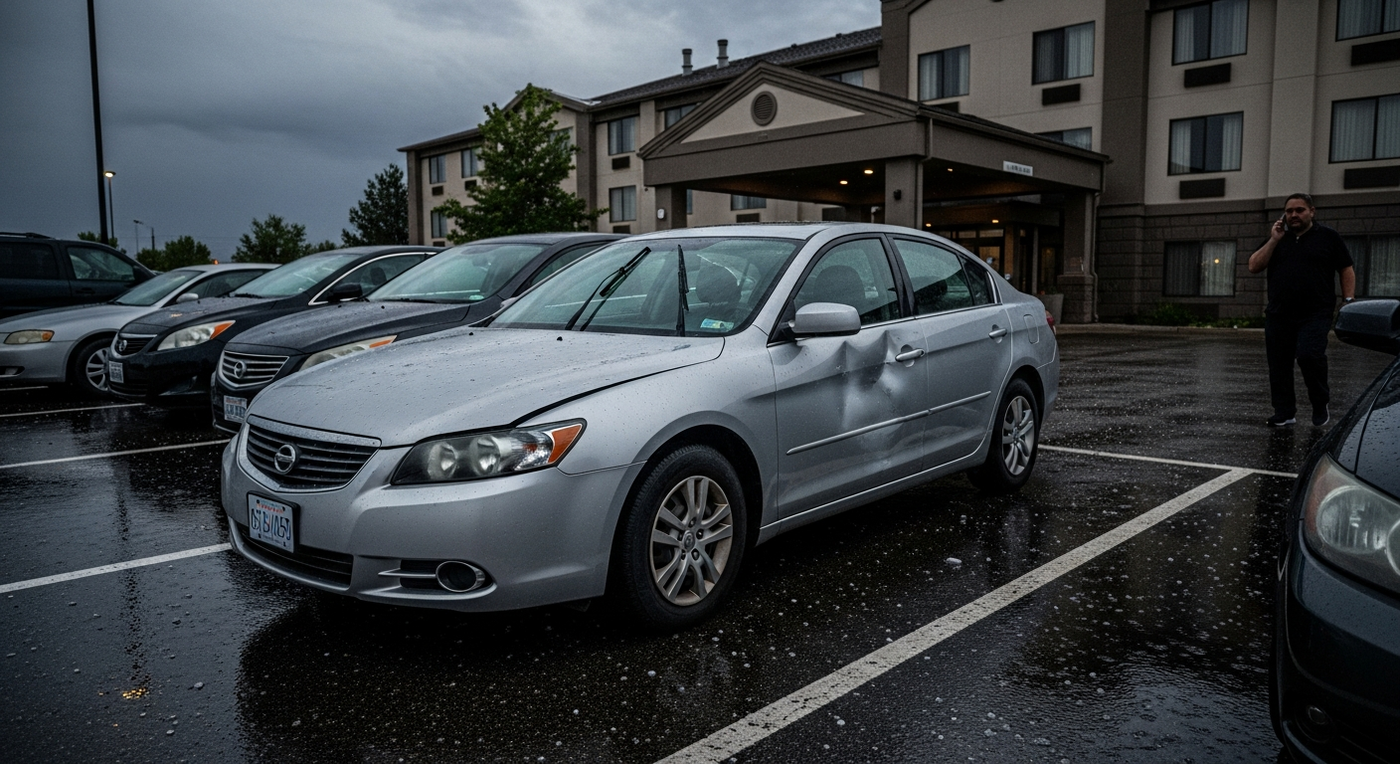
Hail damage appraisal before escalation
Hail damage appraisal during impact

The Re-Inspection Leverage Point

Drivers who understand the appraisal process have one significant negotiating tool: the right to request a re-inspection. If you believe the initial estimate undercounts damage, you can ask the insurer to send the adjuster back—or hire an independent appraiser to prepare a competing estimate.

Timing this re-inspection matters. Request it for late afternoon, ideally between 4-6 PM when the sun is lower in the sky. Park the vehicle so light rakes across the panels at a low angle. Some drivers even wash and wax their cars before re-inspection; the clean, reflective surface makes dents more visible under side lighting.

The data supports this strategy. While insurers don't publish statistics on re-inspection outcomes, body shop managers report that supplement requests accompanied by afternoon lighting photos succeed at notably higher rates than those without. The difference isn't small—estimates can increase by an estimated 20-40% when previously hidden damage becomes visible.

You can also request that the re-inspection occur at a PDR shop rather than your driveway. Professional technicians have overhead LED arrays specifically designed to reveal hail damage, and their trained eyes catch dents adjusters miss. Having a shop representative present during the inspection creates a second expert voice in the conversation.

Hail damage appraisal Key Questions

What the Estimate Doesn't Include

The appraisal focuses on direct damage: dented panels, cracked glass, damaged trim. But hail can cause secondary problems that won't appear in the initial estimate. Dents in the roof can compromise factory sealant, leading to water leaks months later. Hail impacts on plastic components like mirrors or spoilers can create stress fractures that don't fail immediately.

Most estimates also exclude diminished value—the permanent reduction in your car's resale value even after perfect repairs. A vehicle with a hail damage claim on its history report will sell for less than an identical car with a clean record. In Georgia, North Carolina, and Kansas, you can file a separate diminished value claim against your own insurer. In most other states, you can only pursue diminished value if someone else caused the damage, which doesn't apply to weather events.

Some policies include an "agreed value" or "stated value" clause that locks in the car's worth before any damage occurs. These are rare on standard auto policies but common on collector car insurance. If you have one, the ACV calculation becomes much simpler—and usually more favorable to you.

The Adjuster's Constraints

It's worth understanding what adjusters can and can't do. They work from software that constrains their estimates. If the program says a 2020 Honda Accord hood costs $580 for the part and requires 3.2 hours of labor at the regional rate, the adjuster can't simply write a higher number because they feel generous. They can add line items for additional damage or increase dent counts, but they're operating within a structured system.

Most adjusters also carry settlement authority up to a certain limit—typically around $10,000 to $15,000—beyond which they need supervisor approval. This creates an incentive to keep estimates just below that threshold when possible. If your initial estimate comes in at around $9,800 and you suspect undercounting, there's a reasonable chance a re-inspection will push it over $10,000, triggering a different level of review.

The adjuster's job is to estimate accurately, not to minimize your claim, but they're also evaluated on how their estimates compare to final repair costs. If they consistently write estimates that require large supplements, their performance reviews suffer. This creates subtle pressure toward conservative initial appraisals.

Back to Storm Prep