Seasonal Guide Seasonal Briefing

The I-70 Hail Problem: How to Monitor Severe Weather Across Four States in One Day

A driver leaving Kansas City for Denver on July 4th crosses through four distinct severe weather environments before sunset — and each requires different monitoring decisions.

The I-70 Hail Problem: How to Monitor Severe Weather Across Four States in One Day
Hail Protector Editorial / GeminiSeasonal Guide

The Geography Problem Most Road Trippers Miss

A family driving westbound on Interstate 70 from Kansas City to Denver covers roughly 600 miles through Kansas, a sliver of Colorado's eastern plains, and then the Front Range. What most drivers don't realize: they're crossing through completely different hail climatology zones every two hours. Eastern Kansas typically sees peak hail activity in May and June, driven by Gulf moisture colliding with dry air. Western Kansas typically experiences more isolated supercells with larger hail but lower frequency. The Colorado Front Range operates on its own schedule entirely — afternoon heating along the mountains typically triggers storms that drift east across I-70 between 3 PM and 9 PM.

This matters because a single weather check in Kansas City tells you nothing about conditions you'll encounter in Limon, Colorado, six hours later.

The Two-Tool System That Actually Works

The most effective monitoring approach for cross-state summer driving combines the Storm Prediction Center's Day 1 Convective Outlook checked each morning with real-time radar mounted on your dashboard.

The SPC outlook, updated by 1 AM Central and refined throughout the day, shows categorical risk areas — Marginal, Slight, Enhanced, Moderate, or High — across the entire country. A driver planning a July 4th departure can see at 6 AM whether their afternoon route crosses through Enhanced risk zones. This provides strategic-level planning: do we leave at dawn to clear the risk area by 2 PM, or do we delay departure until evening?

Real-time radar provides tactical decisions. Apps like RadarScope or the free NWS radar mosaic typically show storm cells 30-60 minutes before they reach the highway. When you see a red-core thunderstorm 40 miles west of your position and you're driving east, you have time to exit at the next town.

Together, these tools give you both the strategic view (should we drive today at all?) and the tactical view (do we need to exit right now?).

What the Outlook Categories Actually Mean for Drivers

The SPC uses five risk categories, but only three matter for travel planning.

Marginal Risk (the lowest category) means scattered storms are possible but coverage will be limited. According to SPC documentation, this typically indicates less than 10% probability of severe weather within 25 miles of any point. For drivers, this means: proceed with normal plans, but keep radar running.

Slight Risk means widespread severe storms are expected across the region. This is the category where travel decisions get complicated. You can still drive through Slight Risk areas — most of the region won't see storms — but you need active monitoring and a willingness to exit the highway.

Enhanced Risk or higher is when experienced Plains residents start reconsidering travel entirely. These categories indicate organized severe weather systems with high coverage. If your entire route falls within Enhanced Risk, the best decision is often to delay departure by 12 hours or choose a different travel day.

The Timing Window That Matters Most

Here's what most Fourth of July travelers get wrong: they check weather at 8 AM, see clear skies, and assume the entire day is safe.

Summer severe weather across the Plains and Front Range typically follows a predictable diurnal cycle. Storms typically initiate between 2 PM and 5 PM as daytime heating peaks. They reach maximum intensity between 4 PM and 8 PM. They weaken after sunset as they lose their energy source.

This means a driver departing Kansas City at 6 AM can typically cover roughly 300 miles before the atmosphere becomes unstable. But a driver departing at noon drives directly into the peak storm window. The same route, six hours apart, presents completely different risk profiles.

If SPC outlooks show afternoon storm risk along your route, the math is simple: either leave before 7 AM or wait until 8 PM.

The Rest Stop Myth and What Actually Provides Protection

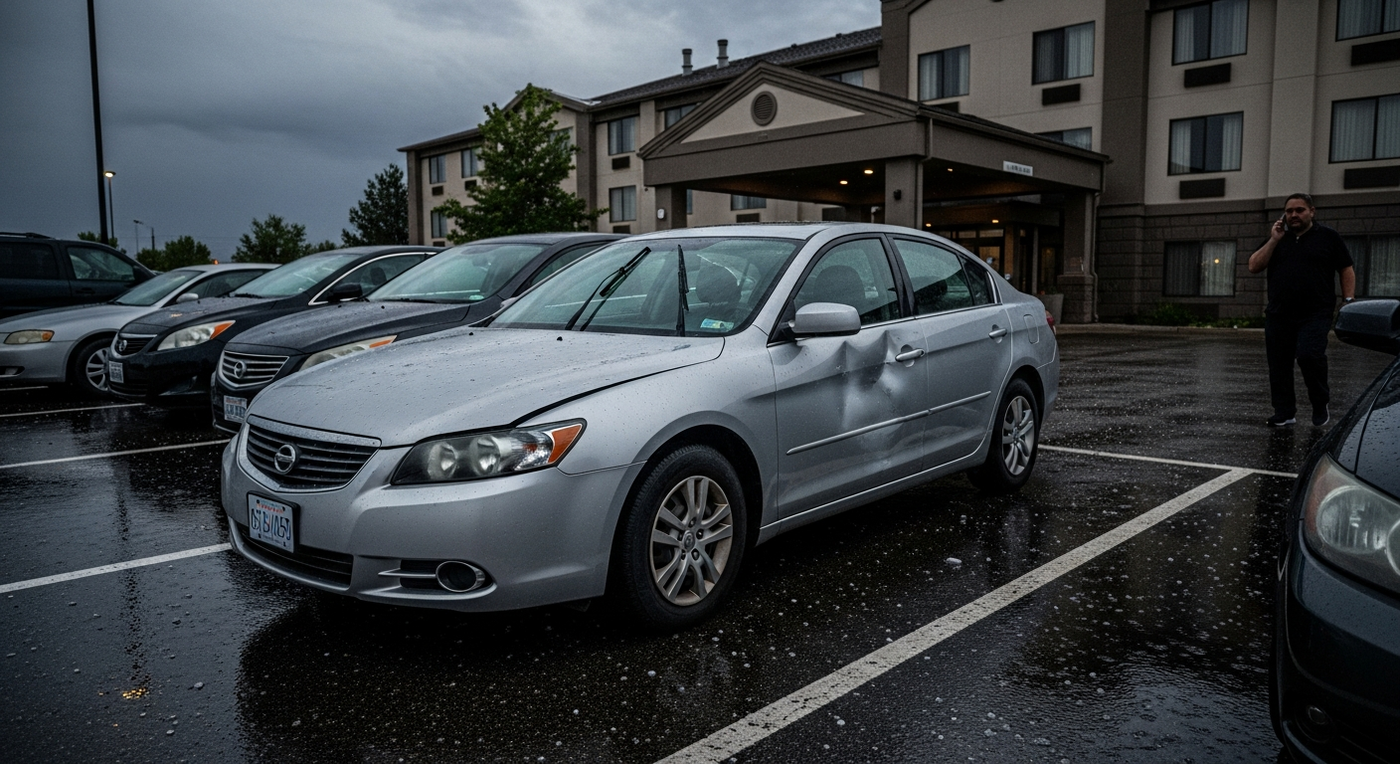
Every summer, highway rest stops fill with cars parked under metal awnings during hailstorms. The drivers believe they're protecting their vehicles.

They're not wrong, but they're not as right as they think.

A standard highway rest stop awning typically provides protection from hail up to roughly pea-sized (quarter-inch diameter). Anything larger punches through or dents the metal itself. Gas station canopies over fuel pumps offer similar marginal protection — better than nothing, worse than actual shelter.

Real protection means a parking garage. When SPC outlooks show Slight Risk or higher for your overnight destination, book a hotel with covered parking or locate public parking garages near your planned stop. A driver planning to overnight in Salina, Kansas, on a Slight Risk day should identify the downtown parking garage locations before departure, not during the storm.

The best strategy isn't finding shelter during a storm — it's planning overnight stops in cities with accessible garages when you know risk exists.

600

miles

Kansas City to Denver

3-9

PM

Front Range storm window

<20

min

Decision time inside 20 miles

<10

%

Severe probability in Marginal Risk

The State-by-State Monitoring Problem

Interstate 70 from Kansas City to Denver crosses through Kansas, a corner of Colorado, and then the Front Range. Each state operates its own Department of Transportation alert system. Kansas has KanDrive. Colorado has COtrip. Missouri has MoDOT traveler information.

None of them talk to each other.

This creates a monitoring gap. A driver receives a KanDrive alert about severe weather near Salina, but crosses into Colorado 30 minutes later with no awareness of Front Range storm development. The SPC outlook solves this by providing a single nationwide view, but it doesn't include road-specific information like closures or accident backups caused by weather.

The practical solution: before departure, bookmark the traveler information website for every state along your route. Check each one at every fuel stop. It's tedious, but it's the only way to catch state-specific alerts.

Storm Initiation
Storm Initiation

When the Radar Shows Red Cores: Exit Decision Points

You're driving westbound on I-70 through Kansas. Your dashboard radar shows a severe thunderstorm 35 miles ahead, directly over the highway. The core is red and orange — indicating heavy rain and likely hail.

Do you exit or continue?

The decision depends on storm movement. If the storm is moving northeast and you're driving west, you might pass south of it entirely.

Most weather apps show storm movement with arrows. If the arrow points toward your route, exit at the next town. If it points away, you can often thread the gap.

The critical distance is roughly 20 miles. Inside 20 miles, you typically have less than 20 minutes to find shelter. Outside 40 miles, you have time to monitor and decide. Between 20 and 40 miles is the decision window.

Small Kansas towns along I-70 — Salina, Russell, WaKeeney — typically have at least one large commercial building near the highway exit. A Walmart parking lot provides no overhead protection, but it's a known location where you can safely pull over and wait. Trying to outrun a storm rarely works. Stopping and waiting for it to pass typically takes 30-45 minutes and eliminates risk.

The Front Range Exception to Every Rule

Everything written above applies to the Plains. The Front Range operates differently.

Storms along Colorado's Front Range — roughly from Colorado Springs north through Fort Collins — form along the mountains in early afternoon and drift east. They're often more intense than Plains storms because of orographic lifting, but they're also more predictable in location and timing.

A driver approaching Denver from the east on I-70 in July should typically expect storm development between 3 PM and 6 PM. These storms form over the mountains (west of the highway) and move east (toward the highway). The practical implication: if you're driving eastbound from Denver toward Kansas in late afternoon, you're driving away from storm formation.

The solution is timing. Arrive in Denver before 2 PM or after 9 PM. The window between 4 PM and 8 PM is when I-70 through the Front Range becomes a shooting gallery.

The Overnight Decision That Changes Everything

The single most effective hail safety decision for summer road trips isn't about monitoring — it's about where you sleep.

A family driving from St. Louis to Denver across three days can choose overnight stops in small Plains towns or in regional cities. Small towns offer cheaper hotels. Regional cities offer parking garages.

When SPC outlooks show multi-day severe weather patterns across the Plains (common in early July), choosing overnight stops in cities with covered parking eliminates the highest-risk scenario: waking up to a destroyed vehicle in a hotel parking lot at 3 AM.

Cities along common routes with accessible downtown parking garages include Salina, Kansas; Hays, Kansas; Colby, Kansas; and Limon, Colorado. Each has hotels within walking distance of covered public parking. The garage might cost roughly $10-15 for overnight parking. The alternative is comprehensive insurance claims and a ruined vacation.

Decision Tradeoffs

Pros

  • Highway rest stop awningsBlocks small hail up to pea-sized; widely available at regular intervals
  • Gas station canopiesEasy to find; provides some overhead coverage during fuel stops
  • City parking garagesFull protection from all hail sizes; secure overnight option

Tradeoffs

  • Highway rest stop awningsFails against larger hail; metal can dent and allow penetration
  • Gas station canopiesOnly marginal protection; not designed for severe weather
  • City parking garagesRequires route planning; may cost $10-15; not available in small towns

Rest stops offer convenience but limited protection. Garages require planning but eliminate risk entirely when severe weather is forecast.

What Experienced Plains Drivers Actually Do

People who live in Kansas, eastern Colorado, and Oklahoma and drive these routes regularly don't use complicated monitoring systems. They use simple heuristics.

If the sky to the west or southwest shows towering cumulus clouds by 2 PM, storms are coming. If the air feels heavy and still, instability is building. If the SPC outlook shows anything above Marginal Risk, they check radar every 30 minutes.

The most valuable skill isn't sophisticated weather interpretation — it's the willingness to stop driving. Experienced Plains drivers don't try to beat storms. They pull into the next town, find a parking lot, and wait. The storm typically passes in 30-45 minutes.

The drivers who get caught are the ones who convince themselves they can make it to the next city.

Verified Sources

  1. spc.noaa.gov

    spc.noaa.gov

    Referenced in article via spc.noaa.gov.

  2. spc.noaa.gov

    spc.noaa.gov

    Referenced in article via spc.noaa.gov.

Back to Storm Prep