Seasonal Guide Seasonal Briefing

The I-70 Problem: How to Monitor Hail Risk When Your Road Trip Crosses Four Weather Zones in One Day

A driver leaving Kansas City for Denver on Independence Day weekend passes through four distinct severe weather environments — each requiring separate storm monitoring — before sunset.

The I-70 Problem: How to Monitor Hail Risk When Your Road Trip Crosses Four Weather Zones in One Day
Hail Protector Editorial / GeminiSeasonal Guide

The Geography of Summer Storm Corridors

Interstate 70 between Kansas City and Denver cuts directly through the most hail-active region in North America. A family departing Kansas City at 7 a.m. will cross eastern Kansas by mid-morning, western Kansas by early afternoon, and reach the Colorado Front Range by evening. Each segment operates under different atmospheric conditions. Eastern Kansas sits in humid, unstable air masses that generate supercells with large, wet hail. Western Kansas experiences drier environments where storms produce smaller but wind-driven hail. The Front Range creates its own weather through orographic lift — afternoon thunderstorms that weren't forecast at sunrise.

This isn't theoretical. According to NOAA Storm Prediction Center data, the I-70 corridor from Topeka to Limon experiences among the highest concentrations of severe hail days per year of any major interstate corridor in the country.

Two Tools That Actually Work While Driving

The most effective monitoring strategy uses exactly two resources: the SPC Day 1 Convective Outlook checked before departure, and live radar on a dashboard-mounted phone.

The Day 1 outlook, issued by 1 a.m. Central and updated throughout the day, color-codes severe weather risk across the entire United States. A driver planning an I-70 trip checks the outlook at breakfast and identifies which segments of the route fall under "slight risk" (yellow) or "moderate risk" (orange) categories. This takes 90 seconds. The outlook won't tell you where individual storms will form, but it identifies which 200-mile segments of your route need active monitoring.

Live radar fills the second role. Apps like RadarScope or the NWS radar mosaic show precipitation cores in real-time with roughly 5-10 minute delays. When you're driving through a slight risk area, checking radar every 30 minutes reveals whether storms are developing ahead of your position or approaching from the west. This typically provides 30-60 minutes of decision-making time — enough to take an early exit, delay lunch, or reroute.

Here's what doesn't work: radio weather alerts, which cover too large an area and arrive too late. Also ineffective: calling ahead to hotels to ask about weather, trusting clear skies at departure, or assuming storms "always miss the highway.".

The Myth of Gas Station Protection

Every summer, travelers pull under gas station canopies during hailstorms, believing the metal overhang provides meaningful protection.

Standard gas station canopies are designed for sun and rain, not impact resistance. During severe hailstorms, hail has been documented punching through corrugated metal roofing at truck stops, damaging vehicles parked underneath. The canopy itself became a secondary hazard, with torn metal edges flapping in 60 mph winds.

Rest stop pavilions offer similarly limited protection. Most feature open-sided structures that shield from vertical hail but not wind-driven stones approaching at 45-degree angles.

The only reliable roadside protection is a concrete parking garage — multilevel structures with enclosed levels. Cities along I-70 with accessible downtown parking garages include Salina, Hays, Colby (limited), and Limon. If the Day 1 outlook shows moderate risk and you're approaching one of these cities in early afternoon — prime storm initiation time — the safest decision is to arrive early, park on a middle level, and wait out the storm window.

Planning Overnight Stops Around SPC Outlooks

The strategic advantage of multi-day road trips is flexibility in overnight locations.

When booking hotels for a July cross-country trip, check the SPC Day 1-3 outlooks for your travel dates. Day 2 and Day 3 outlooks provide lower-confidence forecasts but identify broad patterns. If Day 3 shows a moderate risk across western Kansas on your planned second travel day, book your first night in Salina instead of pushing to Goodland. This positions you to either depart very early (before storm initiation) or delay departure until evening (after the main event).

Cities with both parking garages and hotels within walking distance include Topeka, Manhattan, Salina, and Colorado Springs. This combination lets you park the vehicle in a protected structure and reach your hotel room without exposure.

One counterintuitive detail: hotels near interstate exits typically lack parking garages, while downtown hotels in county seats often have them. The extra 10-minute drive off the highway provides substantially better protection.

What the Colors Actually Mean

SPC outlooks use five risk categories, but only three matter for travel planning.

Marginal risk (dark green): Storms possible but typically weak or isolated. Continue normal travel. Check radar every hour.

Slight risk (yellow): Scattered severe storms likely within the area. This is the threshold for active monitoring. Check radar every 30 minutes. Have a backup plan for each segment.

Moderate risk (orange): Numerous severe storms expected. Moderate risk days generate a disproportionate share of annual hail damage claims in the Plains states, with Insurance Information Institute data suggesting these days account for the majority of severe hail losses. This is the threshold for route changes, early departures, or delayed travel.

Enhanced risk (orange, darker shade) and high risk (magenta) appear less frequently and indicate potentially violent weather.

The outlook boundaries matter more than the colors. A slight risk area might be 300 miles wide, but the embedded text discussion identifies where within that area storms are most likely. Read the text summary, not just the map.

400

miles

Highest hail frequency corridor

60-70%

%

Annual damage from moderate risk days

2-6

PM

Peak storm development window

30-40

mph

Typical severe cell movement speed

The Front Range Exception

Eastern Colorado operates under different rules.

Storms along the Front Range — roughly Fort Morgan to Colorado Springs — initiate through orographic processes that aren't captured well in morning outlooks. A day forecast as "marginal risk" can produce intense, localized hailstorms by 3 p.m. as upslope flow triggers convection against the mountain barrier.

The practical implication: if you're approaching Denver or Colorado Springs between 1 p.m. and 7 p.m. during June or July, monitor radar regardless of the outlook category. Front Range storms develop quickly, move east, and intensify rapidly. The 30-minute warning window compresses to 15 minutes.

Travelers on I-70 approaching Denver from the east should check radar at Limon (60 miles out) and again at Deer Trail (35 miles out). If cells are developing west of Denver, they'll be moving toward you. The decision point is Strasburg — the last exit with services before committing to the metro area.

Standard Departure
Standard Departure

When to Pull Over vs. Keep Driving

The calculus changes based on storm motion and road orientation.

If radar shows a storm cell approaching from the southwest and you're driving east on I-70, you're moving perpendicular to the storm's path. Continuing forward doesn't help; you'll intersect the cell regardless. In this geometry, pull over at the next town with substantial buildings — bank, grocery store, school — and wait 20-30 minutes for the cell to pass.

If the storm is moving east and you're also driving east, speed matters. A severe thunderstorm typically moves at roughly 30-40 mph. If you're maintaining 75 mph, you're outrunning it. Continue driving and monitor whether the gap is widening or closing.

Never attempt to outrun a storm approaching from behind. If radar shows a cell overtaking you from the west, exit immediately and seek shelter. You cannot reliably outrun weather that may be moving at highway speeds or faster, especially when navigating traffic.

The Timing Window Most Drivers Miss

Peak storm initiation in the Central Plains occurs between 2 p.m. and 6 p.m. local time. This is when daytime heating maximizes instability and triggers convection.

A driver leaving Kansas City at 7 a.m. reaches Salina around 11 a.m., Hays by 1 p.m., and Goodland by 4 p.m. — directly in the window. The same driver leaving at 5 a.m. reaches Goodland by 2 p.m., before most storms initiate. Leaving at noon puts you in Salina at 4 p.m. — the worst possible timing.

Early departure isn't always comfortable, but it's the single most effective risk reduction strategy for summer Plains travel. The roads are emptier, visibility is better, and you're through the highest-risk geography before the atmosphere destabilizes.

What Actually Happens to Your Vehicle

Hail damage isn't cosmetic.

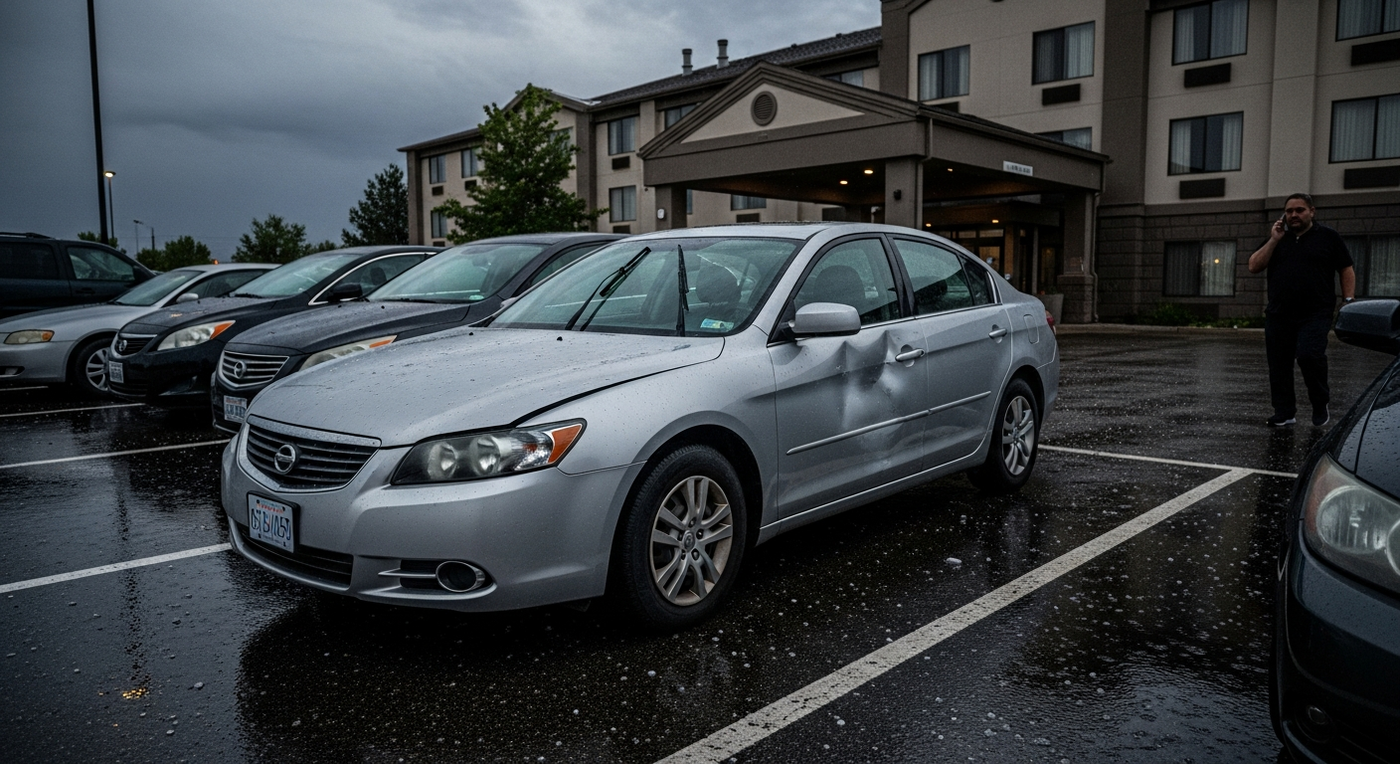
A two-inch hailstone — common in severe Plains thunderstorms — impacts a vehicle at approximately 60-70 mph. This creates permanent dents in sheet metal, cracks windshields, and can shatter side windows entirely. Repair costs for comprehensive hail damage typically run several thousand dollars, and insurance premiums may increase after a comprehensive claim, with increases varying by insurer and claim history.

Windshield damage is particularly problematic mid-trip. A cracked windshield is drivable but dangerous — reduced visibility, structural weakness, and in some states, a ticketable offense. Replacing a windshield in a small Plains town may require 1-2 days or more for parts delivery.

The financial argument for storm monitoring is straightforward: spending 90 seconds checking an outlook and 5 minutes checking radar every hour can prevent damage that costs thousands and disrupts the entire trip.

Decision Tradeoffs

Pros

  • SPC Day 1 OutlookShows risk zones for entire route in 90 seconds
  • Live radar appsProvides 30-60 minute warning for developing cells
  • Concrete parking garagesOnly roadside structure with verified protection

Tradeoffs

  • Radio weather alertsCoverage area too broad, warnings arrive late
  • Gas station canopiesNot impact-rated; metal can tear and create hazards
  • Highway underpassesWind tunnel effect accelerates debris

Effective monitoring requires pre-trip outlook review plus frequent radar checks, not passive alerts or improvised shelter.

The Rest Stop Decision Tree

When you're on the road and radar shows a storm approaching in 15 minutes, your options collapse quickly.

If you see a town ahead with visible multi-story buildings: Exit and park on the north or east side of the largest structure. This provides a wind shadow.

If you're between towns with only a rest stop available: Pull into the rest stop, but don't rely on pavilions. Park your vehicle with the rear facing the approaching storm direction (typically southwest). Hail impacts the front and hood most severely; protecting those surfaces reduces damage.

If you see a highway underpass: Do not stop under it. Underpasses create wind tunnel effects that accelerate debris and hail. They're also illegal stopping zones and create hazards for other drivers.

If you have no options and the storm is imminent: Pull completely off the roadway, turn on hazard lights, and move away from the vehicle. Hail can shatter windows; you're safer outside the vehicle than inside during extreme events.

The decision tree assumes you've been monitoring and have 15 minutes. If you have 45 minutes, you have different options — reaching the next town, delaying at a restaurant, or reversing direction to a city you already passed.

Verified Sources

  1. NOAA Storm Prediction Center

    NOAA Storm Prediction Center

    Official convective outlook archive and risk categories.

  2. spc.noaa.gov

    spc.noaa.gov

    Referenced in article via spc.noaa.gov.

Back to Storm Prep