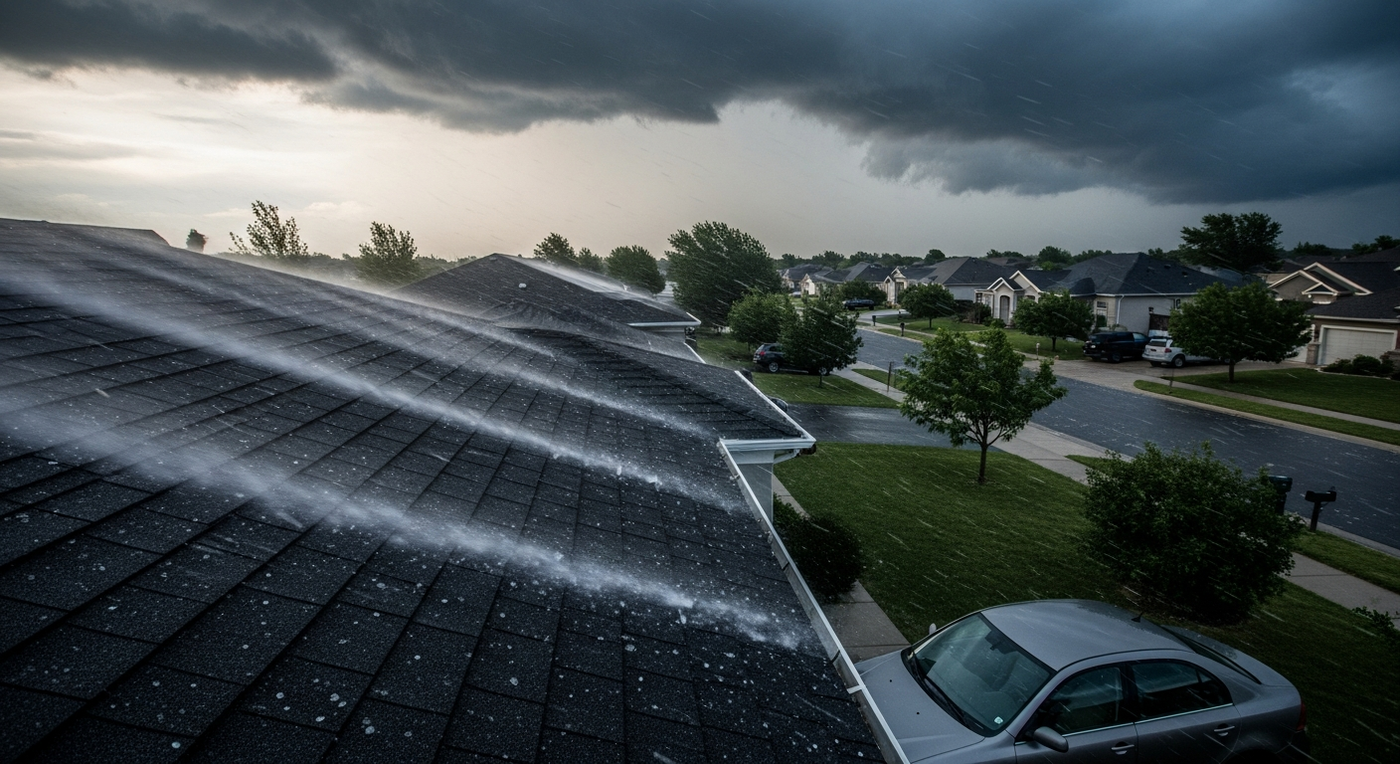
Regional Report Texas Hail Report

Fort Worth's Western Suburbs: First in Line When the Dryline Fires

Parker and western Tarrant Counties sit exactly where dry desert air collides with Gulf moisture, making them the most consistent supercell initiation zone in North Texas.

Fort Worth's Western Suburbs: First in Line When the Dryline Fires
Hail Protector Editorial / GeminiRegional Report

~2x

Population growth since 2000

10-12

years

Roof replacement frequency

120

miles

April 2013 storm track

The Geography of Getting Hit First

Parker County isn't just near the dryline. It's where the dryline becomes dangerous.

West of Parker County, the land is still relatively empty—ranch country, mesquite, the occasional oil pump. When a storm drops hail on open pasture twenty miles west of Weatherford, nobody files a claim. The storm is already severe, already rotating, but it hasn't encountered density yet. Then it crosses into Parker County, where the sprawl begins.

Weatherford, Aledo, Willow Park, Hudson Oaks—these aren't small towns anymore. Weatherford's population has roughly doubled since 2000, according to National Weather Service Fort Worth regional data. Aledo has exploded from approximately 2,700 people in 2000 to over 5,000 today, with subdivisions spreading across what was recently cattle country. The storm that would have been a non-event in 1985, pelting empty fields, now hits hundreds of rooftops per square mile.

And the storms don't weaken as they move east. Often, they intensify. A supercell needs time to organize, and the first twenty minutes after initiation can be chaotic. By the time the storm reaches Aledo or western Fort Worth, it's had fifteen or twenty miles to get its act together. The updraft has tightened. The hail core has concentrated. Western Tarrant County frequently takes a more organized punch than the initiation point did.

Here's what most people get wrong: they assume storms weaken as they move away from "Tornado Alley" or the open plains. But supercells don't care about city limits. A storm that forms near Weatherford and tracks toward Fort Worth is moving into an environment that's often *more* unstable, not less—richer Gulf moisture, stronger low-level winds. The DFW metro sits in a convergence zone where multiple air masses meet. Storms don't die approaching the Metroplex.

The track is brutally consistent. Storm Prediction Center event archives show that significant hail events in the DFW metro overwhelmingly follow a west-to-east or southwest-to-northeast path. The storms that hit downtown Dallas or Plano almost always passed through western Tarrant or Parker County first. It's the same conveyor belt, year after year.

On May 15, 2013, the pattern repeated: initiation near Mineral Wells, rapid intensification through Weatherford, then a destructive march through Aledo, Benbrook, and Cleburne. April 3, 2014: storms fired along the dryline in Parker County, then hammered Tarrant County with hail up to four inches in diameter. March 2016, April 2016, March 2017—the dates change, but the geography doesn't.

The Cost of Being First

Insurance claims tell the story in dollars. After major hail events, Parker County often shows the highest claim density in the metro, not because the hail was necessarily larger, but because the county took the full duration of the storm. When a supercell forms west of Weatherford and tracks east for two hours, Parker County experiences the entire lifecycle. Tarrant County gets the mature phase. Dallas County might catch the tail end. But Parker County gets all of it—the initial blast, the mature core, and often a second round if the storm cycles.

The western suburbs also lack the urban heat island effect that can sometimes disrupt storms. Downtown Fort Worth and Dallas generate enough heat to create localized updrafts and turbulence that can interfere with storm structure—not always, but sometimes. Parker County has no such protection. It's still open enough that storms roll through unimpeded.

Homeowners in Aledo or Weatherford aren't imagining it when they say they replace roofs more often than their friends in Plano or McKinney. They do. Homes in high-frequency hail zones may need roof replacement approximately every 10-12 years instead of the typical 20-25 year lifespan in lower-risk areas. That's not normal wear—that's geography.

And it's not just roofs. Vehicles parked outside during afternoon storms face similar math. A hailstorm that drops golf ball-sized hail for fifteen minutes can total a car. Paintless dent removal works for minor damage, but severe hailstorms cause damage that exceeds the vehicle's value. According to Insurance Information Institute data, catastrophic hail events can generate claims typically averaging several thousand dollars per vehicle, and Parker County sees these events with uncomfortable regularity.

The development boom makes it worse. Every new subdivision west of Fort Worth adds more exposure. In 2000, a supercell tracking through western Parker County might have damaged approximately a few dozen homes. In 2025, that same storm path crosses neighborhoods with hundreds of houses, three elementary schools, shopping centers, and parking lots full of cars. The meteorology hasn't changed.

What the Radar Shows

Storm chasers know the pattern. On high-risk days in April and May, they position themselves along US 180 west of Weatherford or near the Parker-Palo Pinto county line. That's where initiation happens. They're not guessing—they're reading the same atmospheric profiles meteorologists use, and those profiles consistently point to the same initiation zone.

The dryline doesn't just create storms; it creates *persistent* storms. A supercell that forms along a strong dryline has a built-in mechanism to sustain itself: continuous inflow of unstable air from the east meeting the dry punch from the west. As long as that boundary stays organized and the upper-level winds cooperate, the storm can maintain intensity for hours. The May 2015 outbreak saw storms fire west of Weatherford in mid-afternoon and continue producing significant hail past midnight, tracking all the way into East Texas. Parker County was hour one of a six-hour event.

The terrain plays a subtle role too. The land west of Fort Worth isn't flat—it's rolling prairie cut by river valleys, with elevation changes of several hundred feet. These variations can enhance lift along the dryline, giving storms an extra push during initiation. The Brazos River valley, in particular, appears to act as a focusing mechanism, channeling low-level moisture and creating localized zones of enhanced convergence, based on National Weather Service Fort Worth observations.

Meteorologists at the National Weather Service office in Fort Worth watch Parker County closely on severe weather days. It's one of the first counties to go under warnings, and those warnings often come with higher confidence than warnings farther east, because forecasters can see the initiation happening in real time. The storm isn't theoretical—it's already there, already rotating, already on radar. The only question is how strong it will get and exactly where it will track.

The answer to "where" is almost always the same: east. Storms don't back up. They don't stall over Parker County (usually). They form and they move, carried by upper-level winds that, during severe weather season, blow predominantly from the southwest or west. Which means everything east of the initiation point is downwind.

Fort Worth's western suburbs didn't choose this position. They simply grew into it. The same affordable land and open space that attracted development in the 1990s and 2000s happens to sit in the crosshairs of the most reliable storm track in North Texas. The dryline will keep setting up west of the Metroplex every spring. Storms will keep firing along it. And Parker and western Tarrant Counties will keep taking the first hit, year after year, because meteorology doesn't negotiate with zip codes.

Verified Sources

  1. National Weather Service Fort Worth

    National Weather Service Fort Worth

    dryline climatology and storm tracks

  2. NOAA Storm Prediction Center

    NOAA Storm Prediction Center

    Official convective outlook archive and risk categories.

  3. spc.noaa.gov

    spc.noaa.gov

    Referenced in article via spc.noaa.gov.

  4. iii.org

    iii.org

    Referenced in article via iii.org.

Back to Hail Science