Explainer Deep Dive

The Geometry of Violence: What Jagged Hail Reveals About the Storm Above

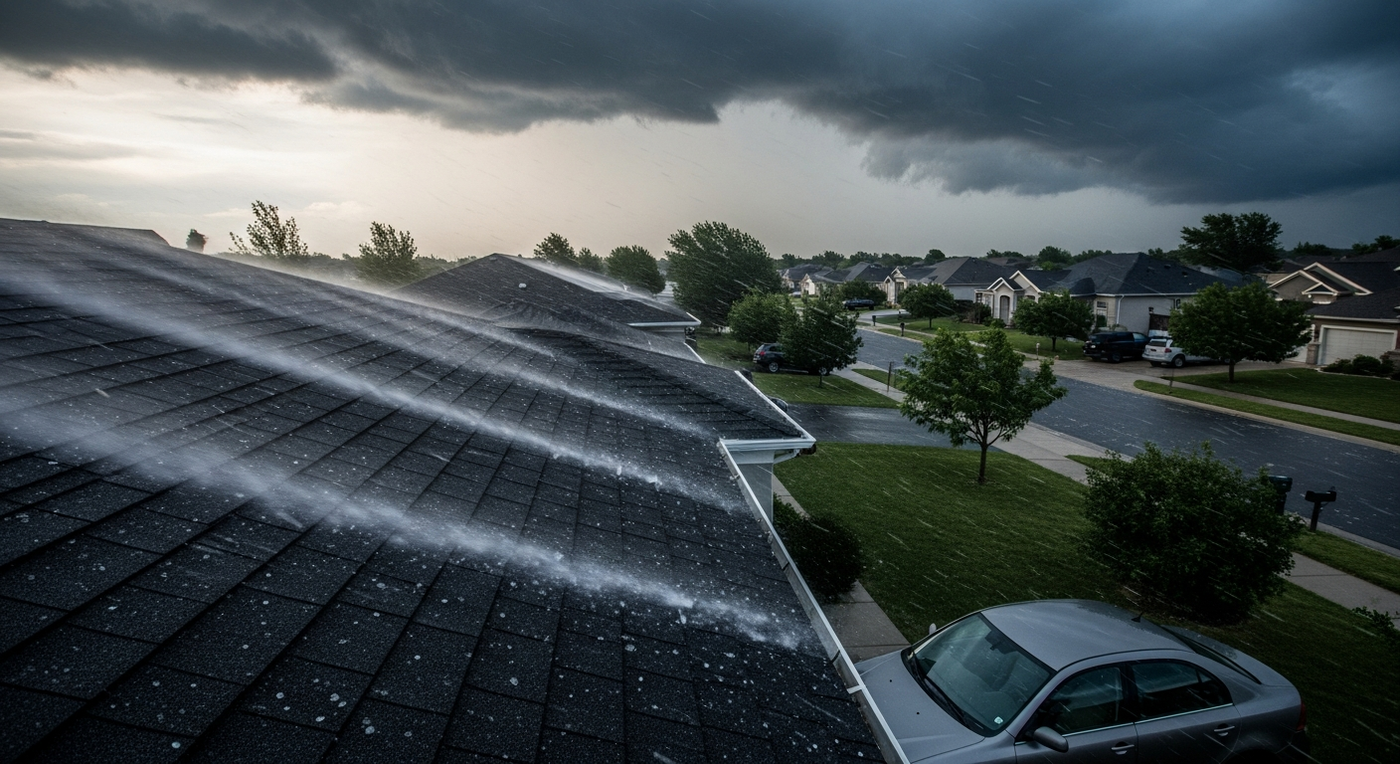
A hailstone's shape is a frozen record of its journey through the thunderstorm—and the spiky, irregular ones that shred metal and shatter glass tell a very different story than smooth spheres.

The Geometry of Violence: What Jagged Hail Reveals About the Storm Above
Hail Protector Editorial / GeminiExplainer

The Anatomy of a Hailstone's Birth

Hailstones form when supercooled water droplets freeze onto a nucleus—a speck of dust, a salt crystal, anything that gives ice a place to start. In a garden-variety thunderstorm with steady updrafts, that embryonic stone makes a relatively smooth journey up and down through layers of supercooled water, accreting ice in even layers like an onion. The result: a sphere or near-sphere, the shape that minimizes surface area for a given volume.

But in a severe thunderstorm—the kind that produces [hail quarter-size or larger](https://www.nssl.noaa.gov/education/svrwx101/hail/)—the internal wind structure is chaotic. Updrafts don't flow smoothly upward; they pulse, surge, and collide with downdrafts in turbulent eddies. A hailstone caught in this maelstrom gets thrown sideways into regions with different temperatures and moisture content. It might spend thirty seconds in a zone of heavy rime ice accumulation, then get flung into a relatively dry pocket where only a thin glaze forms, then tumble through an area where large supercooled drops create clear ice.

Each environment leaves a signature. Heavy rime—formed when droplets freeze on contact—creates opaque, bubbly ice. Clear ice forms when water spreads across the surface before freezing, releasing latent heat slowly. When these processes happen unevenly across the stone's surface, you get protrusions: lobes where the stone spent extra time in a rime-heavy zone, flat faces where it tumbled against other stones, spikes where a single large drop froze in place and became a seed for further asymmetric growth.

The most irregular stones come from storms with rotating updrafts—supercells. The rotation creates horizontal vorticity that gets tilted into the vertical, producing corkscrew wind patterns inside the storm. A hailstone in a supercell doesn't just go up and down; it spirals, spending time in wildly different parts of the storm's internal structure.

Here's what most people get wrong: they assume larger hail is always more dangerous. But a smooth two-inch sphere and a knobby two-inch irregular stone of the same mass behave completely differently on impact. The sphere distributes its kinetic energy across a relatively large contact patch—think of pressing your palm against a surface. The irregular stone concentrates that same energy into whatever protrusion hits first—more like jabbing with a knuckle. The pressure differential can be an order of magnitude higher.

Why Irregular Stones Shred What Smooth Ones Only Dent

The physics of impact damage depends on pressure: force divided by area. When a hailstone strikes a car hood, a roof shingle, or a solar panel, the damage severity correlates less with the stone's total kinetic energy than with how concentrated that energy becomes at the moment of contact.

A perfectly spherical hailstone striking a flat surface creates a circular contact patch. The stone deforms slightly, the target surface deforms slightly, and the impact force spreads across that patch. For a typical automotive clear coat and paint system over sheet metal, this produces the characteristic circular dent—the metal yields, the paint may crack at the edges of the dent, but the system remains intact.

An irregular stone with a pronounced spike or ridge, by contrast, creates a contact area perhaps one-tenth the size. Same kinetic energy, one-tenth the area, ten times the pressure. This exceeds the yield strength not just of the paint but of the underlying metal. Instead of a smooth dent, you get a puncture or a tear. The spike acts like a chisel, concentrating force into a line or point that shears through materials rather than deforming them.

This matters enormously for repair costs. A dented hood can often be pulled, filled, and repainted for somewhere in the low four figures. A punctured hood usually requires replacement—the metal's structural integrity is compromised, and pulling the puncture closed leaves stress concentrations that will fail again. Multiply that across a hailstorm that drops thousands of irregular stones across a metro area, and you understand why some hail events generate insurance claims that dwarf the totals from larger but smoother-hail storms.

Roofing contractors see the same pattern. Asphalt shingles hit by spherical hail show bruising—the granules get pressed into the mat, and you might see circular marks, but the shingle still sheds water. Shingles hit by irregular hail show tears, gouges, and displaced tabs. The spikes catch the edges of shingles and rip them partially free, creating entry points for water that lead to leaks and secondary damage.

The fall speed compounds the problem. [Small hailstones less than one inch in diameter fall between 9 and 25 mph](https://www.nssl.noaa.gov/education/svrwx101/hail/), but larger stones fall much faster—a two-inch stone typically reaches terminal velocity somewhere in the 50–60 mph range, depending on its mass and drag coefficient. Irregular stones have higher drag coefficients than spheres, so they fall slightly slower—but they also tumble unpredictably, which means the spike or ridge that does the damage can hit at any angle, including the worst-case perpendicular orientation.

One hail scientist I spoke with described irregular hailstones as "nature's caltrops"—the medieval weapons designed so that no matter how they land, a spike points upward. Except hail caltrops are falling at highway speeds.

Reading the Storm in the Stone

Insurance adjusters and storm chasers who've handled thousands of hailstones develop an intuitive sense for what a stone's shape reveals about the parent storm. A smooth, layered stone suggests a strong but relatively steady updraft—powerful enough to keep the stone aloft for multiple cycles, but laminar enough that the stone's path was predictable. These often come from the flanks of supercells, where the rotation is less intense.

Highly irregular stones with multiple lobes and chaotic internal structure signal a storm with violent, turbulent updrafts—the kind where wind speeds change dramatically over short distances. These are the storms that also produce tornadoes, extreme straight-line winds, and the kind of radar signatures (hook echoes, debris balls) that send meteorologists reaching for warning language like "particularly dangerous situation.".

The largest hailstone ever recovered in the United States—[an eight-inch, 18.62-inch-circumference monster that fell in Vivian, South Dakota, on June 23, 2010](https://www.nssl.noaa.gov/education/svrwx101/hail/)—was notably irregular, with lobes and ridges that suggested an extraordinarily turbulent journey through a supercell. Storms capable of producing stones that large have updrafts exceeding 100 mph, and the turbulence inside such storms defies simple modeling.

Some stones show clear evidence of multiple hailstones fusing together—they collided while coated in liquid water, froze together, and continued growing as a single irregular mass. This only happens in the most crowded parts of a storm's hail production zone, where stone density is high enough that collisions are common. It's a signature of what meteorologists call "hail swaths"—the narrow corridors of maximum hail accumulation where stones don't just fall individually but pile up in drifts.

The color and clarity of the ice layers also tell stories. Clear layers form when the stone is growing slowly enough that latent heat can dissipate—this happens in regions with fewer but larger supercooled drops. Opaque, white layers form during rapid growth in zones with many small droplets that freeze instantly, trapping air bubbles. A stone with alternating clear and opaque layers has been through multiple distinct environments, likely cycling through different altitudes or different sectors of a rotating storm.

10×

Pressure from spiked vs smooth

$52.3

billion

2025 severe storm losses

The Practical Implications for Property Owners

If you live in hail country—the corridor from Texas through Oklahoma, Kansas, Nebraska, and into South Dakota—you've probably internalized the advice to park in a garage when storms threaten and to inspect your roof after any severe weather. But understanding the relationship between hail shape and damage changes the calculus slightly.

After a hailstorm, most people walk outside, see a few dents in their car hood, and figure they'll deal with it eventually. But if you pick up one of the fallen stones and notice it's jagged, asymmetric, or has pronounced spikes, that's a signal to inspect more carefully. Check the roof, not just for obvious holes but for torn shingles and displaced flashing. Look at vinyl siding for cracks, not just dents. Examine window screens for tears—irregular hail punches through mesh that would stop a smooth stone of the same mass.

The timing of repairs matters more with penetrating damage than with simple dents. A dent in a car hood is cosmetic until you decide to fix it. A torn shingle is a leak waiting for the next rain. A punctured gutter is routing water into your fascia boards right now. The damage from irregular hail tends to be the kind that cascades if ignored.

Insurance companies know this, which is why adjusters pay close attention to hail shape when they're assessing claims. A neighborhood hit by smooth hail might generate mostly cosmetic claims that can wait for the next vehicle trade-in or roof replacement cycle. A neighborhood hit by irregular hail generates urgent claims—water intrusion, structural compromise, the kind of damage that gets worse by the week.

Some property owners in high-risk areas have started installing impact-resistant roofing materials—Class 4 shingles designed to withstand impacts from two-inch steel balls dropped from specific heights. These materials perform well against spherical hail, but their performance against irregular hail is less certain. The testing protocols don't account for concentrated spike impacts, and field observations suggest that while Class 4 shingles resist bruising better than standard shingles, they're still vulnerable to tearing and puncture from the most irregular stones.

The same logic applies to vehicle protection. A car cover rated for hail protection might prevent dents from smooth stones but still fail against irregular stones with enough spike length to penetrate the cover's padding. The best protection remains hard shelter—a garage, a carport with a solid roof, or in a pinch, parking under a concrete overpass (though this comes with its own risks if the storm produces tornadoes).

The Forecasting Challenge

Meteorologists can predict with reasonable accuracy when and where a severe thunderstorm will produce large hail. Radar signatures like three-body scatter spikes and bounded weak echo regions correlate strongly with hail production. But predicting whether that hail will be smooth or irregular—whether it will dent or penetrate—remains largely beyond current capabilities.

The internal structure of a thunderstorm is too complex and evolves too quickly for even the highest-resolution radar to capture in real time. Dual-polarization radar can distinguish between rain, hail, and debris, and it can estimate hail size based on reflectivity and differential reflectivity. But it can't tell you whether the hail is spherical or jagged. That information is locked inside the storm's updraft structure at scales smaller than the radar beam can resolve.

Storm chasers who intercept severe thunderstorms sometimes report being able to guess hail shape from visual cues—the appearance of the storm's base, the character of the lightning, the sound of the hail hitting the ground. But these are subjective assessments, more art than science, and they're only useful if you're already in the storm's path.

The practical result is that hail warnings treat all large hail as equally dangerous, even though the difference between smooth and irregular stones can mean the difference between hundreds of dollars in cosmetic repairs and tens of thousands in structural damage. Homeowners and drivers receive the same warning—"hail up to two inches in diameter possible"—whether the storm is producing smooth spheres or jagged projectiles.

Some researchers are working on machine learning models that correlate radar signatures with hail shape, trained on datasets of photographed and measured hailstones paired with radar data from the storms that produced them. The hypothesis is that certain combinations of updraft strength, rotation, and turbulence might predict irregular hail production. But the datasets are still small, and the models are experimental.

In the meantime, the best proxy for hail shape remains storm severity. The more violent the storm—the stronger the rotation, the higher the tops, the more intense the radar returns—the more likely it is to produce irregular hail. A marginal severe thunderstorm might drop quarter-size hail that's mostly spherical. A violent supercell with a tornado on the ground is almost certainly producing highly irregular hail in its core.

What Happens Next

The insurance industry has started paying closer attention to hail shape as a variable in loss modeling. [In 2025, severe convective storms caused $52,296 million in insured losses across 52 events](https://www.iii.org/fact-statistic/facts-statistics-us-catastrophes)—a figure that includes hail, tornadoes, and straight-line winds, but hail accounts for the majority of the property damage in most of these events. As climate patterns shift and severe thunderstorm frequency changes, understanding which storms produce the most destructive hail becomes increasingly important for risk assessment.

Some insurers are experimenting with post-storm hail collection programs, paying residents in affected areas to gather and photograph hailstones immediately after storms. The goal is to build better datasets linking hail characteristics to damage outcomes, which could eventually feed into more sophisticated pricing models and building code recommendations.

Material scientists are also getting involved, testing new roofing and siding materials against irregular hail impacts rather than just the standardized spherical projectiles used in current testing protocols. Early results suggest that flexibility matters more than hardness—materials that can deform and recover without tearing outperform rigid materials that resist initial penetration but crack under concentrated loads.

For individual property owners, the takeaway is simple: hail shape matters as much as hail size, and the storms that produce the most irregular hail are the same storms that produce the most severe weather overall. When the National Weather Service issues a warning for a particularly dangerous situation, or when storm chasers start posting videos of a supercell with a massive hook echo, the hail falling from that storm is likely to be jagged, irregular, and far more destructive than its diameter alone would suggest.

The geometry of violence is written in ice, and learning to read it might save you thousands of dollars—or at least help you understand why your neighbor's car has dents while yours has holes.

Verified Sources

  1. NOAA NSSL

    NOAA NSSL

    hail severity threshold, largest U.S. hailstone record, fall speeds for small hailstones

  2. Insurance Information Institute

    Insurance Information Institute

    2025 severe convective storm insured losses

Back to Hail Science