Regional Report Texas Hail Report

The Storm Corridor: Why Three Dallas Suburbs Lead the Nation in Hail Claims

McKinney, Allen, and Frisco occupy the exact geography where Great Plains supercells reach peak intensity, creating the highest-density hail damage zone in American suburbs.

The Storm Corridor: Why Three Dallas Suburbs Lead the Nation in Hail Claims
Hail Protector Editorial / GeminiRegional Report

The Maturity Window

Supercell thunderstorms don't reach full strength instantly. They require time to organize their internal structure—the rotating updraft that defines a supercell strengthens gradually as the storm ingests warm, moist air and develops its mesocyclone. During the first 30 to 45 minutes after formation, a supercell is typically still building. Its hail production during this phase tends to be modest, often pea to marble-sized.

The storm typically reaches what meteorologists call "mature stage" after roughly an hour of development. At this point, the updraft velocity peaks—sometimes exceeding 100 mph in the most intense storms—and hail stones can be recycled through the updraft multiple times, accumulating concentric layers of ice. National Severe Storms Laboratory research shows that the largest hail almost always falls during this mature window, which typically lasts 30 to 60 minutes before the storm begins to weaken.

For DFW, the geography creates a natural laboratory. Storms commonly initiate along the Caprock escarpment or near the dryline boundary west of Abilene. They typically track east-northeast at roughly 40 mph. Fort Worth sits approximately 120 miles from common initiation zones—that's the "building phase" distance. The northeast corridor sits another 30 to 40 miles beyond Fort Worth. By the time a supercell crosses US-75 through McKinney or the Dallas North Tollway through Frisco, it has typically been alive for 90 minutes to two hours.

Here's what most people misunderstand: Fort Worth gets hit by the same storms, but earlier in their lifecycle. The western suburbs—Weatherford, Azle, Aledo—experience frequent severe weather, but the hail is typically smaller and the wind less extreme because they're encountering storms that haven't fully organized yet. The northeast corridor catches the storm at its worst.

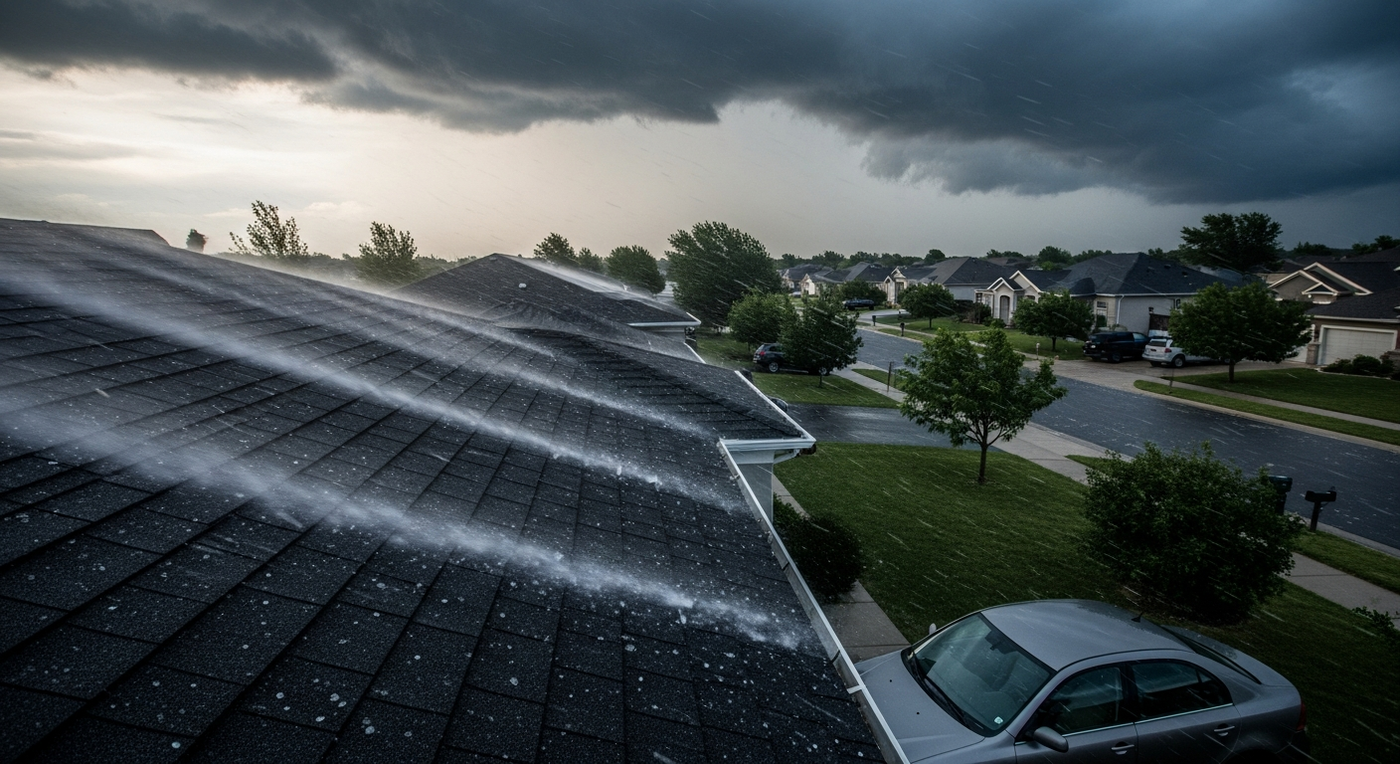
Insurance claim data reveals the corridor's unique risk profile.
The Claim Pattern

The Exposure Explosion

Frisco's population in 2000 stood at approximately 33,700. By 2020, that number reached approximately 200,500. The 2024 census estimate pushed past 230,000. McKinney grew from approximately 54,000 to over 210,000 in the same period. Allen expanded from approximately 43,000 to roughly 110,000. The three cities combined added approximately 400,000 residents in two decades, and each resident brought vehicles, roofs, and property into the highest-intensity hail zone in North America.

The construction boom placed enormous insurable value directly in the storm corridor. Subdivisions sprawled across former ranch land in eastern Denton County and throughout Collin County. The Dallas Morning News reported in 2019 that Collin County issued more residential building permits than any other Texas county for three consecutive years. Every new house added a roof typically around 2,500 square feet. Every three-car garage added three vehicles parked outside during the workday. The math is unforgiving: more exposure in the worst possible location.

Insurance carriers noticed. Premiums in the northeast corridor typically run roughly 25-35% higher than comparable suburbs in southern Dallas County or Tarrant County, even when controlling for home value and construction quality. Underwriters price for claim frequency, and the frequency in McKinney-Allen-Frisco exceeds anywhere else in the state. Some national carriers stopped writing new homeowner policies in specific ZIP codes after the 2016 season. Others increased deductibles for wind and hail to 2% or 5% of dwelling value—meaning a $400,000 home would carry an $8,000 to $20,000 deductible before coverage begins.

The vehicle exposure is particularly acute. Collin County's median household income sits well above the state average, and the vehicle mix skews toward newer, higher-value cars and trucks. Hail damage on a three-year-old pickup can easily run several thousand dollars for paintless dent repair, and if the hail cracks windshields or damages body panels beyond repair, costs escalate into five figures. Multiply that across tens of thousands of vehicles caught outside during a daytime storm, and a single event generates claim volumes that strain adjuster capacity across the entire region.

$1.3

billion

Single storm insured losses

60%

Damage concentrated in northeast corridor

40%

Higher claim density vs comparable cities

90

min

Storm travel time to peak intensity

The Claim Pattern

Insurance claim data reveals the corridor's unique risk profile. While tornado damage tends to be geographically narrow—a quarter-mile-wide path through a city—hail swaths can span 20 to 40 miles in width and 100 miles in length. A major supercell crossing the northeast corridor doesn't just hit one neighborhood; it hammers entire cities simultaneously. The April 2024 event that produced baseball-sized hail from Prosper through McKinney to Wylie generated an estimated 80,000 individual claims in a single afternoon. Adjusters from across the country flew into DFW to handle the volume.

The claim-to-household ratio in these suburbs routinely exceeds 0.4 during active years—meaning more than 40% of households typically file at least one property or auto claim related to hail. In extreme years, the ratio can approach 0.6. For context, most suburban areas typically see ratios between 0.1 and 0.2 even in severe weather-prone states. The northeast corridor's ratio is an outlier that reflects both storm intensity and the timing of when storms arrive.

Interestingly, claim severity—the average dollar amount per claim—runs slightly lower in the northeast corridor than in wealthier Dallas suburbs like Highland Park or University Park. The reason is vehicle mix and construction type. While Collin County incomes are high, the housing stock is newer and consists largely of production homes with composition shingle roofs rather than the tile or slate roofs common in older, established neighborhoods. Composition shingles are cheaper to replace. Similarly, the vehicle mix includes many trucks and SUVs, but fewer exotic or luxury vehicles than areas closer to downtown Dallas. High frequency, moderate severity—the pattern that makes actuaries nervous.

The Forecast Problem

Meteorologists can identify days with supercell potential 48 to 72 hours in advance with reasonable accuracy. The Storm Prediction Center issues outlooks that highlight areas where severe thunderstorms are likely.

For residents of the northeast corridor, this creates a planning challenge. You know your area is high-risk. You know spring afternoons carry elevated danger. But you can't park your car in the garage every day from March through June on the off-chance that today is the day a supercell matures overhead. Most people work outside the home. Vehicles sit in parking lots.

The economic impact extends beyond direct damage. Body shops and roofing contractors in Collin County stay booked months in advance during hail season. After a major event, wait times for repairs can stretch to six months or longer. Rental car agencies run out of vehicles. The secondary economic disruption ripples through the service economy—every damaged car means a resident driving a rental, every roof replacement means a crew that could be working on new construction instead spending weeks on insurance work.

Some residents have adapted by installing hail-resistant roofing materials—Class 4 impact-rated shingles that can withstand larger hail stones without damage. Insurance companies typically offer premium discounts around 10-20% for Class 4 roofs, which helps offset the higher upfront cost. But the adoption rate remains modest. Most homeowners replace roofs only after damage, and at that point, they're working within insurance proceeds that may not cover the upgrade to impact-resistant materials.

The vehicle problem has no comparable solution. Hail blankets can protect cars parked at home, but they're impractical for daily use and offer no protection for vehicles at work or shopping. Some parking garages in the corridor now advertise "hail-protected parking" as a premium amenity, charging monthly rates that typically run $50 to $100 above standard parking fees. The market has recognized the risk and priced it accordingly.

Why This Corridor Specifically

Other parts of DFW experience severe weather. Southern Dallas County sees tornadoes. Western Tarrant County gets damaging wind. But the northeast corridor's unique position as the maturity zone for eastward-tracking supercells makes it the hail epicenter. The storms aren't more frequent here than elsewhere in the metro—they're simply more intense when they arrive.

The elevation change plays a subtle role. The terrain slopes gently downward from west to east across the metroplex, dropping approximately 400 feet from Fort Worth to McKinney. As supercells move downslope, they encounter slightly higher moisture content and warmer surface temperatures in the lower elevations, which can enhance updraft strength during the mature phase. The effect is modest—meteorologists debate its significance—but it may contribute to the corridor's consistently extreme hail events.

Urban heat island effects also factor in. The dense development in the northeast corridor creates a localized warm zone that can intensify storms passing overhead. Asphalt, rooftops, and concrete absorb and radiate heat, typically increasing surface temperatures by several degrees compared to rural areas. For a supercell already at peak intensity, that additional heat energy can push updraft velocities slightly higher, enabling the production of even larger hail stones.

The result is a feedback loop: explosive growth places more property in the path of peak-intensity storms, generating massive claim volumes that drive up insurance costs, which in turn become a hidden cost of living in the corridor. Residents pay a premium—literally—for the convenience and amenities of these rapidly growing suburbs, and part of that premium is the near-certainty that every few years, a supercell will arrive at exactly the wrong time and pummel everything in its path.

The northeast corridor isn't going to depopulate. Growth continues, with new master-planned communities breaking ground every year. The storms aren't going to change their behavior—the meteorology is dictated by geography and atmospheric physics that operate on scales far beyond human influence. The collision between suburban expansion and supercell maturity zones will continue, making McKinney, Allen, and Frisco the perennial leaders in a statistic no city wants to win: hail claims per capita. The storm corridor has been defined by nature and filled in by development, and every spring, the pattern repeats.

Verified Sources

  1. National Severe Storms Laboratory

    National Severe Storms Laboratory

    supercell structure and hail formation research

Back to Hail Science