Regional Report Arizona Hail Report

When the Desert Makes Ice: Arizona's Monsoon Hail Season Catches Drivers Off Guard

Between July and September, Phoenix receives more hail than many northern cities — all from afternoon thunderstorms fueled by tropical moisture colliding with superheated desert air.

When the Desert Makes Ice: Arizona's Monsoon Hail Season Catches Drivers Off Guard
Hail Protector Editorial / GeminiRegional Report

How Desert Thunderstorms Manufacture Ice

The mechanics require three ingredients that monsoon season delivers reliably: moisture, heat, and atmospheric instability. By early July, dewpoints across southern Arizona climb from the typical 20s and 30s into the 50s and 60s Fahrenheit as southerly winds pull tropical air northward. That moisture sits atop a desert surface baked to 170 degrees or hotter on asphalt. The result is what meteorologists call "extreme CAPE" — Convective Available Potential Energy, a measure of atmospheric instability. According to National Weather Service Phoenix, summer monsoon days in Phoenix routinely generate CAPE values above 2,000 joules per kilogram, comparable to the energy available during Great Plains tornado outbreaks.

When these storms ignite — usually between 2 p.m. and 8 p.m. — updrafts can exceed approximately 60 miles per hour. A raindrop gets lofted into subfreezing air at roughly 15,000 feet, freezes, falls, gets caught in another updraft, gains another layer of ice, and repeats the cycle. The hailstone grows like an onion until it's heavy enough that even a 60-mph updraft can't hold it aloft. Then it falls, often into neighborhoods where the temperature at ground level is still 105 degrees. The ice doesn't melt fast enough during the two-minute descent.

Here's what surprises atmospheric scientists: Arizona monsoon hail often grows larger than Great Plains hail despite shorter storm lifespans. The explanation involves lapse rates — the temperature change with altitude. Desert air temperature drops more steeply with height than humid continental air, creating a tighter vertical temperature gradient. Hailstones cycle through the freezing zone more times per minute, accreting ice faster. A Phoenix supercell might last roughly forty minutes but produce two-inch hail, while a Kansas storm lasting three hours produces similar sizes. The desert is efficient.

The monsoon follows a calendar most people outside the Southwest don't recognize. The National Weather Service officially defines monsoon season as June 15 through September 30, but the moisture doesn't arrive on schedule like a train. Some years the dewpoint doesn't crack 50 degrees until mid-July. Other years — 2021 was notable — robust moisture arrives by June 20 and triggers daily storms through early August before abruptly shutting off. According to NOAA's National Centers for Environmental Information, August historically produces the most hail reports across Arizona, followed by July, then September. June hail is rare. October hail happens but usually from different storm types as the monsoon retreats.

Peak threat typically sits in a narrow window: roughly July 10 through August 25. This is when Gulf moisture is most reliable, when surface temperatures are still extreme enough to generate violent updrafts, and when the upper-level pattern favors afternoon storm development. By mid-September, overnight temperatures drop enough that daytime heating becomes less intense. Storms still form but with less explosive energy. The hail threat diminishes but doesn't disappear — September surprises happen, usually during the last gasp of tropical moisture before the pattern flips back to dry desert air.

Phoenix drivers remain unprepared because a few hail days per summer doesn't train behavior. In Denver, where hail falls more frequently throughout the year, residents know to park in garages during storm season. In Phoenix, covered parking is a luxury amenity, not a hail precaution. Most apartment complexes offer zero covered spaces. Office parks have uncovered lots. Shopping centers are asphalt fields. When a storm drops golf ball hail at 4 p.m. on a Tuesday, thousands of cars sit exposed because no one checks radar before going to Target.
The Geography of Surprise

Monsoon hail doesn't distribute evenly across Arizona. Elevation and terrain create microclimates that funnel storms into predictable corridors — though "predictable" is relative when you're talking about convection. The Phoenix metro area sits in a bowl surrounded by mountains including the McDowell Mountains to the northeast, the White Tank Mountains to the west, and South Mountain to the south. These ranges channel monsoon winds and create convergence zones where air piles up, rises, and ignites storms. North Phoenix and Scottsdale receive disproportionate hail compared to south Phoenix, largely because storms forming over the Mogollon Rim to the north drift southwest and intensify as they descend into the valley.

Tucson has a different pattern. The city sits higher (at approximately 2,400 feet versus Phoenix's roughly 1,100 feet) and closer to the source moisture from the Gulf of California. Tucson storms tend to form earlier in the afternoon and produce more frequent lightning but slightly less severe hail. The Santa Catalina Mountains north of Tucson trigger daily storms in July and August, but those storms often dissipate as they move over the city rather than intensifying. When Tucson does get severe hail, it's usually from storms forming over the Rincon Mountains to the east.

Flagstaff — at approximately 7,000 feet — gets hail regularly but from entirely different mechanisms. High-elevation summer storms produce pea-sized hail almost daily, but it's nuisance hail, not car-destroying hail. The atmosphere at 7,000 feet doesn't have the same extreme surface heating that generates violent Phoenix updrafts. Flagstaff hail is cold-cloud hail, formed in storms that are tall but not particularly intense. It melts within minutes of landing.

The most destructive hail in Arizona history — measured by insurance payouts — has consistently hit the Phoenix metro's northern suburbs: Anthem, Deer Valley, north Scottsdale. These areas combine three risk factors: they sit in a convergence zone where storms intensify, they have high property values and newer vehicles, and they've experienced rapid development in the past twenty years, meaning thousands of homes and cars exist in areas that were empty desert during earlier monsoon seasons. The hail threat hasn't increased; the exposure has.

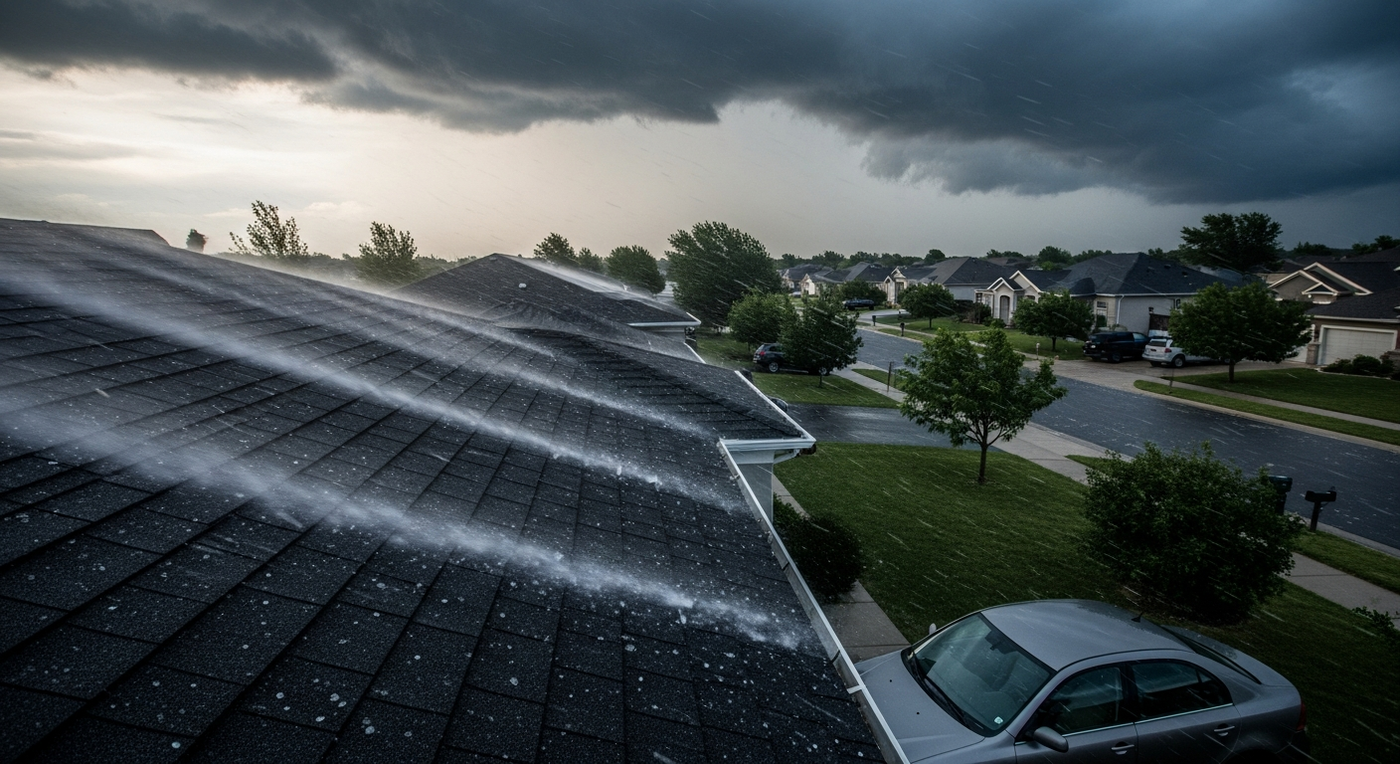
One detail that doesn't get enough attention: monsoon hail often falls at night. The classic pattern is afternoon storm initiation, but many of the most severe hail events in Phoenix have occurred between 8 p.m. and midnight as storms that formed in the mountains drift into the valley after sunset. These nocturnal hail events catch people completely off guard. You're asleep, you hear what sounds like gunfire on your roof, you run outside in your pajamas to find ice cubes the size of limes bouncing off your driveway. By morning they've melted, leaving only the dents.

Insurance implications follow predictably. Comprehensive coverage handles hail damage, but an estimated 20-30% of Arizona drivers carry liability-only policies. After a severe hail event, those drivers face a choice: pay typically several thousand dollars for repairs or drive a dimpled car. Many choose the latter, which is why you see so many hail-pocked vehicles on Phoenix freeways in late August. The damage is cosmetic but permanent. Resale value drops, but the car functions fine. It's a visible reminder of a ten-minute storm that happened weeks or months earlier.

Premium increases after hail claims vary by insurer, but comprehensive claims generally affect rates less than collision or liability claims. Some insurers don't surcharge for a single comprehensive claim; others may raise rates by varying amounts. The larger issue is availability. After major hail events, some insurance companies may temporarily stop writing new policies in affected ZIP codes. They don't announce it, but agents know. If you're shopping for insurance in north Scottsdale in September after a bad hail summer, you might find fewer options than you expect.

The monsoon hail season operates on a rhythm that contradicts everything people assume about desert weather. Ice falls when temperatures hit 110 degrees. The wettest months are the hottest months. Storms are most violent in mid-afternoon when the sun is strongest. For three months each summer, Arizona becomes a place where tropical moisture and extreme heat collide to create atmospheric chaos — and where drivers park their cars in open lots, check the forecast, see a 40% chance of thunderstorms, and think nothing of it until golf balls start denting their hood.

$80M

Single storm damage estimate

A

few days

Annual hail events

~60

mph

Peak updraft velocity

Several

weeks

Body shop wait times

Verified Sources

  1. National Weather Service Phoenix

    National Weather Service Phoenix

    monsoon hail climatology and frequency data

  2. NOAA Storm Prediction Center

    NOAA Storm Prediction Center

    Storm report archive with severe hail event records.

  3. National Weather Service

    National Weather Service

    Public guidance on severe thunderstorm and hail safety.

  4. Insurance Information Institute

    Insurance Information Institute

    Insurance context for auto losses and claims impact.

Back to Hail Science