Regional Report

Hail Alley Is Actually Three Alleys: Mapping America's Shifting Hailstorm Corridors

The geography of severe hail follows the jet stream across three distinct zones from March through September, creating overlapping risk areas that move 800 miles north between spring and summer.

Hail Alley Is Actually Three Alleys: Mapping America's Shifting Hailstorm Corridors
Hail Protector Editorial / GeminiRegional Report

The Three-Zone System Nobody Talks About

Hail Alley isn't one place. It's three overlapping corridors that activate sequentially as the jet stream migrates north through spring and summer. The Southern Zone—stretching from north Texas through central Oklahoma into southern Kansas—peaks in April and May. The Central Zone, running from Nebraska through eastern Colorado and Wyoming, sees maximum activity in June. The Northern Zone, covering South Dakota, Montana, and the Canadian border states, doesn't hit peak hail season until July and early August.

This matters because insurance companies, roofing contractors, and emergency planners often treat "Hail Alley" as a static geographic feature, like Tornado Alley. But hail risk is temporal. A homeowner in Cheyenne faces fundamentally different timing than someone in Oklahoma City, even though both live in what maps label as high-risk zones.

According to NOAA's Storm Events Database, the shift is dramatic. Texas reports approximately 60% of its annual severe hail reports between March and May. Wyoming reports approximately 70% of its severe hail between May and July. Montana's peak doesn't arrive until late June through mid-August.
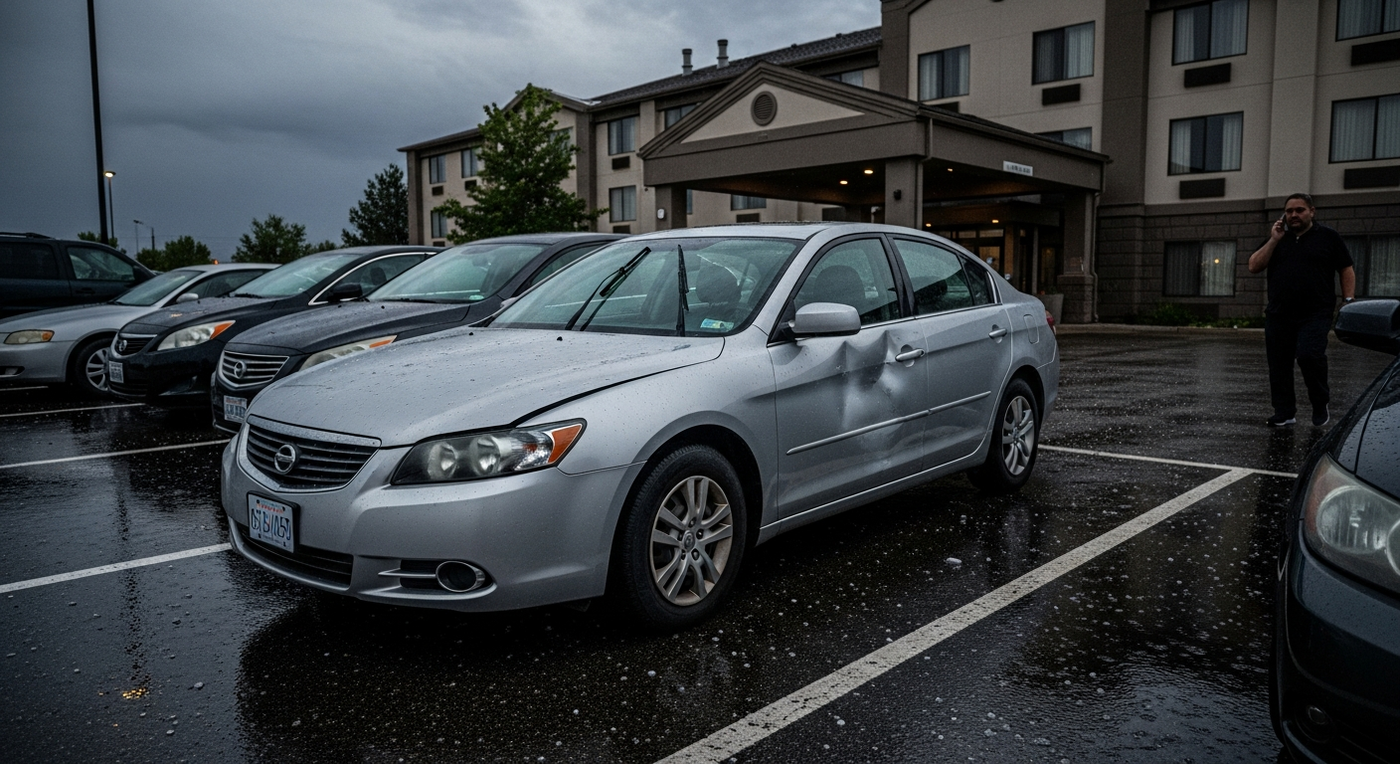
The Cities That Actually Lead the Rankings

When you measure hail frequency per capita rather than total events, the top ten list surprises most people.

Cheyenne, Wyoming consistently ranks first or second nationally for severe hail days per year—the city experiences approximately 9-10 days annually with hail one inch or larger. That's more frequent than Denver, despite Denver's larger population drawing more media attention to Colorado hail events. Lubbock, Texas; Amarillo, Texas; and Pueblo, Colorado all record higher per-capita hail frequencies than Dallas or Oklahoma City.

The pattern holds for smaller cities. Dodge City, Kansas averages approximately seven severe hail days annually. Rapid City, South Dakota sees similar numbers. These communities experience hail as a regular seasonal occurrence, not an exceptional event.

Population density distorts perception. Dallas-Fort Worth reports more total hail damage claims than Cheyenne simply because millions more people and vehicles sit exposed when storms arrive. But a resident of Cheyenne is statistically more likely to experience severe hail in any given year than a Dallas resident. Insurance actuaries know this—premiums in Cheyenne reflect it—but public perception lags behind the data.

Interstate Corridors as Hail Damage Concentrators

I-25 through Colorado and Wyoming functions as a hail damage superhighway. Not because hail targets the road—storms don't care about asphalt—but because the interstate channels tens of thousands of vehicles per day through the exact topographic zone where severe hail forms most reliably.

The Front Range corridor, where I-25 runs from Pueblo through Denver to Cheyenne, sits at the collision point between upslope flow from the plains and the Rocky Mountain barrier. Storms forming here produce hail with unusual consistency. According to National Weather Service Boulder's hail climatology, the I-25 corridor from Castle Rock to Fort Collins experiences severe hail approximately 5-7 times per summer season.

I-35 through central Oklahoma and Kansas creates a similar concentration effect. The highway runs directly through the heart of the Southern Zone, parallel to the dryline where gulf moisture meets continental air. Commuters traveling I-35 between Oklahoma City and Wichita during late afternoon in May are driving through one of the highest hail-probability corridors in North America during peak activity hours.

I-70 across eastern Colorado presents a different pattern. The highway crosses perpendicular to typical storm motion, meaning hail events affect shorter stretches of road but with intense localized impact. A supercell moving northeast across the plains might drop baseball-sized hail across a roughly 15-mile stretch of I-70 east of Limon, leaving vehicles with nowhere to shelter and no advance warning beyond what radar provides.

I-44 through southwest Missouri and northeast Oklahoma sits at the southern edge of maximum hail frequency but catches the tail end of major outbreak sequences. The Joplin-Tulsa corridor sees fewer hail days annually than I-25 or I-35, but the events that do occur often happen as part of larger severe weather systems that also produce tornadoes.

800

miles

Northward seasonal shift

9-10

days

Cheyenne annual severe hail

~60%

Texas hail: March-May

~70%

Wyoming hail: May-July

Why the Jet Stream Writes the Map

The jet stream's seasonal position controls where hail forms because it determines where cold upper-level air intersects with warm, moist surface air. Severe hail requires strong updrafts—typically 50-70 mph vertical velocity according to NOAA's Storm Events Database—to keep ice particles suspended long enough to grow large. That kind of instability happens where temperature contrasts are sharpest.

In April, the jet stream typically dips south across Texas and Oklahoma, positioning the zone of maximum wind shear and temperature contrast directly over the Southern Plains.

Here's what most people get wrong: they assume hail follows heat. Peak hail season doesn't align with peak summer temperatures. Nebraska's worst hail months are May and June, not July and August when temperatures are highest. The key ingredient isn't heat alone—it's the collision between heat and cold aloft, which happens most violently during the transition seasons.

The Overlooked Eastern Edge

While the Great Plains dominate hail statistics, a secondary corridor runs through the western Midwest that receives less attention but produces significant damage. A band stretching from Kansas City through Des Moines to Minneapolis experiences regular severe hail, particularly in June and July.

This zone doesn't produce the giant hail—grapefruit-sized stones—that make headlines from Colorado and Wyoming storms. But it generates frequent golf-ball to tennis-ball hail that damages vehicles and roofs across metropolitan areas with millions of residents. According to Insurance Information Institute claims data, the Kansas City metro area typically ranks in the top fifteen nationally for hail damage payouts, despite sitting east of what traditional maps label as Hail Alley.

The mechanism differs slightly from classic High Plains hail. Midwest hail often forms in mesoscale convective systems—organized clusters of thunderstorms—rather than isolated supercells. These systems produce hail across wider areas but with slightly smaller maximum stone sizes. The trade-off: more vehicles and structures exposed, even if individual stones are somewhat smaller.

Elevation's Hidden Role

Hail size correlates with elevation in ways that aren't immediately obvious. Higher elevation doesn't just mean colder air aloft—it means hailstones have less atmosphere to fall through before reaching the ground.

A two-inch hailstone forming at approximately 40,000 feet over Cheyenne (elevation roughly 6,000 feet) falls through approximately 34,000 feet of atmosphere. The same stone forming over Oklahoma City (elevation approximately 1,200 feet) falls through approximately 38,800 feet. That extra distance matters. Hailstones melt as they fall, particularly when dropping through warm air near the surface. Stones that would reach the ground as baseballs in Wyoming might arrive as golf balls in Oklahoma after melting during the longer descent.

This partially explains why Colorado and Wyoming report disproportionate numbers of very large hail (approximately 2.75 inches or greater) despite not necessarily having stronger storms than Texas or Oklahoma. The elevation advantage preserves stone size.

Where the Maps Fail

Standard hail risk maps show annual probability zones but obscure critical details. A map showing "high risk" across the entire Great Plains from Texas to Montana treats radically different seasonal patterns as equivalent.

Better maps would show monthly risk, revealing how the danger zone migrates. A homeowner in Billings, Montana looking at an annual map sees "high risk" and might schedule roof inspections in May, missing the fact that local hail season doesn't peak until July. Timing matters for preparation.

The maps also struggle with urban heat island effects. Cities create their own microclimates that can enhance or suppress hail formation. Some research suggests urban areas may experience slightly reduced hail frequency in their immediate cores due to disrupted storm inflow, but dramatically increased frequency in downwind suburbs where urban-enhanced updrafts mature. The data remains incomplete, but the pattern appears in claims records from Denver, Oklahoma City, and Dallas.

The Forecast Problem

Predicting where hail will fall remains harder than predicting where tornadoes will form, despite hail being more common. Radar can identify hail signatures in existing storms, but forecasting which developing storms will produce severe hail hours in advance involves substantial uncertainty.

The challenge: hail formation happens inside the storm, hidden from direct observation. Meteorologists infer hail size from radar reflectivity and updraft strength, but two storms with identical radar signatures can produce dramatically different hail sizes depending on subtle differences in internal structure.

This creates planning difficulties for anyone trying to protect assets. A construction company with equipment staged along I-25 can see that severe thunderstorms are forecast for the afternoon, but knowing whether those storms will produce damaging hail versus just heavy rain requires waiting until storms develop and mature. By then, options for protection have narrowed.

Verified Sources

  1. NOAA National Centers for Environmental Information Storm Events Database

    NOAA National Centers for Environmental Information Storm Events Database

    hail frequency and timing data by state and season

  2. National Weather Service Boulder Hail Climatology

    National Weather Service Boulder Hail Climatology

    Front Range corridor hail patterns and frequency

Back to Storm Prep