Regional Report Nebraska Hail Report

Nebraska's June Hail Siege: Why the Cornhusker State Waits Longer and Gets Hit Harder

Nebraska's hail season peaks a full month after the southern Plains, creating a concentrated window of risk that puts Omaha directly in the path of the continent's most violent updrafts.

Nebraska's June Hail Siege: Why the Cornhusker State Waits Longer and Gets Hit Harder
Hail Protector Editorial / GeminiRegional Report

The I-80 Gradient: From Omaha's Bulls-Eye to the Panhandle's Lottery

If you drive Interstate 80 from Omaha to the Wyoming border, you're traveling through a complete spectrum of hail climatology compressed into 455 miles. Eastern Nebraska, particularly the Omaha metro area and the Platte River valley, sits in what meteorologists call a "hail maximum"—a zone where atmospheric conditions align with remarkable consistency to produce large, damaging hail.

Omaha's position isn't coincidental. The city sits on bluffs above the Missouri River, where the relatively flat terrain of eastern Nebraska begins its gradual climb toward the High Plains. This subtle topography matters more than you'd think. When supercell thunderstorms move east across the state, they encounter the Missouri River valley's slightly cooler, more stable air mass. This creates a boundary layer where storms can intensify their rotation and, critically, where downdrafts can accelerate.

The terrain effect works like this: as a supercell's rear-flank downdraft descends toward the river valley, it encounters denser air near the surface. This can create a focusing effect, concentrating the downdraft's energy and allowing hailstones to fall through a narrower column of air with less time to melt. It's not a dramatic mountain range creating the effect—it's a roughly 200-foot elevation change doing subtle but meaningful work.

Move west along I-80, and the hail character changes. Lincoln sees slightly less frequent hail than Omaha but similar stone sizes. Grand Island, sitting in the central Platte valley, experiences some of the state's most consistent severe weather, with hail reports clustering along the river corridor where moisture convergence is most pronounced. By the time you reach North Platte, you're in a transitional zone—still firmly in hail country, but with a different flavor. The western Sandhills and Panhandle see fewer total hail days, but when storms do develop, they're often more isolated and intense, fed by the higher elevation and drier air that allows for more extreme temperature gradients.

The Omaha metro area's hail frequency is striking enough that it shows up clearly in Storm Prediction Center climatology data. According to Storm Prediction Center climatology data, the region experiences significant hail (one inch diameter or larger) on roughly four to six days per year on average, with individual years seeing considerably more. The 2003 season, for instance, brought multiple significant hail events to the metro area, including a May 22 outbreak that produced baseball-sized hail in Bennington and caused widespread roof and vehicle damage across the northern suburbs.

Here's what surprises people: Omaha's hail risk is higher than many cities much farther south. The metro area sees large hail more frequently than Little Rock, Memphis, or even parts of northern Texas. The reason comes down to timing and atmospheric structure. By June, Nebraska sits beneath the "sweet spot" where the jet stream's energy, Gulf moisture, and continental heating intersect. The storms that form in this environment aren't just severe—they're structurally optimized for hail production, with updrafts strong enough to suspend stones in the growth zone for extended periods.
60%

%

Hail events in six-week window

4-6

days/year

Large hail in Omaha metro

4.5

inches

2014 York-Seward stone diameter

$100M+

2008 Omaha storm claims

Why June Matters: The Atmospheric Mechanics of Delayed Violence

Nebraska's late-season hail peak is a function of continental-scale thermodynamics. In April and May, when Oklahoma and Kansas are getting hammered, Nebraska's soil is still relatively cool and the polar jet stream remains too far north to provide consistent upper-level support for severe weather. The state gets storms during this period, certainly, but they lack the organizational structure and intensity of what's coming.

By early June, everything changes. Soil temperatures across the eastern third of the state typically climb into the 70s, creating a warm boundary layer that destabilizes the lower atmosphere. The jet stream settles into a pattern that frequently positions its exit region—the area of strongest upper-level divergence—directly over Nebraska. Meanwhile, southerly winds at the surface begin reliably transporting Gulf moisture northward, with dew points often climbing into the 60s and occasionally touching 70 degrees.

This combination creates what meteorologists call "loaded gun" environments. The atmosphere becomes extremely unstable, with Convective Available Potential Energy (CAPE) values frequently exceeding 3,000 joules per kilogram. When storms initiate in these conditions, they don't just grow—they explode upward, with updrafts sometimes reaching 50,000 feet or higher. These towering updrafts are hail factories, cycling supercooled water droplets through multiple freeze-thaw cycles until stones grow large enough to overcome the updraft and fall.

The hailstone growth process depends on updraft strength and the amount of supercooled liquid water available in the storm. Nebraska's June storms excel at both. The strong updrafts keep stones suspended in the growth zone—the region typically between roughly 10,000 and 30,000 feet where temperatures range from approximately -10°C to -30°C—for extended periods. Each cycle through this zone adds another layer of ice. Cut a large hailstone in half and you'll see the concentric rings, like tree growth rings, each representing another trip through the updraft.

Wind shear plays a crucial role in organizing these storms into long-lived supercells rather than short-lived pulse thunderstorms. Nebraska's June environment typically features strong directional wind shear, with winds veering (turning clockwise) with height from southerly at the surface to southwesterly or westerly aloft. This shear tilts the updraft, separating the precipitation region from the updraft core and allowing the storm to persist for hours rather than minutes.

The result is storms that can track across multiple counties, dropping hail along paths sometimes extending 50 miles or more. The June 17, 2009 Aurora supercell traveled from south-central Nebraska into Iowa, producing hail up to 3.75 inches in diameter and maintaining severe intensity for more than three hours. These long-track events cause disproportionate damage because they affect larger geographic areas and give the hail time to accumulate in deep drifts that can take days to melt.

One aspect of Nebraska's hail climatology that doesn't get enough attention: the state's hail season has a sharp cutoff. By mid-July, hail frequency typically drops dramatically. The jet stream lifts into Canada, upper-level winds weaken, and while severe thunderstorms still occur, they're less likely to produce giant hail. The atmospheric window is narrow—approximately six to eight weeks—which means property owners, farmers, and insurers face a concentrated period of risk rather than a diffuse, season-long threat.

The Economic Geography of Frozen Water

Nebraska's hail risk creates distinct economic patterns across the state. In Omaha and Lincoln, the damage is primarily to vehicles, roofs, and siding—urban hail damage that shows up in homeowners and auto insurance claims. A single significant hail event in the Omaha metro area can generate insurance claims totaling tens of millions of dollars, with the May 2008 hailstorm producing claims estimated at over $100 million across the region.

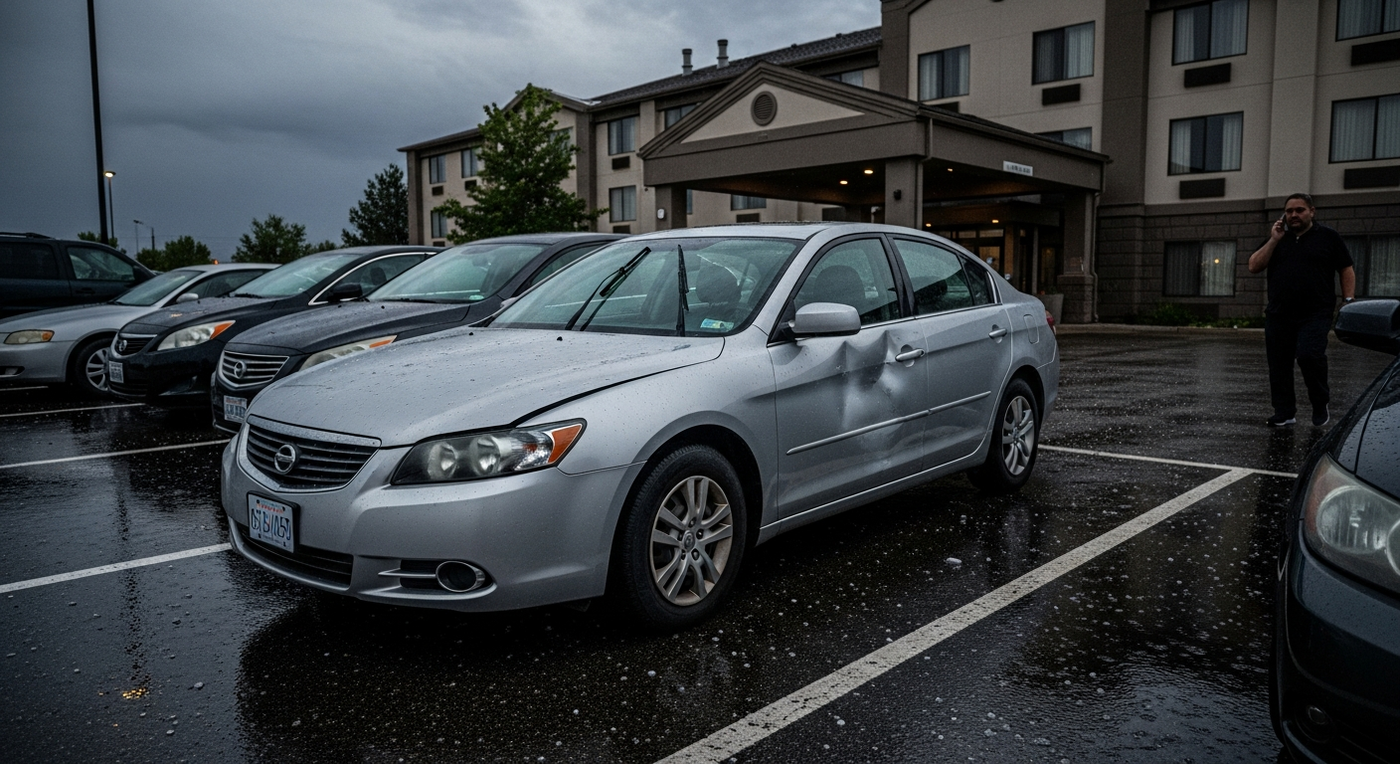
The vehicle damage is particularly expensive because modern cars have become more susceptible to hail. Thin aluminum hoods and composite body panels dent more easily than the heavier steel used in older vehicles. Paintless dent removal has become a specialized industry in Nebraska, with technicians following the storm tracks each season. After a major hail event, you'll see parking lots full of damaged vehicles waiting for repair, and body shops booking appointments months in advance.

Agricultural hail damage follows different patterns. Corn and soybeans—Nebraska's primary crops—are most vulnerable during specific growth stages. Hail in late May or early June can destroy newly emerged corn plants, forcing farmers to replant or accept reduced stands. Hail in July, when corn is tasseling and soybeans are flowering, can devastate yields by shredding leaves and breaking stalks. A single hailstorm can reduce corn yields by an estimated 50% or more in affected fields, turning what should be a profitable harvest into a break-even proposition or worse.

Crop insurance has become essential in Nebraska's hail-prone counties. Most farmers carry multi-peril crop insurance that covers hail damage, but the coverage comes with deductibles and coverage limits that mean farmers still absorb significant losses. The insurance payouts keep farms solvent after major hail events, but they don't fully compensate for lost income or the disruption to farm operations.

The hail risk also shapes agricultural practices. Some farmers adjust planting dates to minimize exposure during the peak hail window, though this strategy has limited effectiveness since you can't really dodge a six-week period that coincides with critical growth stages. Others diversify crops or plant fields in different locations to spread risk. In the highest-risk areas, some farmers have simply accepted that they'll lose a portion of their crop to hail every few years and factor that into their business planning.

Here's an odd detail that illustrates how localized hail damage can be: after the 2014 York-Seward storm, adjusters found fields where the hail path was so clearly defined that you could stand with one foot in destroyed corn and the other foot in undamaged plants. The storm's swath was less than a mile wide in some places, creating a patchwork of devastation and normalcy that made damage assessment surreal. Farmers whose fields were spared watched their neighbors' crops get shredded while their own plants swayed untouched in the wind.

The state's hail climatology has also created a specialized forecasting and warning infrastructure. The National Weather Service offices in Omaha and Hastings have refined their severe weather warning procedures to account for Nebraska's hail patterns, issuing warnings with specific hail size estimates and impact-based language. During peak season, storm spotters position themselves along likely storm tracks, providing ground truth that helps forecasters issue more accurate warnings.

Radio stations in rural areas still interrupt programming for severe weather warnings, a practice that's faded in many urban markets but remains vital in agricultural regions where farmers need real-time information to make decisions about moving equipment, protecting livestock, or seeking shelter. The integration of smartphone-based warning systems has improved coverage, but in areas with spotty cellular service, traditional broadcast warnings remain the primary alert mechanism.

Insurance Adaptation and Risk Pricing

The insurance industry has responded to Nebraska's concentrated hail risk by adjusting premiums and coverage options. Homeowners in Omaha and Lincoln typically pay higher premiums than similar homes in non-hail-prone regions, with the hail risk factored into the base rate. Some insurers offer impact-resistant roofing discounts, encouraging homeowners to install Class 4 shingles designed to withstand larger hail impacts. These roofs cost more upfront but can reduce insurance premiums and provide better protection during severe weather.

Auto insurance follows similar patterns, with comprehensive coverage—which covers hail damage—priced higher in Nebraska than in states with lower hail frequency. Insurers track hail climatology carefully, using decades of claims data to model risk and set premiums that reflect the state's unique exposure to severe hail events. risk at the ZIP code level. The result is pricing that reflects actual exposure, but also creates affordability challenges for residents in the highest-risk areas.

The concentration of hail risk in a narrow seasonal window creates operational challenges for insurance companies. Claims adjusters must be available in large numbers during June and early July, then have much less to do during the rest of the year. Some insurers bring in temporary adjusters from other regions during peak season, while others maintain relationships with independent adjusters who work multiple states throughout the year, following the hail season north as summer progresses.

Looking at Nebraska's hail patterns over multiple decades reveals some interesting variability. Individual years can deviate significantly from the average, with some Junes passing relatively quietly while others bring multiple significant events. The 2003 season was particularly active, with major hail events in May, June, and July affecting different parts of the state. The 2012 season, by contrast, saw below-average hail activity, partly due to drought conditions that limited atmospheric moisture.

Climate researchers have studied whether Nebraska's hail patterns are changing, but the data remains somewhat ambiguous. Hail is difficult to measure consistently over long time periods because detection depends on population density and reporting practices. Rural hailstorms may go unreported if they don't affect people or property, creating gaps in the historical record. Satellite-based hail detection has improved in recent years, but the record is still too short to identify long-term trends with confidence.

What's clear is that Nebraska's position in the central Great Plains ensures that it will remain a hail hotspot regardless of broader climate patterns. The geographic factors that create favorable conditions for hail production—the moisture source to the south, the elevated terrain to the west, the jet stream position overhead—aren't going anywhere. As long as warm, moist air can collide with strong upper-level winds over Nebraska's landscape, June will bring hailstorms, and Omaha will remain in the crosshairs.

Verified Sources

  1. NOAA

    NOAA

    Historical hail event records and statistics

  2. NOAA Storm Prediction Center

    NOAA Storm Prediction Center

    Official convective outlook archive and risk categories.

  3. spc.noaa.gov

    spc.noaa.gov

    Referenced in article via spc.noaa.gov.

Back to Storm Prep