Editorial Quick Answers

One Person, Three Minutes: How to Deploy a Hail Cover Alone Without Fighting the Wind

The difference between a 15-minute struggle and a sub-three-minute deployment isn't strength—it's knowing which corner to start with when the wind picks up.

One Person, Three Minutes: How to Deploy a Hail Cover Alone Without Fighting the Wind
Hail Protector Editorial / GeminiEditorial

Why Car Cover Experience Misleads You

If you've ever wrestled a fitted car cover onto a sedan in your driveway, you've developed exactly the wrong mental model for hail cover deployment. Car covers require precision—lining up mirror pockets, tucking elastic edges, smoothing wrinkles. They're tailored garments designed to fit one specific vehicle shape.

Hail covers work on opposite principles. They're oversized tarps with weighted edges, designed to drape and anchor rather than fit. The fabric doesn't need to touch the vehicle at all—in fact, the best deployments leave several inches of air gap. Your muscle memory from fighting polyester car covers will actively work against you here, because you'll instinctively try to pull fabric tight and smooth when you should be letting it fall loose.

The mental shift matters: you're not dressing your vehicle.
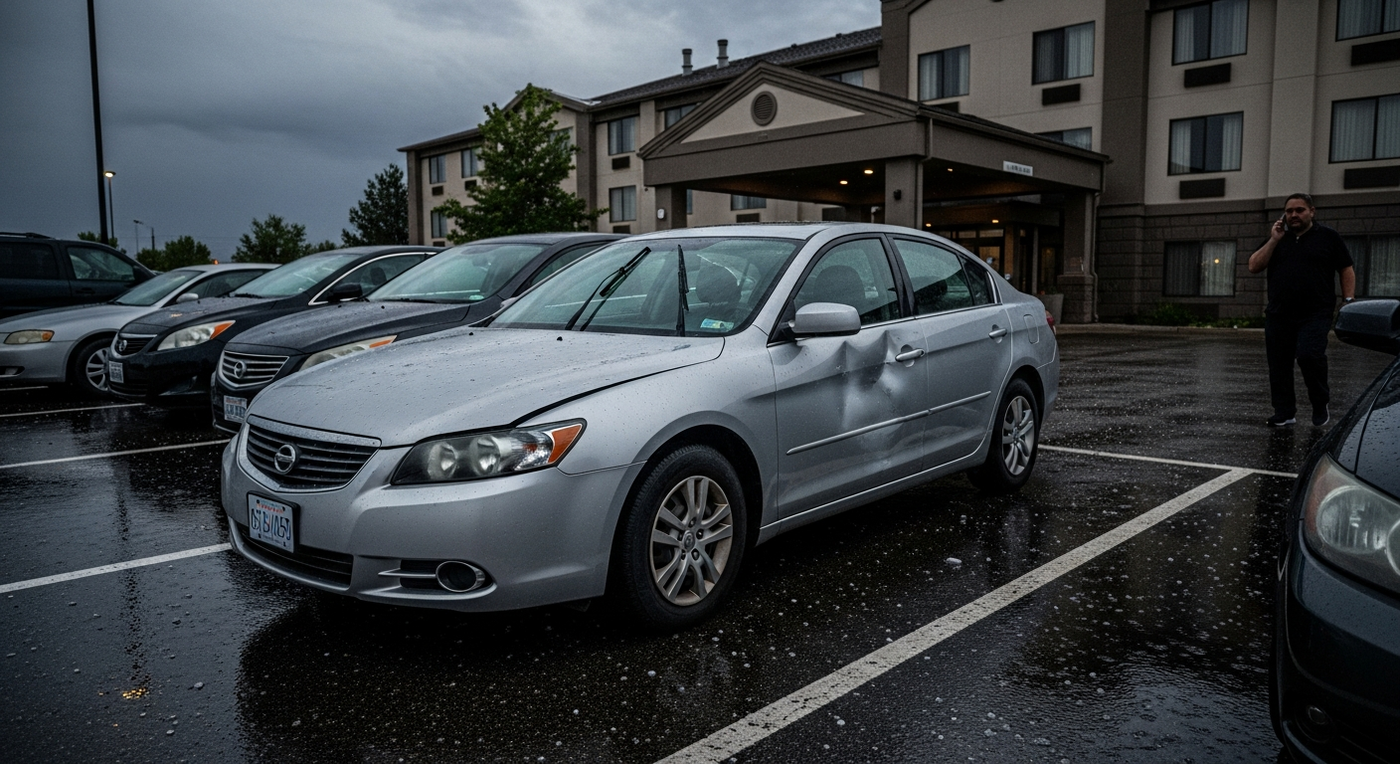
The Wind Management Sequence That Actually Works

Here's what most people get wrong on their first attempt: they unfold the cover completely on the ground, then try to lift the entire thing onto the vehicle while wind catches every square foot of fabric. This turns a typical 15-to-25-pound cover into a sail.

The practiced sequence uses wind as a tool rather than fighting.

Step one: Position yourself upwind of the vehicle. If you're not sure which way the wind is blowing during a storm approach, you're not paying attention to the right signals—but that's a different problem. Stand where the wind will push fabric away from you, toward the vehicle.

Step two: Unfold only the first third of the cover. Keep the rest bundled. You're creating a controlled section of fabric that can catch wind without becoming unmanageable.

Step three: Drape that first third over the windshield and hood, letting the weighted edge fall naturally on the far side. Don't pull it tight. Don't smooth it. Just let it fall.

Step four: Walk to the rear of the vehicle, staying on the upwind side, and unfold the remaining fabric as you go. The wind pushes it across the roof for you. You're not lifting—you're guiding.

Step five: Check that weighted edges have dropped below the door handles on both sides. If they haven't, give the cover a single firm tug at the rear.

Timed properly, this typically takes roughly 90 seconds for a sedan, maybe two minutes for a full-size truck. The key is accepting that the cover won't look neat.

The Severe Thunderstorm Warning Math

According to National Weather Service warning protocols, severe thunderstorm warnings typically provide around 13 minutes of lead time. That sounds like plenty of time until you account for decision-making paralysis, gathering keys, moving the vehicle if needed, and the actual deployment.

Here's the realistic timeline breakdown.

You hear the warning or see the alert: typically 30 seconds of "is this really happening" hesitation. Another minute to grab keys and the cover from wherever you store it. If you need to move the vehicle from a carport to open ground or reposition for wind direction, add two minutes. That's roughly three and a half minutes gone before you touch the cover.

A practiced three-minute deployment leaves you with six and a half minutes of buffer. A fumbled ten-minute struggle leaves you covering the vehicle as the first hail starts falling—or making the rational decision to abandon the attempt and head for shelter instead.

The math explains why practice runs matter. Not in perfect weather when you have all afternoon, but in your driveway on a breezy day when you're slightly rushed. Muscle memory built under mild stress transfers to actual storm conditions. Muscle memory built while relaxed on a calm Sunday doesn't.

The Counterintuitive Weight Distribution Trick

Most first-time users assume the cover needs to be centered perfectly on the vehicle, with equal overhang on all sides. This leads to a lot of walking around the vehicle, tugging corners, checking measurements.

Professional hail cover users—the people who deploy these things on dealership lots with 50 vehicles to protect—use a different approach: they intentionally bias the cover toward the windward side. If wind is coming from the north, they let the north edge hang several inches lower than the south edge.

Why? Because wind pressure against the fabric creates natural tension that holds the cover in place better than perfect centering. The windward side acts as an anchor point, and the leeward side drapes with just enough slack to prevent the whole thing from lifting like a kite.

This seems wrong until you try it. Then it seems obvious.

What to Do When You're Parked Between Vehicles

The open-ground deployment sequence assumes you have space to work around the entire vehicle. Parking lot reality often means you're wedged between two other cars with limited clearance on each side.

The workaround: deploy from the rear. Open the hatch or trunk, unfold the cover on top of the rear cargo area, then walk it forward over the roof. The cover bunches up as you go, which actually helps—you're creating a fabric roll that you push rather than a flat sheet you lift.

When you reach the windshield, step to the side (whichever side has more clearance) and let the bundled fabric unroll down the hood. The weighted edges will find their way to the ground on their own, even in tight spaces. You might need to crouch down and pull one edge forward if it catches on a mirror, but that's usually a quick adjustment, not a fundamental problem.

This method typically adds 30 to 45 seconds to your deployment time. Still well under three minutes, still faster than the storm.

The Single Most Important Practice Run

Do one deployment at dusk or after dark, using only your phone flashlight for illumination. Not because you'll routinely cover your vehicle at night, but because storm light is weird—green-tinted, shadow-free, disorienting. Your spatial awareness doesn't work the same way.

A nighttime practice run teaches you to work by feel and sequence rather than visual confirmation. You learn where your hands should be at each step without looking. You learn what the weighted edge feels like when it's hung up on something versus when it's fallen free.

This matters more than any other practice scenario because it simulates the perceptual conditions of an actual severe storm approach, when light levels drop, your adrenaline is up, and you can't quite see as clearly as you think you should.

Verified Sources

  1. weather.gov

    weather.gov

    Referenced in article via weather.gov.

Back to Storm Prep