Seasonal Guide Seasonal Briefing

The $175 Airport Parking Upgrade That Saves $4,000 in Hail Damage

Denver International Airport's uncovered economy lots hold roughly 20,000 vehicles on a busy summer day — all sitting exposed in one of the nation's most active hail corridors during peak storm season.

The $175 Airport Parking Upgrade That Saves $4,000 in Hail Damage
Hail Protector Editorial / GeminiSeasonal Guide

The Math Nobody Does Before Vacation

You're booking a week-long trip out of DIA, DFW, or Will Rogers World. The airport website offers uncovered economy parking at $8 per day or covered garage parking at $24 per day. For seven days, that's a $112 difference. Most travelers click "economy" without a second thought.

Here's what that decision actually risks: a moderate hail event causing body damage can run several thousand dollars to repair. Windshield replacement can add several hundred dollars more. According to Insurance Information Institute data, comprehensive claims for hail damage average around $4,000 nationally, with higher figures common in severe-hail states.

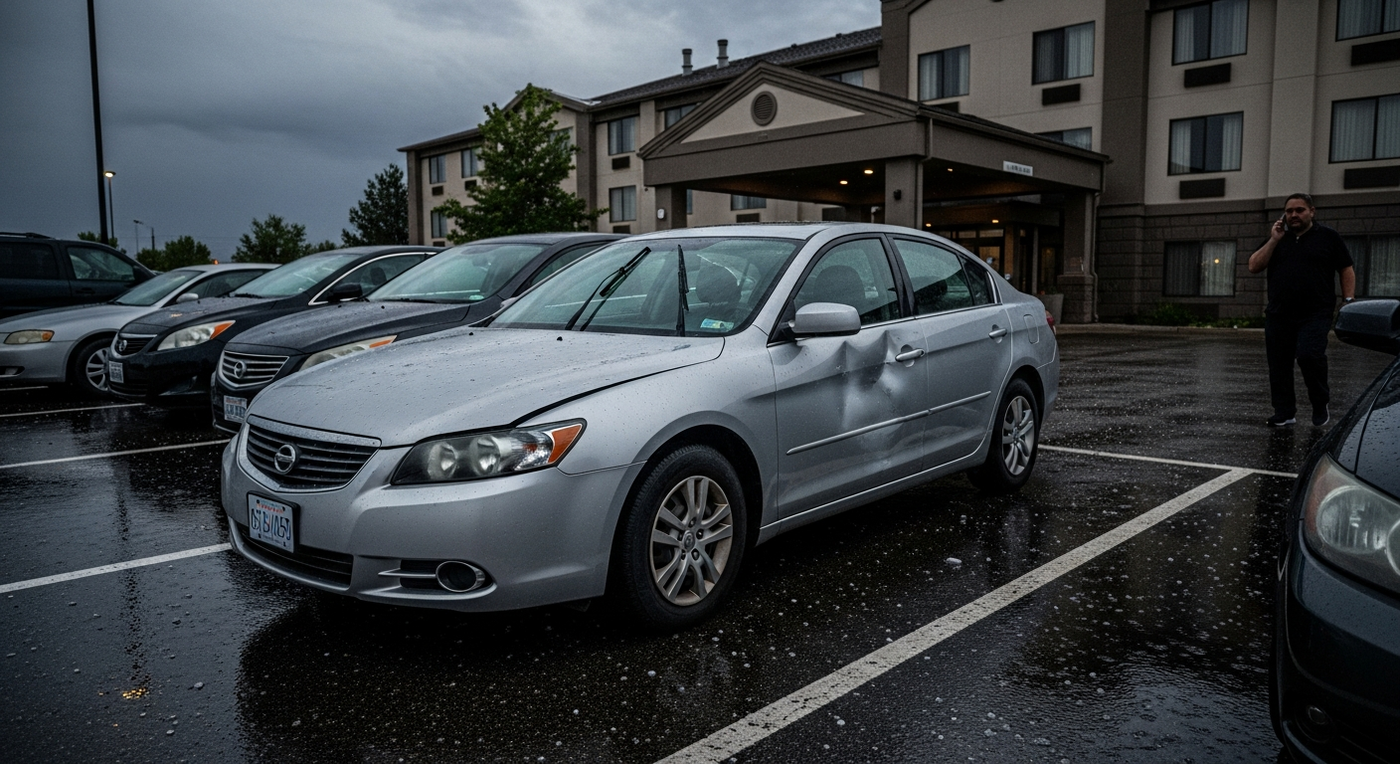
The $112 you saved evaporates in about eight minutes of quarter-sized hail.

Airport Lots Sit in the Bullseye

Denver International Airport lies 23 miles northeast of downtown, positioned directly in Colorado's Front Range hail alley where upslope storms intensify. DFW Airport sprawls across the northern Texas plains where supercells track northeast through April, May, and June. Oklahoma City's Will Rogers World sits in the heart of Tornado Alley, where the same atmospheric conditions that spawn tornadoes also produce giant hail.

These aren't random locations. Airports require flat, open land far from urban centers — exactly the terrain where hail falls hardest. And summer travel season overlaps perfectly with peak hail season across the Great Plains. Storm Prediction Center data shows May and June produce the highest hail report counts across the central United States, precisely when families book vacations and business travel peaks.

Your car sits in an uncovered lot for seven days during the most hail-prone weeks of the year, in some of the most hail-prone square miles in North America. The question isn't whether hail will eventually hit that lot — it's whether your specific week will be the unlucky one.

The Rental Car Loophole Most People Miss

If you're renting a car at your destination, you face a different calculation. Rental companies carry their own insurance, but you've likely declined the loss damage waiver to save $15-30 per day. Smart move for collision risk; questionable for hail.

Here's the gap: your personal auto policy's comprehensive coverage extends to rental vehicles in most cases, but you're still responsible for the deductible. If a hailstorm hits the hotel parking lot where you left the rental overnight, you'll file a claim through your own insurance, pay your $500 or $1,000 deductible, and watch your rates potentially increase at renewal.

The rental company doesn't care whether you accepted their coverage or not — they want their vehicle returned undamaged or they want compensation. You're on the hook either way.

Hotel Parking: The Illusion of Safety

Highway hotels across Oklahoma, Kansas, Texas, and Nebraska offer almost universally uncovered parking. Even properties that advertise "free parking" rarely specify that "free" means "exposed to the sky in a former wheat field.".

But here's a detail worth knowing: hail doesn't fall straight down. Wind-driven hail during severe thunderstorms strikes at an angle, sometimes 30 to 45 degrees from vertical. A parking spot on the east side of a three-story hotel building gains marginal protection from hail driven by westerly winds — emphasis on marginal. The building creates a small shadow zone, perhaps one or two car-lengths wide, where hail density decreases slightly.

This isn't reliable protection. It's simply better than parking in the middle of an open lot 100 yards from any structure. When you check in, ask if spots near the building are available. Front desk staff won't understand why you're asking, but they'll usually accommodate the request.

The Math Nobody Does Before Vacation

What Covered Parking Actually Covers

Airport garage structures vary wildly in their protection level. DIA's parking garages feature full concrete decks — genuine overhead protection. Some regional airports offer "covered parking" that's actually a fabric canopy structure, which stops hail smaller than golf balls but won't survive direct hits from baseball-sized stones.

Before you pay the premium, confirm what "covered" means. Look for: - Concrete deck overhead (best protection) - Steel roof structure (good protection) - Fabric or tensile membrane (marginal protection) - "Covered" spots that are actually just painted lines under a carport overhang (nearly worthless).

The parking reservation website won't specify construction details. Call the airport parking office directly. If they can't or won't describe the structure type, assume it's minimal protection and price your decision accordingly.

$4,000

Average hail claim cost

$112

Week-long parking savings

20-30%

%

Rate hike after dual claims

The Deductible Timing Trap

Let's say you park at DIA uncovered, fly to Seattle, and hail damages your car on day three of your trip. You won't discover the damage until you return four days later. You'll file a comprehensive claim, pay your deductible, and start the repair process.

Now imagine hail hits your Seattle hotel parking lot the night before you fly home, damaging your rental car. That's a second comprehensive claim in the same week. Two deductibles. Two claims on your record. Multiple claims in a short period can trigger premium increases at renewal, even for no-fault comprehensive claims.

The airport parking decision and the rental car insurance decision aren't separate — they're compounding risks during the same trip window.

When the Math Flips

Covered parking makes overwhelming sense for trips longer than three days during May, June, and July in hail-prone regions. For a weekend getaway, the calculation shifts. Two days of covered parking at $24 per day costs $48 versus $16 for uncovered — a $32 difference. The risk-adjusted value of that $32 depends on the specific weather pattern that weekend. The risk-adjusted value of that $32 depends on the specific weather pattern that weekend.

This is where most travelers should check the Storm Prediction Center's convective outlook before they leave. If Day 1 and Day 2 outlooks show marginal or slight risk across your airport's region, uncovered parking carries measurable risk. If the outlook shows no severe weather expected, the $32 savings might be reasonable.

But here's the uncomfortable truth: severe weather outlooks extend only eight days. For longer trips, you're parking blind. The atmosphere doesn't care about your vacation itinerary.

The Thing Nobody Mentions About Hail Damage Timing

Hail damage doesn't always announce itself. Quarter-sized hail can create dimples in your hood and roof that you won't notice in an airport parking lot at 11 PM after a long flight. You drive home, park in your garage, and discover the damage three days later when sunlight hits the hood at the right angle.

Insurance companies know this pattern. They'll ask when the damage occurred. If you parked uncovered at the airport from June 15-22, and DIA recorded a hail event on June 18, your claim is straightforward. But if you can't pinpoint when or where the damage happened — maybe it was the airport, maybe it was the hotel in Tulsa, maybe it was the grocery store parking lot after you got home — claims adjusters get skeptical.

Covered parking creates a clean timeline. Your car entered the garage undamaged and exited undamaged. Everything in between is protected. That clarity has value beyond the physical protection.

What Rental Companies Won't Tell You

Major rental agencies at hail-prone airports maintain dedicated hail-repair relationships with local body shops. They process hail claims routinely — sometimes dozens per week during active storm periods. This is a known, budgeted cost of doing business in Denver, Oklahoma City, and Dallas.

When you return a hail-damaged rental, the counter agent will note the damage, print a damage report, and start the claim process before you've left the lot. They're efficient because they've done this hundreds of times. You'll receive a bill or a notice that your insurance is being contacted, usually within 48 hours.

The rental company's insurance will cover the damage if you purchased their loss damage waiver. Your personal insurance will cover it if you declined their waiver. Either way, someone pays — the question is whether that someone is you via a deductible and potential rate increase, or you via the $25/day waiver you purchased.

There's no free option here. You're either pre-paying for protection or gambling on weather.

Key Questions

The Regional Variation That Matters

Not all summer travel destinations carry equal hail risk. Flying out of SeaTac, Portland, or San Francisco? Hail is nearly nonexistent, and covered parking is an expensive waste. Flying out of Albuquerque, Wichita, or Cheyenne? You're parking in some of the highest hail-frequency terrain in North America.

The decision tree is geographic. If your departure airport sits east of the Rockies and between the Canadian border and Interstate 40, covered parking during May through July may be worth considering. If your destination hotel is anywhere along I-70 across Kansas, I-35 through Oklahoma, or I-25 along Colorado's Front Range, park near the building and consider the rental company's coverage.

If you're traveling the coasts or the Deep South, hail risk drops substantially.

Verified Sources

  1. spc.noaa.gov

    spc.noaa.gov

    Referenced in article via spc.noaa.gov.

  2. spc.noaa.gov

    spc.noaa.gov

    Referenced in article via spc.noaa.gov.

Back to Storm Prep