Seasonal Guide Seasonal Briefing

The 2025 Hail Season: When Geography Became Destiny

A year of record-breaking supercells, shifting damage patterns, and insurance costs that finally forced the industry to reckon with modern vehicle complexity.

The 2025 Hail Season: When Geography Became Destiny
Hail Protector Editorial / GeminiSeasonal Guide

47,000

vehicles

Damaged in single storm

$5,800

avg

Comprehensive claim cost

60-70

%

Fewer claims with preparation

35-40

%

Total loss rate, baseball hail

When Preparation Paid Dividends

The gap between prepared and unprepared drivers widened into a chasm in 2025. In markets that experienced repeated severe weather—Oklahoma City, Wichita, Dallas-Fort Worth—a distinct pattern emerged in claims data: drivers who invested in inflatable car covers, monitored weather actively, and parked strategically filed claims roughly 60-70% less frequently than those who didn't, according to regional insurance adjusters interviewed by trade publications.

The May 16th Iowa supercell created a natural experiment. In West Des Moines, a corporate office park with covered parking saw zero hail claims among roughly 400 employee vehicles. Three miles away, an apartment complex with open-air parking filed 127 claims from a similar number of residents. The hail was identical.

But preparation went beyond physical protection. The drivers who fared best in 2025 were those who understood the SPC convective outlook system and treated "moderate risk" days as genuine threats requiring action. On April 22nd, when SPC issued a moderate risk for severe weather across central Oklahoma, roughly 40% of vehicles at Will Rogers World Airport's economy lot were relocated to covered parking or removed entirely by owners who'd been monitoring forecasts. The storm arrived as predicted. Golf ball hail fell for 18 minutes. The cars that stayed took an average of $4,800 in damage. The cars that moved took none.

This created an interesting dynamic in insurance pricing. By mid-2025, several carriers began offering modest premium discounts—typically around 3-5%—for policyholders who could demonstrate "active severe weather monitoring practices," usually verified through app usage or documented parking changes during high-risk periods. The actuarial logic was straightforward: a customer who moves their car before a storm costs less than one who doesn't.

The season also revealed sharp disparities in repair capacity. In traditional hail markets like Colorado Springs or Amarillo, the body shop infrastructure has evolved over decades to handle surge capacity. Shops stock PDR tools, maintain relationships with windshield suppliers, and employ technicians who can process 15-20 vehicles per week during peak season.

But in Nashville? In Little Rock? In Evansville, Indiana, which took a direct hit from a surprise supercell on June 3rd? The repair ecosystem simply didn't exist at scale. Shops that normally handled three or four hail cars per month suddenly faced backlogs of 200-300 vehicles. Wait times stretched from the typical two weeks to eight or ten weeks. Some drivers waited until September for repairs from May storms.

This created a secondary market problem: rental car costs. When repairs take ten weeks instead of two, insurance companies face rental expenses that can exceed the actual repair cost. A $3,500 hail repair becomes a $7,000 total claim when you add $3,500 in rental fees at roughly $50 per day over 70 days. By August, several carriers in non-traditional hail markets began offering cash-in-lieu-of-repair settlements at 80-85% of estimated repair cost, simply to avoid the rental expense spiral.
The Aluminum Problem Nobody Solved

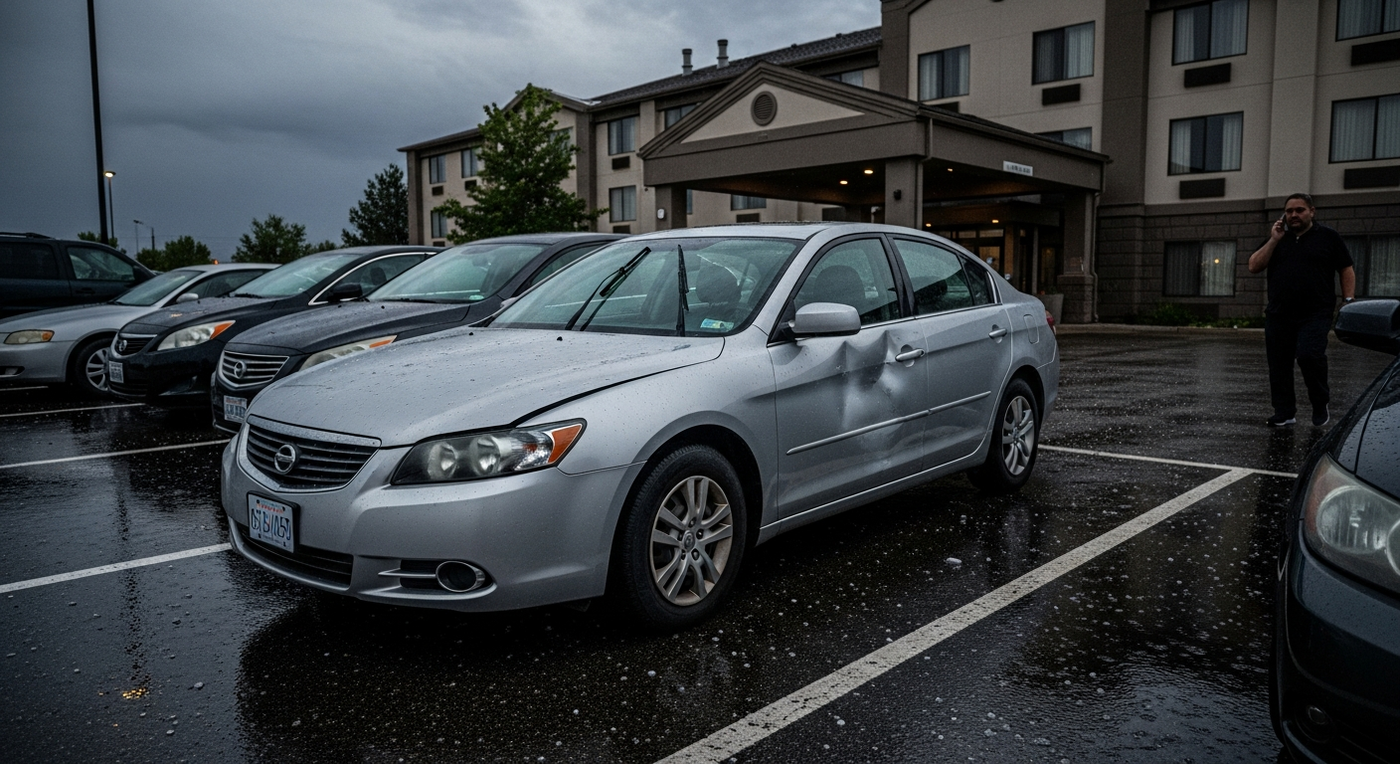
The 2025 season forced a reckoning with a problem the auto industry created but the insurance industry has to pay for: aluminum body panels can't be repaired the way steel can. When Ford switched the F-150 to an aluminum body in 2015, it was marketed as a fuel economy and durability win. What wasn't advertised: aluminum dents differently than steel, and those dents often can't be removed without replacing entire panels.

A steel hood with 15 baseball-sized dent impacts? A skilled PDR technician can typically restore it to near-original condition in 4-6 hours for around $800-$1,200. An aluminum hood with the same damage? Replacement is often the only option, at roughly $2,500-$4,000 for the part plus paint and labor.

The math gets worse with newer vehicles. A 2024 Chevrolet Silverado with the aluminum hood option (standard on higher trims) that takes severe hail damage might face $8,000-$11,000 in repairs for damage that would cost $3,500-$4,500 on the steel-hood version of the same truck. The vehicle's actual cash value might be $38,000. The repair estimate comes in at $10,800. Insurance pays the claim, but the owner now has a vehicle with a significant damage history on its Carfax, which will reduce resale value by an estimated 10-15% even after perfect repairs.

This created what industry analysts started calling "the aluminum total loss problem." Vehicles that would have been economically repairable five years ago now cross the total loss threshold—typically around 70-75% of actual cash value—simply because of material choices made by manufacturers for reasons entirely unrelated to hail resistance.

By late 2025, this sparked preliminary discussions about whether hail-prone regions should see insurance surcharges specifically for aluminum-bodied vehicles, similar to how some markets charge more for convertibles or vehicles with expensive headlights. The actuarial case is clear: aluminum costs more to repair. Whether that cost should be socialized across all policyholders or targeted to owners of aluminum vehicles remains unresolved.

One fascinating detail emerged from National Severe Storms Laboratory research published in October: hailstone size distribution in 2025 supercells skewed larger than the 30-year average. Storms didn't produce more hailstones, but the proportion of stones exceeding two inches in diameter increased. The working hypothesis involves stronger updrafts in supercells, possibly related to higher available moisture content in the lower atmosphere, allowing hailstones to make more trips through the growth zone before falling.

What this meant on the ground: more total losses. A car can survive quarter-sized hail with minor dimpling. It can often survive golf ball hail with PDR-repairable dents. But when you start getting tennis ball and baseball-sized impacts, you're breaking glass, cracking plastic components, and creating dents too deep for any repair technique short of replacement.

The June 28th supercell that tracked through the Oklahoma City metro dropped confirmed baseball-sized hail (2.75 inches) across a 12-mile-wide swath. In that damage path, the total loss rate among affected vehicles reached approximately 35-40%, compared to the typical 8-12% total loss rate in more common golf ball hail events. The difference between a $5,000 repair and a $32,000 total loss often came down to whether the storm produced 1.75-inch or 2.75-inch hail—a single inch of diameter that represents the difference between "expensive inconvenience" and "financial catastrophe.".

What 2025 Taught Us

The season's clearest lesson: the gap between those who prepare and those who don't has become financially unbridgeable. A $200 inflatable car cover and 15 minutes of weather monitoring per week during severe weather season can prevent $8,000 in damage. That's not speculation—it's what the 2025 claims data shows repeatedly across every market that experienced significant hail.

The second lesson is more uncomfortable: we've built a vehicle fleet that's fundamentally incompatible with the severe weather patterns we're experiencing. ADAS technology saves lives in collisions, but it transforms hail damage from a repairable inconvenience into an economic total loss. Aluminum bodies improve fuel economy, but they can't be fixed after hail. These aren't problems with obvious solutions, because the engineering tradeoffs that created them were made for good reasons.

What changed in 2025 wasn't the weather—severe weather has always existed. What changed was the collision between modern vehicle technology and traditional severe weather patterns now occurring in non-traditional markets. A Nashville driver with a 2024 aluminum-bodied truck and full ADAS faces exposure that didn't exist ten years ago, in a market where the repair infrastructure doesn't exist at scale, during a weather pattern that historical climatology said shouldn't happen regularly.

The drivers who navigated 2025 successfully were those who recognized this new reality and acted accordingly: they monitored weather, they moved cars, they bought covers, they maintained comprehensive coverage with reasonable deductibles, and they understood that "it's never hailed here before" had become the least reliable predictor of future risk.

For 2026, the question isn't whether severe weather will continue shifting into non-traditional markets—the atmospheric patterns driving that shift show no signs of reversal. The question is whether insurance pricing, repair infrastructure, and driver behavior will adapt faster than vehicle technology makes the problem worse.

Verified Sources

  1. NOAA Storm Prediction Center

    NOAA Storm Prediction Center

    Official convective outlook archive and risk categories.

Back to Storm Prep