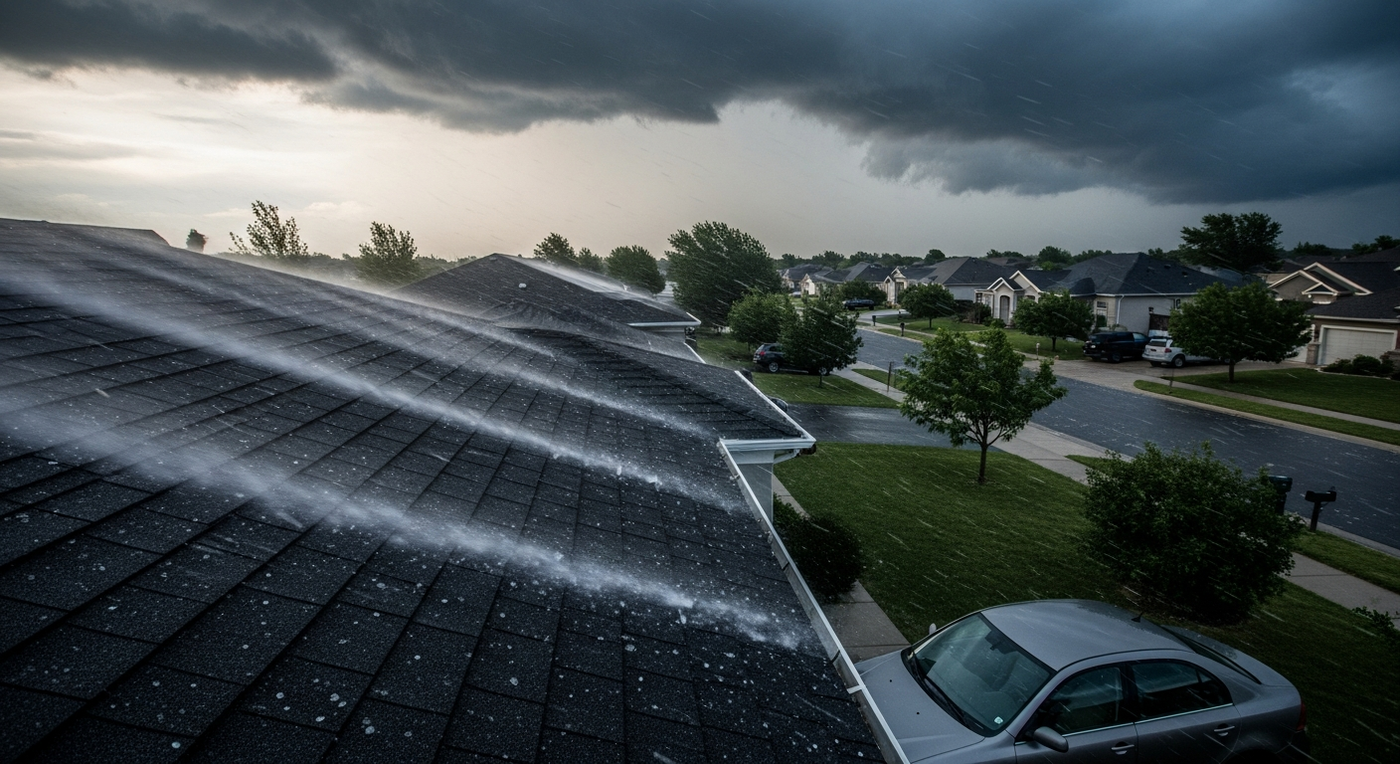
The Velocity Problem
Denver's elevation amplifies hail damage in ways that aren't immediately obvious. The relationship between altitude and terminal velocity is straightforward physics, but its practical implications are significant. A hailstone's terminal velocity — the maximum speed it reaches while falling — depends on the balance between gravitational acceleration and air resistance. At higher elevations, lower air density means less resistance. The stone falls faster.
The difference isn't trivial. A two-inch diameter hailstone falling through sea-level atmosphere reaches a terminal velocity of approximately 60-65 miles per hour. The same stone falling through Denver's atmosphere, with roughly 15% less air density, reaches approximately 68-72 miles per hour. That approximately 10% velocity increase translates to roughly 20% more kinetic energy on impact (kinetic energy increases with the square of velocity). This is why Denver hail produces disproportionate damage compared to similar-sized stones in lower-elevation cities.
Vehicle damage illustrates this clearly. A two-inch hailstone in Denver will often shatter windshields or create deep dents in hoods and roofs. The same size stone in Dallas or Atlanta typically produces less severe damage. Insurance adjusters who work across multiple markets notice this pattern. Denver hail claims involve more total-loss vehicles and more severe structural damage to homes than comparable events elsewhere.
The velocity effect compounds with hail size. Denver storms occasionally produce stones exceeding three inches in diameter — roughly the size of a baseball. At sea level, a three-inch stone falls at approximately 85 miles per hour. In Denver's thinner air, that same stone approaches 95 miles per hour. At these speeds, hail becomes genuinely dangerous to people caught outdoors. It can break bones, cause severe lacerations, and even be fatal. The National Weather Service issues warnings specifically about large hail for good reason — these are projectiles falling from the sky at highway speeds.
Building codes in the Denver metro area have evolved to address hail risk, though not uniformly. Impact-resistant roofing materials are increasingly common, but not required on all structures. Window standards vary by jurisdiction. Some newer developments require tempered or laminated glass for skylights and large windows, recognizing that standard glass can't withstand large hail. Older homes and buildings lack these protections, making them particularly vulnerable during severe events.
The insurance industry has responded to Denver's hail climate by adjusting underwriting and pricing. Homeowners insurance premiums in the Denver metro area include a substantial hail risk component. Some insurers have pulled back from the market entirely, finding the risk-reward ratio unfavorable. Others have increased deductibles specifically for hail and wind damage, shifting more cost to policyholders. A separate hail deductible of 1-2% of the dwelling coverage amount is common — on a $500,000 home, that's a $5,000-$10,000 deductible just for hail damage, according to Insurance Information Institute data.
This creates a difficult calculation for homeowners. Pay higher premiums for lower deductibles, or accept more out-of-pocket risk? There's no clearly correct answer. It depends on individual risk tolerance, financial reserves, and how long you plan to own the property. What's certain is that Denver's unique combination of geography, elevation, and atmospheric dynamics creates a hail risk unlike anywhere else in the country. The predictable afternoon window offers both a warning and a challenge — residents know when to expect danger, but that knowledge doesn't eliminate the threat. Understanding these patterns is the first step in managing the risk that comes with living in the Mile High City's hail corridor. is that Denver's elevation-amplified hail risk makes these decisions more consequential than in most other metro areas.
The afternoon window, the predictable storm tracks, and the velocity amplification combine to make Denver one of America's most hail-exposed cities. It's not the frequency alone — other cities see comparable numbers of hail days. It's the concentration of that frequency into a narrow time window, affecting specific corridors, with stones that hit harder than elsewhere. Understanding this pattern doesn't eliminate the risk, but it allows residents and businesses to make informed decisions about when to seek shelter, where to park, and how much protection to build into their properties. The storms will keep coming every afternoon. The only question is whether you'll be ready when they do.