Regional Report

The 8-Inch Vivian Hailstone: What the Largest Recorded Hailstone Tells Us About Supercell Physics and Vehicle Survival

The 2010 Vivian, South Dakota hailstone measured 8 inches in diameter and weighed 1.94 pounds — roughly the size of a volleyball — and no commercially available vehicle protection can stop stones that large.

The 8-Inch Vivian Hailstone: What the Largest Recorded Hailstone Tells Us About Supercell Physics and Vehicle Survival
Hail Protector Editorial / GeminiRegional Report

The Stone That Rewrote the Record Books

On July 23, 2010, a supercell thunderstorm dropped a hailstone in Vivian, South Dakota that shattered the previous diameter record by nearly an inch. The stone measured 8.0 inches across — larger than a softball, closer to a volleyball. It weighed 1.94 pounds, just shy of two pounds of ice falling from the sky at terminal velocity.

The previous record holder, a 7-inch stone from Aurora, Nebraska in 2003, had stood for seven years. The Vivian stone beat it decisively. What makes the Vivian stone particularly notable is that it survived intact enough for official measurement — many large hailstones shatter on impact, meaning the actual largest stones ever produced may have broken apart before anyone could verify their size.

A resident found the stone in his yard shortly after the storm passed and had the presence of mind to preserve it in a freezer. NOAA's National Centers for Environmental Information certified the measurements, making it the official record holder for diameter. A separate stone from Coffeyville, Kansas in 1970 still holds the weight record at 1.67 pounds, though the Vivian stone's 1.94 pounds actually exceeded it.

What It Takes to Build an 8-Inch Stone

Hailstones don't grow in a single trip through a thunderstorm. They require multiple cycles through the updraft, accumulating layers of ice with each pass. The Vivian supercell had an updraft strong enough to suspend a nearly two-pound chunk of ice long enough for it to complete those cycles without falling out prematurely.

According to NOAA's National Severe Storms Laboratory, updraft speeds need to reach approximately 100-120 mph to support the largest hailstones. The stronger the updraft, the longer the stone can remain aloft, and the more layers it can accumulate. The Vivian storm almost certainly had updraft speeds at the extreme end of that range.

The stone's growth also required a specific moisture profile. Supercooled water droplets — liquid water that remains unfrozen despite being below 32°F — must be abundant throughout the updraft column. Each time the developing hailstone passes through these regions, it collects another layer of ice. The layering is visible when you cut a large hailstone in half: concentric rings of clear and opaque ice, like tree rings, each representing a trip through the storm.

The Vivian stone's size suggests it made multiple passes through the updraft before finally falling. The storm's structure had to remain stable long enough for that process to complete — a mesocyclone that maintained its intensity for an extended period.

An 8-inch hailstone doesn't fall straight down.
Terminal Velocity and Impact Energy

Terminal Velocity and Impact Energy

An 8-inch hailstone doesn't fall straight down. It tumbles, it rotates, and air resistance slows it considerably compared to a free-falling object. But "considerably" is relative — terminal velocity for a stone that size is estimated at roughly 100-110 mph.

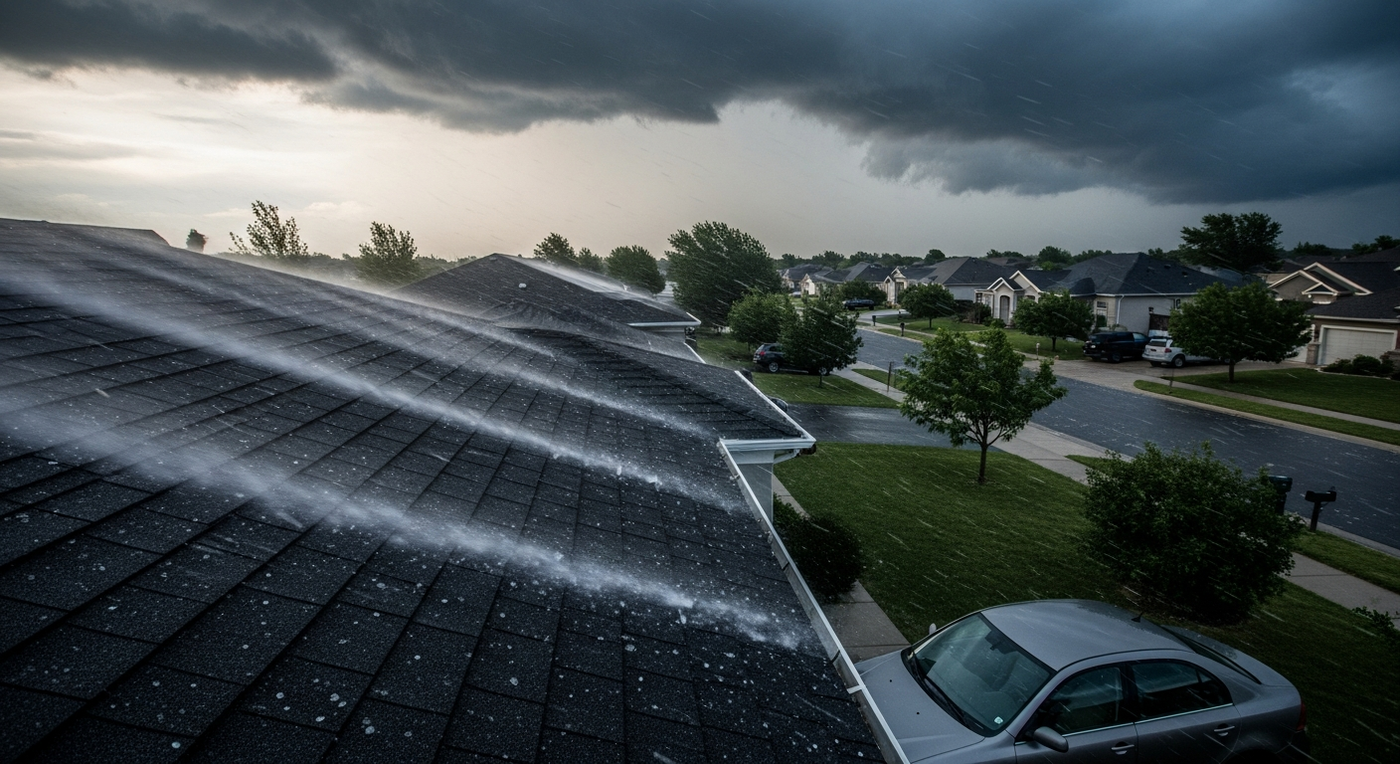
At that speed, the kinetic energy is devastating. A two-pound object moving at 100 mph carries enough force to punch through most residential roofing materials in a single impact. Vehicle sheet metal stands no chance. The Vivian stone — and others like it — will penetrate car hoods, roofs, and windshields regardless of thickness or reinforcement.

This is where the conversation about hail protection needs to become realistic. Hail blankets, car covers, and aftermarket windshield films are typically designed for stones up to approximately 2-3 inches in diameter. Those products work within their design parameters. But nothing commercially available will stop an 8-inch stone. The impact energy is simply too high.

The physics are unforgiving. Kinetic energy increases with the square of velocity and linearly with mass. Double the speed, quadruple the energy. A stone twice as heavy carries twice the energy. The Vivian stone had both significant mass and high velocity. No fabric layer, no foam padding, no windshield laminate can dissipate that much energy without failing.

8.0

inches

Vivian stone diameter

1.94

lbs

Weight at impact

100-110

mph

Terminal velocity estimate

100-120

mph

Updraft speed required

How Often Do Stones This Size Actually Fall?

Rarely. But "rarely" doesn't mean "never."

The Vivian stone is the largest ever officially measured, but that's partly because most giant hailstones are never found or are too damaged to measure accurately. Stones in the 4-6 inch range occur somewhere in the United States most years. Stones above 6 inches are documented periodically. The 8-inch threshold is exceptional, but it's not a physical impossibility that happened once and will never repeat.

Storm Prediction Center severe weather reports show significant hail — defined as 2 inches or larger — occurs hundreds of times annually across the Great Plains and Midwest. Most of those reports are in the 2-3 inch range. Stones above 4 inches are uncommon but regular. The distribution has a long tail: the bigger the stone, the rarer it becomes, but the probability never quite reaches zero.

South Dakota, Nebraska, Kansas, and Oklahoma see the highest frequency of giant hail. The combination of Gulf moisture, Rocky Mountain upslope flow, and strong jet stream dynamics creates ideal supercell environments. Vivian is in central South Dakota, right in the heart of that zone.

If you live in or travel through that region during spring and summer, you're statistically more likely to encounter large hail than someone in most other parts of the country. The odds of encountering hail above 4 inches in any given severe storm are low, but if you spend enough time in the region during severe weather season, those odds accumulate.

The Calibration Question

The Vivian hailstone forces a calibration of expectations. Most hail protection advice focuses on stones in the 1-3 inch range because that's what people encounter most often. That advice is useful and accurate for typical severe weather. But "typical" doesn't cover the full range of what's physically possible. The Vivian stone demonstrates that supercells can produce hail far beyond the size range most protection strategies address.

Vehicle insurance doesn't distinguish between 3-inch hail damage and 8-inch hail damage — both are comprehensive claims. But the practical difference is enormous. A 3-inch stone might dent your hood and crack your windshield. An 8-inch stone will total your vehicle. The repair versus replacement threshold matters for deductibles, for resale value, for whether you're driving home or calling a tow truck.

Understanding the physics helps set realistic goals. If you're preparing for hail season, protective measures make sense for the common scenarios — the 1-3 inch stones that cause expensive but repairable damage. Those scenarios are preventable with the right preparation. But if you're in the path of a Vivian-scale supercell, your preparation shifts entirely. You're not trying to prevent damage. You're trying to survive.

That's not fatalism.

Verified Sources

  1. NOAA National Centers for Environmental Information

    NOAA National Centers for Environmental Information

    official certification and measurements of the Vivian hailstone

  2. NOAA National Severe Storms Laboratory

    NOAA National Severe Storms Laboratory

    hail formation physics and updraft requirements

  3. spc.noaa.gov

    spc.noaa.gov

    Referenced in article via spc.noaa.gov.

Back to Hail Science